

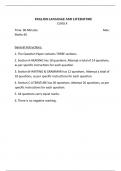
ENGLISH LANGUAGE AND LITERATURE
CLASS X
Time: 90 Minutes Max.
Marks 40
General Instructions:
1. The Question Paper contains THREE sections.
2. Section A-READING has 18 questions. Attempt a total of 14 questions,
as per specific instructions for each question.
3. Section B-WRITING & GRAMMAR has 12 questions. Attempt a total of
10 questions, as per specific instructions for each question.
4. Section C-LITERATURE has 30 questions. Attempt 26 questions, as per
specific instructions for each question.
5. All questions carry equal marks.
6. There is no negative marking.
,READING
I Read the passage given below.
I. Nature is our mother, our first teacher. The greatest lesson that she teaches
us is to maintain an equilibrium in life. We learn to maintain composure
through our joys, sorrows and fears in fact, there are a thousand lessons
that nature can teach us, provided we look for them.
II. With time, a sapling grows into a full-grown tree; something so tiny and
delicate develops into a strong tree capable of supporting others. No matter
how tall it grows, how much it may flourish, or how many animals and birds
it may support, its roots are firmly buried from where it once rose. That's a
lesson to keep ourselves grounded, respect and embrace our roots, and
give something back to those humble beginnings that nurtured us into who
we are.
III. Then there is the message of peaceful coexistence. 'I am because we are.
Nature provides every creature a chance to exist. However, the existence of
one creature or being depends on the existence of the other. The tiger eats
the antelope; without the antelope, the tiger wouldn't survive. Likewise,
without tigers, the overabundance of antelopes would cause them to starve
to death.
IV. I wonder if you have noticed that when birds or squirrels see a predator,
they give out an alarm call to their fellow creatures, of the lurking danger.
They put themselves in danger to save the lives of others. Many animals,
like the salmon, usually die after they spawn, but this doesn't stop them.
One life extinguished for the betterment of others is a small price to pay.
V. The snow melts in the warmth of spring to give birth to fresh green leaves.
In autumn these leaves age into shades of gold only to be buried in the cold
grave of winter. Change is inevitable; the sooner we embrace this, the
better it is for us. We must also understand that even in pain there is
growth.If you cut a hole in the tree, it will grow around it. No matter what
, may come in its way, a river will continue to flow. Similarly, no matter what
grief may break your heart, nature teaches us that life goes on.
VI. Keep in mind life isn't about making lists and trying to be one step ahead of
others. Life is to live. Take a break-stop being a workaholic, and smell the
roses, do whatever makes you feel happy and most of all spend some time
with nature to pick up invaluable lessons
Based on your understanding of the passage, answer any eight out of the ten
questions by choosing the correct option.
Q.1 According to the author, what, from the following, is the greatest lesson being
taught by nature?
A. balanced in our emotions.
B. partial to joys in life.
C afraid of unhappiness.
D. indifferent to fears.
Q.2 Select the option that suitably completes the dialogue with reference to
paragraph II.
Jai: I've done well for myself in this school. I'm the best they have. I can get
admission anywhere. This is my moment!
Sid: Congratulations! Just remember, we should ………………………………….
A. become strong despite our weakness.
B. be kind and supportive towards everyone.
C. respect the origins from where we have grown.
D. nurture ourselves well from the beginning.
CLASS X
Time: 90 Minutes Max.
Marks 40
General Instructions:
1. The Question Paper contains THREE sections.
2. Section A-READING has 18 questions. Attempt a total of 14 questions,
as per specific instructions for each question.
3. Section B-WRITING & GRAMMAR has 12 questions. Attempt a total of
10 questions, as per specific instructions for each question.
4. Section C-LITERATURE has 30 questions. Attempt 26 questions, as per
specific instructions for each question.
5. All questions carry equal marks.
6. There is no negative marking.
,READING
I Read the passage given below.
I. Nature is our mother, our first teacher. The greatest lesson that she teaches
us is to maintain an equilibrium in life. We learn to maintain composure
through our joys, sorrows and fears in fact, there are a thousand lessons
that nature can teach us, provided we look for them.
II. With time, a sapling grows into a full-grown tree; something so tiny and
delicate develops into a strong tree capable of supporting others. No matter
how tall it grows, how much it may flourish, or how many animals and birds
it may support, its roots are firmly buried from where it once rose. That's a
lesson to keep ourselves grounded, respect and embrace our roots, and
give something back to those humble beginnings that nurtured us into who
we are.
III. Then there is the message of peaceful coexistence. 'I am because we are.
Nature provides every creature a chance to exist. However, the existence of
one creature or being depends on the existence of the other. The tiger eats
the antelope; without the antelope, the tiger wouldn't survive. Likewise,
without tigers, the overabundance of antelopes would cause them to starve
to death.
IV. I wonder if you have noticed that when birds or squirrels see a predator,
they give out an alarm call to their fellow creatures, of the lurking danger.
They put themselves in danger to save the lives of others. Many animals,
like the salmon, usually die after they spawn, but this doesn't stop them.
One life extinguished for the betterment of others is a small price to pay.
V. The snow melts in the warmth of spring to give birth to fresh green leaves.
In autumn these leaves age into shades of gold only to be buried in the cold
grave of winter. Change is inevitable; the sooner we embrace this, the
better it is for us. We must also understand that even in pain there is
growth.If you cut a hole in the tree, it will grow around it. No matter what
, may come in its way, a river will continue to flow. Similarly, no matter what
grief may break your heart, nature teaches us that life goes on.
VI. Keep in mind life isn't about making lists and trying to be one step ahead of
others. Life is to live. Take a break-stop being a workaholic, and smell the
roses, do whatever makes you feel happy and most of all spend some time
with nature to pick up invaluable lessons
Based on your understanding of the passage, answer any eight out of the ten
questions by choosing the correct option.
Q.1 According to the author, what, from the following, is the greatest lesson being
taught by nature?
A. balanced in our emotions.
B. partial to joys in life.
C afraid of unhappiness.
D. indifferent to fears.
Q.2 Select the option that suitably completes the dialogue with reference to
paragraph II.
Jai: I've done well for myself in this school. I'm the best they have. I can get
admission anywhere. This is my moment!
Sid: Congratulations! Just remember, we should ………………………………….
A. become strong despite our weakness.
B. be kind and supportive towards everyone.
C. respect the origins from where we have grown.
D. nurture ourselves well from the beginning.


