NUR-211 Test 2
A client is in the emergency department reporting a brief episode during which he was
dizzy, unable to speak, and felt like his legs were very heavy. Currently the client's
neurologic examination is normal. About what drug should the nurse plan to teach the
client?
a. Alteplase (Activase)
b. Clopidogrel (Plavix)
c. Heparin sodium
d. Mannitol (Osmitrol) - CORRECT ANSWER-ANS: B
This client's manifestations are consistent with a transient ischemic attack, and the
client would be prescribed aspirin or clopidogrel on discharge. Alteplase is used for
ischemic stroke. Heparin and mannitol are not used for this condition.
A client had an embolic stroke and is having an echocardiogram. When the client asks
why the provider ordered "a test on my heart," how should the nurse respond?
a. "Most of these types of blood clots come from the heart."
b. "Some of the blood clots may have gone to your heart too."
c. "We need to see if your heart is strong enough for therapy."
d. "Your heart may have been damaged in the stroke too." - CORRECT ANSWER�ANS:A
An embolic stroke is caused when blood clots travel from one area of the body to the
brain. The most common source of the clots is the heart. The other statements are
inaccurate.
A nurse receives a report on a client who had a left-sided stroke and has homonymous
hemianopsia. What action by the nurse is most appropriate for this client?
a. Assess for bladder retention and/or incontinence.
b. Listen to the client's lungs after eating or drinking.
c. Prop the client's right side up when sitting in a chair.
d. Rotate the client's meal tray when the client stops eating. - CORRECT ANSWER�ANS:D
This condition is blindness on the same side of both eyes. The client must turn his or
her head to see the entire visual field. The client may not see all the food on the tray, so
the nurse rotates it so uneaten food is now within the visual field. This condition is not
related to bladder function, difficulty swallowing, or lack of trunk control.
A client with a stroke is being evaluated for fibrinolytic therapy. What information from
the client or family is most important for the nurse to obtain?
a. Loss of bladder control
b. Other medical conditions
c. Progression of symptoms
d. Time of symptom onset - CORRECT ANSWER-ANS:D
The time limit for initiating fibrinolytic therapy for a stroke is 3 to 4.5 hours, so the exact
time of symptom onset is the most important information for this client. The other
information is not as critical.
A client is being prepared for a mechanical embolectomy. What action by the nurse
takes priority?
a. Assess for contraindications to fibrinolytics.
b. Ensure that informed consent is on the chart.
c. Perform a full neurologic assessment.
d. Review the client's medication lists. - CORRECT ANSWER-ANS:B
For this invasive procedure, the client needs to give informed consent. The nurse
ensures that this is on the chart prior to the procedure beginning. Fibrinolytics are not
used. A neurologic assessment and medication review are important, but the consent is
the priority.
A client had an embolectomy for an arteriovenous malformation (AVM). The client is
now reporting a severe headache and has vomited. What action by the nurse takes
priority?
a. Administer pain medication.
b. Assess the client's vital signs.
c. Notify the Rapid Response Team.
d. Raise the head of the bed. - CORRECT ANSWER-ANS:C
This client may be experiencing a rebleed from the AVM. The most important action is
to call the Rapid Response Team as this is an emergency. The nurse can assess vital
signs while someone else notifies the Team, but getting immediate medical attention is
the priority. Administering pain medication may not be warranted if the client must return
to surgery. The optimal position for the client with an AVM has not been determined, but
calling the Rapid Response Team takes priority over positioning.
A student nurse is preparing morning medications for a client who had a stroke. The
student plans to hold the docusate sodium (Colace) because the client had a large stool
earlier. What action by the supervising nurse is best?
a. Have the student ask the client if it is desired or not.
b. Inform the student that the docusate should be given.
c. Tell the student to document the rationale.
d. Tell the student to give it unless the client refuses. - CORRECT ANSWER-ANS:B
Stool softeners should be given to clients with neurologic disorders in order to prevent
an elevation in intracranial pressure that accompanies the Valsalva maneuver when
constipated. The supervising nurse should instruct the student to administer the
docusate. The other options are not appropriate. The medication could be held for
diarrhea.
A client experiences impaired swallowing after a stroke and has worked with speech�language pathology on eating. What nursing assessment best indicates that a priority
goal for this problem has been met?
a. Chooses preferred items from the menu
b. Eats 75% to 100% of all meals and snacks
c. Has clear lung sounds on auscultation
d. Gains 2 pounds after 1 week - CORRECT ANSWER-ANS:C
Impaired swallowing can lead to aspiration, so the priority goal for this problem is no
aspiration. Clear lung sounds is the best indicator that aspiration has not occurred.
Choosing menu items is not related to this problem. Eating meals does not indicate the
client is not still aspirating. A weight gain indicates improved nutrition but still does not
show a lack of aspiration.
A client with a stroke has damage to Broca's area. What intervention to promote
communication is best for this client?
a. Assess whether or not the client can write.
b. Communicate using "yes-or-no" questions.
c. Reinforce speech therapy exercises.
d. Remind the client not to use neologisms. - CORRECT ANSWER-ANS: A
Damage to Broca's area often leads to expressive aphasia, wherein the client can
understand what is said but cannot express thoughts verbally. In some instances the
client can write. The nurse should assess to see if that ability is intact. "Yes-or-no"
questions are not good for this type of client because he or she will often answer
automatically but incorrectly. Reinforcing speech therapy exercises is good for all clients
with communication difficulties. Neologisms are made-up "words" often used by clients
with sensory aphasia.
A nurse assesses a client with the National Institutes of Health (NIH) Stroke Scale and
determines the client's score to be 36. How should the nurse plan care for this client?
a. The client will need near-total care.
b. The client will need cuing only.
c. The client will need safety precautions.
d. The client will be discharged home. - CORRECT ANSWER-ANS:A
This client has severe neurologic deficits and will need near-total care. Safety
precautions are important but do not give a full picture of the client's dependence. The
client will need more than cuing to complete tasks. A home discharge may be possible,
but this does not help the nurse plan care for a very dependent client.
A nurse is providing community screening for risk factors associated with stroke. Which
client would the nurse identify as being at highest risk for a stroke?
a. A 27-year-old heavy cocaine user
b. A 30-year-old who drinks a beer a day
c. A 40-year-old who uses seasonal antihistamines
d. A 65-year-old who is active and on no medications - CORRECT ANSWER-ANS:A
Heavy drug use, particularly cocaine, is a risk factor for stroke. Heavy alcohol use is
also a risk factor, but one beer a day is not considered heavy drinking. Antihistamines
may contain phenylpropanolamine, which also increases the risk for stroke, but this
client uses them seasonally and there is no information that they are abused or used
heavily. The 65-year-old has only age as a risk factor.
A client has a shoulder injury and is scheduled for a magnetic resonance imaging (MRI).
The nurse notes the presence of an aneurysm clip in the client's record. What action by
the nurse is best?
a. Ask the client how long ago the clip was placed.
b. Have the client sign an informed consent form.
c. Inform the provider about the aneurysm clip.
d. Reschedule the client for computed tomography. - CORRECT ANSWER-ANS:A
Some older clips are metal, which would preclude the use of MRI. The nurse should
determine how old the clip is and relay that information to the MRI staff. They can
determine if the client is a suitable candidate for this examination. The client does not
need to sign informed consent. The provider will most likely not know if the client can
have an MRI with this clip. The nurse does not independently change the type of
diagnostic testing the client receives.
After a stroke, a client has ataxia. What intervention is most appropriate to include on
the client's plan of care?
a. Ambulate only with a gait belt.
b. Encourage double swallowing.
c. Monitor lung sounds after eating.
d. Perform post-void residuals. - CORRECT ANSWER-ANS:A
Ataxia is a gait disturbance. For the client's safety, he or she should have assistance
and use a gait belt when ambulating. Ataxia is not related to swallowing, aspiration, or
voiding.
A client in the emergency department is having a stroke and needs a carotid artery
angioplasty with stenting. The client's mental status is deteriorating. What action by the
nurse is most appropriate?
a. Attempt to find the family to sign a consent.
b. Inform the provider that the procedure cannot occur.
c. Nothing; no consent is needed in an emergency.
d. Sign the consent form for the client. - CORRECT ANSWER-ANS:A
The nurse should attempt to find the family to give consent. If no family is present or can
be found, under the principle of emergency consent, a life-saving procedure can be
performed without formal consent. The nurse should not just sign the consent form.
A nursing student studying the neurologic system learns which information? (Select all
that apply.)
a. An aneurysm is a ballooning in a weakened part of an arterial wall.
b. An arteriovenous malformation is the usual cause of strokes.
c. Intracerebral hemorrhage is bleeding directly into the brain.
d. Reduced perfusion from vasospasm often makes stroke worse.
e. Subarachnoid hemorrhage is caused by high blood pressure. - CORRECT ANSWER�ANS: A,C,D
An aneurysm is a ballooning of the weakened part of an arterial wall. Intracerebral
hemorrhage is bleeding directly into the brain. Vasospasm often makes the damage
from the initial stroke worse because it causes decreased perfusion. An arteriovenous
malformation (AVM) is unusual. Subarachnoid hemorrhage is usually caused by a
ruptured aneurysm or AVM.
The nurse working in the emergency department assesses a client who has symptoms
of stroke. For what modifiable risk factors should the nurse assess? (Select all that
apply.)
a. Alcohol intake
b. Diabetes
c. High-fat diet
d. Obesity
e. Smoking - CORRECT ANSWER-ANS:A,C,D,E
Alcohol intake, a high-fat diet, obesity, and smoking are all modifiable risk factors for
stroke. Diabetes is not modifiable but is a risk factor that can be controlled with medical
intervention.
A nurse is caring for a client after a stroke. What actions may the nurse delegate to the
unlicensed assistive personnel (UAP)? (Select all that apply.)
a. Assess neurologic status with the Glasgow Coma Scale.
b. Check and document oxygen saturation every 1 to 2 hours.
c. Cluster client care to allow periods of uninterrupted rest.
d. Elevate the head of the bed to 45 degrees to prevent aspiration.
e. Position the client supine with the head in a neutral midline position. - CORRECT
ANSWER-ANS: B,E
The UAP can take and document vital signs, including oxygen saturation, and keep the
client's head in a neutral, midline position with correct direction from the nurse. The
nurse assesses the Glasgow Coma Scale score. The nursing staff should not cluster
care because this can cause an increase in the intracranial pressure. The head of the
bed should be minimally elevated, up to 30 degrees.
A nurse has applied to work at a hospital that has National Stroke Center designation.
The nurse realizes the hospital adheres to eight Core Measures for ischemic stroke
care. What do these Core Measures include? (Select all that apply.)
A. Discharging the client on a statin medication
b. Providing the client with comprehensive therapies
c. Meeting goals for nutrition within 1 week
d. Providing and charting stroke education
e. Preventing venous thromboembolism - CORRECT ANSWER-ANS:A,D,E
Core Measures established by The Joint Commission include discharging stroke clients
on statins, providing and recording stroke education, and taking measures to prevent
venous thromboembolism. The client must be assessed for therapies but may go
elsewhere for them. Nutrition goals are not part of the Core Measures.
A nurse is working with many stroke clients. Which clients would the nurse consider
referring to a mental health provider on discharge? (Select all that apply.)
a. Client who exhibits extreme emotional lability
b. Client with an initial National Institutes of Health (NIH) Stroke Scale score of 38
c. Client with mild forgetfulness and a slight limp
d. Client who has a past hospitalization for a suicide attempt
e. Client who is unable to walk or eat 3 weeks post-stroke - CORRECT ANSWER�ANS:A,B,D,E
Clients most at risk for post-stroke depression are those with a previous history of
depression, severe stroke (NIH Stroke Scale score of 38 is severe), and post-stroke
physical or cognitive impairment. The client with mild forgetfulness and a slight limp
would be a low priority for this referral.
A nursing student is caring for a client with leukemia. The student asks why the client is
still at risk for infection when the client's white blood cell count (WBC) is high. What
response by the registered nurse is best?
a. "If the WBCs are high, there already is an infection present."
b. "The client is in a blast crisis and has too many WBCs."
c. "There must be a mistake; the WBCs should be very low."
d. "Those WBCs are abnormal and don't provide protection." - CORRECT ANSWER�ANS:D
In leukemia, the WBCs are abnormal and do not provide protection to the client against
infection. The other statements are not accurate.
The family of a neutropenic client reports the client "is not acting right." What action by
the nurse is the priority?
a. Ask the client about pain.
b. Assess the client for infection.
c. Delegate taking a set of vital signs.
d. Look at today's laboratory results. - CORRECT ANSWER-ANS:B
Neutropenic clients often do not have classic manifestations of infection, but infection is
the most common cause of death in neutropenic clients. The nurse should assess for
infection. The nurse should assess for pain but this is not the priority. The nurse should
take the client's vital signs instead of delegating them since the client has had a change
in status. Laboratory results may be inconclusive.
A nurse is caring for a client who is about to receive a bone marrow transplant. To best
help the client cope with the long recovery period, what action by the nurse is best?
a. Arrange a visitation schedule among friends and family.
b. Explain that this process is difficult but must be endured.
c. Help the client find things to hope for each day of recovery.
d. Provide plenty of diversionary activities for this time. - CORRECT ANSWER-ANS:C
Providing hope is an essential nursing function during treatment for any disease
process, but especially during the recovery period after bone marrow transplantation,
which can take up to 3 weeks. The nurse can help the client look ahead to the recovery
period and identify things to hope for during this time. Visitors are important to clients,
but may pose an infection risk. Telling the client the recovery period must be endured
does not acknowledge his or her feelings. Diversionary activities are important, but not
as important as instilling hope.
Content preview
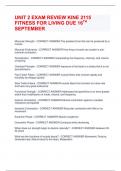
UNIT 2 EXAM REVIEW KINE 2115
FITNESS FOR LIVING DUE 16TH
SEPTEMBER
Muscular Strength - CORRECT ANSWER-The greatest force that can be produced by a
muscle
Muscular Endurance - CORRECT ANSWER-How long a muscle can sustain a sub-
maximal contraction
Periodization - CORRECT ANSWER-manipulating the frequency, intensity, and volume
of training
Overload Principle - CORRECT ANSWER-exposure of the body to a stress that it is not
accustomed to
Fast Twitch Fibers - CORRECT ANSWER-muscle fibers that contract rapidly and
forcefully but fatigue quickly
Slow Twitch Fibers - CORRECT ANSWER-muscle fibers that contract at a slow rate
and have very good endurance
Functional Strength - CORRECT ANSWER-Addresses the specificity to an even greater
extent than modification of mode, volume, and frequency
Isotonic Contraction - CORRECT ANSWER-Muscle contraction against a variable
resistance and speeds
Isometric Contraction - CORRECT ANSWER-Muscular contraction with little or no
movement
Eccentric Phase - CORRECT ANSWER-Muscle Lengthens
Concentric Phase - CORRECT ANSWER-Contracts while shortening
When does our strength begin to decline naturally? - CORRECT ANSWER-between 20-
30 years
What are the functions of muscle tissue? - CORRECT ANSWER-Movement, Posture,
Generate heat, Return blood to the heart, Metabolism
, How does muscle mass affect metabolism? - CORRECT ANSWER-extra pound of
muscle can increase resting metabolism by about 35 calories per day
What percent of our body weight is muscle? - CORRECT ANSWER-40%
What are optimal training conditions to achieve gains in strength training in terms of
frequency per week? - CORRECT ANSWER-4-6 per week
What are the 3 components of a sound strength training program? - CORRECT
ANSWER-Mode, Volume, and Frequency
What percent of a one-rep maximum is a good level to start a weight training program? -
CORRECT ANSWER-50-60%
What is the required time frame to see significant strength improvement? - CORRECT
ANSWER-Minimum of 8 weeks
How does reduced strength affect the aging person? - CORRECT ANSWER-lessons
the quality of his/her mobility and can lead to musculoskeletal injury
Is walking sufficient for sustaining muscle mass in the lower body? - CORRECT
ANSWER-No
How does strength training affect the female's muscle(s)? - CORRECT ANSWER-
Decrease body fat and improved muscle
Do men and women have the same quality of muscle fibers? - CORRECT ANSWER-
Yes
What assessments are used to determine muscular endurance? - CORRECT
ANSWER-Bench Jump, Abdominal Crunch, Push-ups, Modified Dip
When is a spotter recommended? - CORRECT ANSWER-Free Weights
Daily total fat should be what % of daily total caloric intake? - CORRECT ANSWER-20-
35%
Cholesterol consumption should be kept below ____ mg per day - CORRECT
ANSWER-180 mg
General daily sodium intake should be less than _____mg per day. - CORRECT
ANSWER-2300 mg
Vegetarianism - CORRECT ANSWER-Consumption of a diet consisting predominantly
of plant foods.