Diversity in Living Organism
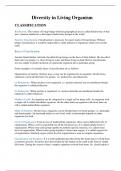
CLASSIFICATION
Biodiversity: The variety of living beings found in geographical area is called biodiversity of that
area. Amazon rainforests is the largest biodiversity hotspot in the world.
Need for Classification: Classification is necessary for easier study of living beings. Without
proper classification, it would be impossible to study millions of organisms which exist on this
earth.
Basis of Classification:
Ancient Greek thinker Aristotle classified living beings on the basis of their habitat. He classified
them into two groups, i.e. those living in water and those living on land. But his classification
was too simple to justify inclusion of a particular organism into a particular group.
Some examples of scientific bases of classification are as follows:
Organization of nucleus: Nucleus may or may not be organized in an organism. On this basis,
organisms can be divided into two groups, viz. prokaryotes and eukaryotes.
(a) Prokaryotes: When nucleus is not organized, i.e. nuclear materials are not membrane bound;
the organism is called prokaryote.
(b) Eukaryotes: When nucleus is organized, i.e. nuclear materials are membrane bound; the
organism is called eukaryote.
Number of cells: An organism can be composed of a single cell or many cells. An organism with
a single cell is called unicellular organism. On the other hand, an organism with more than one
cell is called multicellular organism.
Mode of Nutrition: On this basis, organisms can be divided into two broad groups, i.e. autotrophs
and heterotrophs. An autotroph makes its own food, while a heterotroph depends on other
organisms for food.
Level of Organisation: Even in case of multicellular organisms, there can be different levels of
organization. When a cell is responsible for all the life processes, it is called cellular level or
organization. When some cells group together to perform specific function, it is called tissue
level of organization. When tissues group together to form some organs, it is called organ level
of organization. Similarly organ system level of organization is seen in complex organisms.
Classification and Evolution: It is a well established fact that all the life forms have evolved from
a common ancestor. Scientists have proved that the life begun on the earth in the form of simple
life forms. During the course of time, complex organism evolved from them. So, classification is
, also based on evolution. A simple organism is considered to be primitive while a complex
organism is considered to be advanced.
Five Kingdom Classification by Robert Whittaker (1959)
This is the most accepted system of classification. The five kingdoms and their key
characteristics are given below:
1. Monera: These are prokaryotes; which means nuclear materials are not membrane bound in
them. They may or may not have cell wall. They can be autotrophic or heterotrophic. All
organisms of this kingdom are unicellular. Examples: bacteria, blue green algae (cyanobacteria)
and mycoplasma.
2. Protista: These are eukaryotes and unicellular. Some organisms use cilia or flagella for
locomotion. They can be autotrophic or heterotrophic. Examples: unicellular algae, diatoms and
protozoans.
3. Fungi: These are heterotrohic and have cell wall. The cell wall is made of chitin. Most of the
fungi are unicellular. Many of them have the capacity to become multicellular at certain stage in
life. They feed on decaying organic materials. Such a mode of nutrition is called saprophytic.
CLASSIFICATION
Biodiversity: The variety of living beings found in geographical area is called biodiversity of that
area. Amazon rainforests is the largest biodiversity hotspot in the world.
Need for Classification: Classification is necessary for easier study of living beings. Without
proper classification, it would be impossible to study millions of organisms which exist on this
earth.
Basis of Classification:
Ancient Greek thinker Aristotle classified living beings on the basis of their habitat. He classified
them into two groups, i.e. those living in water and those living on land. But his classification
was too simple to justify inclusion of a particular organism into a particular group.
Some examples of scientific bases of classification are as follows:
Organization of nucleus: Nucleus may or may not be organized in an organism. On this basis,
organisms can be divided into two groups, viz. prokaryotes and eukaryotes.
(a) Prokaryotes: When nucleus is not organized, i.e. nuclear materials are not membrane bound;
the organism is called prokaryote.
(b) Eukaryotes: When nucleus is organized, i.e. nuclear materials are membrane bound; the
organism is called eukaryote.
Number of cells: An organism can be composed of a single cell or many cells. An organism with
a single cell is called unicellular organism. On the other hand, an organism with more than one
cell is called multicellular organism.
Mode of Nutrition: On this basis, organisms can be divided into two broad groups, i.e. autotrophs
and heterotrophs. An autotroph makes its own food, while a heterotroph depends on other
organisms for food.
Level of Organisation: Even in case of multicellular organisms, there can be different levels of
organization. When a cell is responsible for all the life processes, it is called cellular level or
organization. When some cells group together to perform specific function, it is called tissue
level of organization. When tissues group together to form some organs, it is called organ level
of organization. Similarly organ system level of organization is seen in complex organisms.
Classification and Evolution: It is a well established fact that all the life forms have evolved from
a common ancestor. Scientists have proved that the life begun on the earth in the form of simple
life forms. During the course of time, complex organism evolved from them. So, classification is
, also based on evolution. A simple organism is considered to be primitive while a complex
organism is considered to be advanced.
Five Kingdom Classification by Robert Whittaker (1959)
This is the most accepted system of classification. The five kingdoms and their key
characteristics are given below:
1. Monera: These are prokaryotes; which means nuclear materials are not membrane bound in
them. They may or may not have cell wall. They can be autotrophic or heterotrophic. All
organisms of this kingdom are unicellular. Examples: bacteria, blue green algae (cyanobacteria)
and mycoplasma.
2. Protista: These are eukaryotes and unicellular. Some organisms use cilia or flagella for
locomotion. They can be autotrophic or heterotrophic. Examples: unicellular algae, diatoms and
protozoans.
3. Fungi: These are heterotrohic and have cell wall. The cell wall is made of chitin. Most of the
fungi are unicellular. Many of them have the capacity to become multicellular at certain stage in
life. They feed on decaying organic materials. Such a mode of nutrition is called saprophytic.