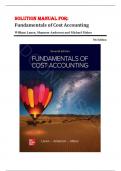
Fundamentals of
Advanced Accounting,
9e By Joe Hoyle
(Solutions Manual All
Chapters, 100%
Original Verified, A+
Grade)
Part 1: CH 7-12: Page 2-304
Part2: CH 1-6: Page 305-976
, Part 1
CHAPTER 7
FOREIGN CURRENCY TRANSACTIONS AND HEDGING
FOREIGN EXCHANGE RISK
Chapter Outline
I. In today’s global economy, a great many companies deal in currencies other than their
reporting currencies.
A. Merchandise may be imported or exported with prices stated in a foreign currency.
B. For reporting purposes, foreign currency balances must be stated in terms of the
company’s reporting currency by multiplying it by an exchange rate.
C. Accountants face two questions in restating foreign currency balances.
1. What is the appropriate exchange rate for restating foreign currency balances?
2. How are changes in the exchange rate accounted for?
D. Companies often engage in foreign currency hedging activities to avoid the adverse
impact of exchange rate changes.
E. Accountants must determine how to properly account for these hedging activities.
II. Foreign exchange rates are determined in the foreign exchange market under a variety of
different currency arrangements.
A. Exchange rates can be expressed in terms of the number of U.S. dollars to purchase one
foreign currency unit (direct quotes) or the number of foreign currency units that can be
obtained with one U.S. dollar (indirect quotes).
B. Foreign currency trades can be executed on a spot or forward basis.
1. The spot rate is the price at which a foreign currency can be purchased or sold today.
2. The forward rate is the price today at which foreign currency can be purchased or sold
sometime in the future.
3. Forward exchange contracts provide companies with the ability to “lock in” a price
today for purchasing or selling currency at a specific future date.
C. Foreign currency options provide the right but not the obligation to buy or sell foreign
currency in the future, and therefore are more flexible than forward contracts.
III. FASB ASC 830, Foreign Currency Matters, prescribes accounting rules for foreign currency
transactions.
A. Export sales denominated in foreign currency are reported in U.S. dollars at the spot
exchange rate at the date of the transaction. Subsequent changes in the exchange rate
until collection of the receivable are reflected through a restatement of the foreign currency
account receivable with an offsetting foreign exchange gain or loss reported in income.
This is known as a two-transaction perspective, accrual approach.
B. The two-transaction perspective, accrual approach also is used in accounting for foreign
currency payables. Receivables and payables denominated in foreign currency create an
exposure to foreign exchange risk; this is the risk that changes in the exchange rate over
time will result in a foreign exchange gain or loss.
IV. FASB ASC 815, Derivatives and Hedging, governs the accounting for derivative financial
instruments and hedging activities including the use of foreign currency forward contracts and
foreign currency options.
A. The fundamental requirement is that all derivatives must be carried on the balance sheet
at their fair value. Derivatives are reported on the balance sheet as assets when they have
7-1
.
,Chapter 07 - Foreign Currency Transactions and Hedging Foreign Exchange Risk – Hoyle, Schaefer,
Doupnik, Fundamentals of Advanced Accounting, 9/e
a positive fair value and as liabilities when they have a negative fair value.
B. U.S. GAAP provides guidance for hedges of the following sources of foreign exchange
risk:
1. foreign currency denominated assets and liabilities.
2. unrecognized foreign currency firm commitments.
3. forecasted foreign currency transactions.
4. net investments in foreign operations (covered in Chapter 10).
C. Companies prefer to account for hedges in such a way that the gain or loss from the
hedge is recognized in net income in the same period as the loss or gain on the risk being
hedged. This approach is known as hedge accounting. Hedge accounting for foreign
currency derivatives may be applied only if three conditions are satisfied:
1. the derivative is used to hedge either a cash flow exposure or fair value exposure to
foreign exchange risk,
2. the derivative is highly effective in offsetting changes in the cash flows or fair value
related to the hedged item, and
3. the derivative is properly documented as a hedge.
D. Hedge accounting is allowed for hedges of two different types of exposure: cash flow
exposure and fair value exposure. Hedges of (1) foreign currency denominated assets and
liabilities, (2) foreign currency firm commitments, and (3) forecasted foreign currency
transactions can be designated as cash flow hedges. Hedges of (1) and (2) also can be
designated as fair value hedges. Accounting procedures differ for the two types of hedges.
E. For cash flow hedges of foreign currency denominated assets and liabilities, at each
balance sheet date:
1. Adjust the hedged asset or liability to fair value based on changes in the spot exchange
rate, and a foreign exchange gain or loss is recognized in net income.
2. Adjust the derivative hedging instrument to fair value (resulting in an asset or liability
reported on the balance sheet), with the counterpart recognized as a change in Other
Comprehensive Income (OCI).
3. Recognize a foreign exchange gain or loss on the hedging instrument equal in amount
but of opposite sign to the foreign exchange gain or loss on the hedged asset or
liability in net income, with the counterpart in OCI; the net effect is to offset the gain or
loss on the hedged asset or liability.
4. Recognize a portion of (a) the original forward points (discount or premium) on the
forward contract (if a forward contract is the hedging instrument) or (b) the original time
value of the option (if an option is the hedging instrument) in net income with the
counterpart reported in OCI.
F. For fair value hedges of foreign currency denominated assets and liabilities, at each
balance sheet date:
1. Adjust the hedged asset or liability to fair value based on changes in the spot
exchange rate, and recognize a foreign exchange gain or loss in net income.
2. Adjust the derivative hedging instrument to fair value (resulting in an asset or liability
reported on the balance sheet), with the counterpart recognized as a foreign exchange
gain or loss in net income.
G. Under fair value hedge accounting for hedges of foreign currency firm commitments:
1. the gain or loss on the hedging instrument is recognized currently in net
income, and
2. the change in fair value of the firm commitment is also recognized currently in
net income.
This accounting treatment requires (1) measuring the fair value of the firm
7-2
.
, Chapter 07 - Foreign Currency Transactions and Hedging Foreign Exchange Risk – Hoyle, Schaefer,
Doupnik, Fundamentals of Advanced Accounting, 9/e
commitment, (2) recognizing the change in fair value in net income, and (3)
reporting the firm commitment on the balance sheet as an asset or liability. A
decision must be made whether to measure the fair value of the firm commitment
through reference to (a) changes in the spot exchange rate or (b) changes in the
forward rate.
H. Cash flow hedge accounting is allowed for hedges of forecasted foreign currency
transactions. For hedge accounting to apply, the forecasted transaction must be probable
(likely to occur). The accounting for a hedge of a forecasted transaction differs from the
accounting for a hedge of a foreign currency firm commitment in two ways:
1. Unlike the accounting for a firm commitment, there is no recognition of the
forecasted transaction or gains and losses on the forecasted transaction.
2. The hedging instrument (forward contract or option) is reported at fair value, but
because there is no gain or loss on the forecasted transaction to offset against,
changes in the fair value of the hedging instrument are not reported as gains and
losses in net income. Instead they are reported in other comprehensive income. On
the projected date of the forecasted transaction, the cumulative change in the fair
value of the hedging instrument is transferred from accumulated other comprehensive
income (balance sheet) to net income.
V. IFRS is very similar to U.S. GAAP with respect to the accounting for foreign currency
transactions and hedging of foreign exchange risk.
A. IAS 21 requires the use of a two-transaction perspective in accounting for foreign currency
transactions with unrealized foreign exchange gains and losses accrued in net income in
the period of exchange rate change.
B. IAS 39 allows hedge accounting for foreign currency hedges of recognized assets and
liabilities, firm commitments, and forecasted transactions when documentation
requirements and effectiveness tests are met. Hedges are designated as cash flow or fair
value hedges.
C. One difference between IFRS and U.S. GAAP relates to the type of financial instrument
that can be designated as a foreign currency hedge. Under U.S. GAAP, generally only
derivative financial instruments can be used as hedges, whereas IFRS is more flexible in
allowing non-derivative financial instruments to be designated as hedging instruments in a
foreign currency hedge.
7-3
.
Advanced Accounting,
9e By Joe Hoyle
(Solutions Manual All
Chapters, 100%
Original Verified, A+
Grade)
Part 1: CH 7-12: Page 2-304
Part2: CH 1-6: Page 305-976
, Part 1
CHAPTER 7
FOREIGN CURRENCY TRANSACTIONS AND HEDGING
FOREIGN EXCHANGE RISK
Chapter Outline
I. In today’s global economy, a great many companies deal in currencies other than their
reporting currencies.
A. Merchandise may be imported or exported with prices stated in a foreign currency.
B. For reporting purposes, foreign currency balances must be stated in terms of the
company’s reporting currency by multiplying it by an exchange rate.
C. Accountants face two questions in restating foreign currency balances.
1. What is the appropriate exchange rate for restating foreign currency balances?
2. How are changes in the exchange rate accounted for?
D. Companies often engage in foreign currency hedging activities to avoid the adverse
impact of exchange rate changes.
E. Accountants must determine how to properly account for these hedging activities.
II. Foreign exchange rates are determined in the foreign exchange market under a variety of
different currency arrangements.
A. Exchange rates can be expressed in terms of the number of U.S. dollars to purchase one
foreign currency unit (direct quotes) or the number of foreign currency units that can be
obtained with one U.S. dollar (indirect quotes).
B. Foreign currency trades can be executed on a spot or forward basis.
1. The spot rate is the price at which a foreign currency can be purchased or sold today.
2. The forward rate is the price today at which foreign currency can be purchased or sold
sometime in the future.
3. Forward exchange contracts provide companies with the ability to “lock in” a price
today for purchasing or selling currency at a specific future date.
C. Foreign currency options provide the right but not the obligation to buy or sell foreign
currency in the future, and therefore are more flexible than forward contracts.
III. FASB ASC 830, Foreign Currency Matters, prescribes accounting rules for foreign currency
transactions.
A. Export sales denominated in foreign currency are reported in U.S. dollars at the spot
exchange rate at the date of the transaction. Subsequent changes in the exchange rate
until collection of the receivable are reflected through a restatement of the foreign currency
account receivable with an offsetting foreign exchange gain or loss reported in income.
This is known as a two-transaction perspective, accrual approach.
B. The two-transaction perspective, accrual approach also is used in accounting for foreign
currency payables. Receivables and payables denominated in foreign currency create an
exposure to foreign exchange risk; this is the risk that changes in the exchange rate over
time will result in a foreign exchange gain or loss.
IV. FASB ASC 815, Derivatives and Hedging, governs the accounting for derivative financial
instruments and hedging activities including the use of foreign currency forward contracts and
foreign currency options.
A. The fundamental requirement is that all derivatives must be carried on the balance sheet
at their fair value. Derivatives are reported on the balance sheet as assets when they have
7-1
.
,Chapter 07 - Foreign Currency Transactions and Hedging Foreign Exchange Risk – Hoyle, Schaefer,
Doupnik, Fundamentals of Advanced Accounting, 9/e
a positive fair value and as liabilities when they have a negative fair value.
B. U.S. GAAP provides guidance for hedges of the following sources of foreign exchange
risk:
1. foreign currency denominated assets and liabilities.
2. unrecognized foreign currency firm commitments.
3. forecasted foreign currency transactions.
4. net investments in foreign operations (covered in Chapter 10).
C. Companies prefer to account for hedges in such a way that the gain or loss from the
hedge is recognized in net income in the same period as the loss or gain on the risk being
hedged. This approach is known as hedge accounting. Hedge accounting for foreign
currency derivatives may be applied only if three conditions are satisfied:
1. the derivative is used to hedge either a cash flow exposure or fair value exposure to
foreign exchange risk,
2. the derivative is highly effective in offsetting changes in the cash flows or fair value
related to the hedged item, and
3. the derivative is properly documented as a hedge.
D. Hedge accounting is allowed for hedges of two different types of exposure: cash flow
exposure and fair value exposure. Hedges of (1) foreign currency denominated assets and
liabilities, (2) foreign currency firm commitments, and (3) forecasted foreign currency
transactions can be designated as cash flow hedges. Hedges of (1) and (2) also can be
designated as fair value hedges. Accounting procedures differ for the two types of hedges.
E. For cash flow hedges of foreign currency denominated assets and liabilities, at each
balance sheet date:
1. Adjust the hedged asset or liability to fair value based on changes in the spot exchange
rate, and a foreign exchange gain or loss is recognized in net income.
2. Adjust the derivative hedging instrument to fair value (resulting in an asset or liability
reported on the balance sheet), with the counterpart recognized as a change in Other
Comprehensive Income (OCI).
3. Recognize a foreign exchange gain or loss on the hedging instrument equal in amount
but of opposite sign to the foreign exchange gain or loss on the hedged asset or
liability in net income, with the counterpart in OCI; the net effect is to offset the gain or
loss on the hedged asset or liability.
4. Recognize a portion of (a) the original forward points (discount or premium) on the
forward contract (if a forward contract is the hedging instrument) or (b) the original time
value of the option (if an option is the hedging instrument) in net income with the
counterpart reported in OCI.
F. For fair value hedges of foreign currency denominated assets and liabilities, at each
balance sheet date:
1. Adjust the hedged asset or liability to fair value based on changes in the spot
exchange rate, and recognize a foreign exchange gain or loss in net income.
2. Adjust the derivative hedging instrument to fair value (resulting in an asset or liability
reported on the balance sheet), with the counterpart recognized as a foreign exchange
gain or loss in net income.
G. Under fair value hedge accounting for hedges of foreign currency firm commitments:
1. the gain or loss on the hedging instrument is recognized currently in net
income, and
2. the change in fair value of the firm commitment is also recognized currently in
net income.
This accounting treatment requires (1) measuring the fair value of the firm
7-2
.
, Chapter 07 - Foreign Currency Transactions and Hedging Foreign Exchange Risk – Hoyle, Schaefer,
Doupnik, Fundamentals of Advanced Accounting, 9/e
commitment, (2) recognizing the change in fair value in net income, and (3)
reporting the firm commitment on the balance sheet as an asset or liability. A
decision must be made whether to measure the fair value of the firm commitment
through reference to (a) changes in the spot exchange rate or (b) changes in the
forward rate.
H. Cash flow hedge accounting is allowed for hedges of forecasted foreign currency
transactions. For hedge accounting to apply, the forecasted transaction must be probable
(likely to occur). The accounting for a hedge of a forecasted transaction differs from the
accounting for a hedge of a foreign currency firm commitment in two ways:
1. Unlike the accounting for a firm commitment, there is no recognition of the
forecasted transaction or gains and losses on the forecasted transaction.
2. The hedging instrument (forward contract or option) is reported at fair value, but
because there is no gain or loss on the forecasted transaction to offset against,
changes in the fair value of the hedging instrument are not reported as gains and
losses in net income. Instead they are reported in other comprehensive income. On
the projected date of the forecasted transaction, the cumulative change in the fair
value of the hedging instrument is transferred from accumulated other comprehensive
income (balance sheet) to net income.
V. IFRS is very similar to U.S. GAAP with respect to the accounting for foreign currency
transactions and hedging of foreign exchange risk.
A. IAS 21 requires the use of a two-transaction perspective in accounting for foreign currency
transactions with unrealized foreign exchange gains and losses accrued in net income in
the period of exchange rate change.
B. IAS 39 allows hedge accounting for foreign currency hedges of recognized assets and
liabilities, firm commitments, and forecasted transactions when documentation
requirements and effectiveness tests are met. Hedges are designated as cash flow or fair
value hedges.
C. One difference between IFRS and U.S. GAAP relates to the type of financial instrument
that can be designated as a foreign currency hedge. Under U.S. GAAP, generally only
derivative financial instruments can be used as hedges, whereas IFRS is more flexible in
allowing non-derivative financial instruments to be designated as hedging instruments in a
foreign currency hedge.
7-3
.