Learning goals case 4
1. Describe the oxidation of glucose?
GLYCOLYSE (cytoplasm)
- Aerobe
Energy-requiring phase
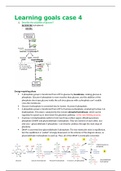
A phosphate group is transferred from ATP to glucose by hexokinase, making glucose-6-
phosphate. Glucose-6-phosphate is more reactive than glucose, and the addition of the
phosphate also traps glucose inside the cell since glucose with a phosphate can’t readily
cross the membrane.
Glucose-6-phosphate is converted into its isomer, fructose-6-phosphate.
A phosphate group is transferred from ATP to fructose-6-phosphate, producing fructose-1,6-
bisphosphate. This step is catalyzed by the enzyme phosphofructokinase, which can be
regulated to speed up or slow down the glycolysis pathway. Is the rate-limiting enzyme.
Fructose-1,6-bisphosphate splits to form two three-carbon sugars: dihydroxyacetone
phosphate (DHAP) and glyceraldehyde-3-phosphate. They are isomers of each other, but
only one—glyceraldehyde-3-phosphate—can directly continue through the next steps of
glycolysis.
DHAP is converted into glyceraldehyde-3-phosphate. The two molecules exist in equilibrium,
but the equilibrium is “pulled” strongly downward, in the scheme of the diagram above, as
glyceraldehyde-3-phosphate is used up. Thus, all of the DHAP is eventually converted.
, Energy-releasing phase
Two half reactions occur simultaneously:
1) Glyceraldehyde-3-phosphate is oxidized
2) NAD+ is reduced to NADH and H+
The overall reaction is exergonic, releasing energy that is then used to phosphorylate the
molecule, forming 1,3-bisphosphoglycerate.
1,3-bisphosphoglycerate donates one of its phosphate groups to ADP, making a molecule of
ATP and turning into 3-phosphoglycerate in the process.
3-phosphoglycerate is converted into its isomer, 2-phosphoglycerate.
2-phosphoglycerate loses a molecule of water, becoming phosphoenolpyruvate (PEP). PEP is
an unstable molecule, poised to lose its phosphate group in the final step of glycolysis.
PEP donates its phosphate group to ADP, making a second ATP. As it loses its phosphate it is
converted to pyruvate. Done by pyruvate kinase.
Know the two phases, remember GPDH (glyceraldehyde-3-phosphate dehydrogenase) it is
the most important enzyme and produces NADH. Also remember enzymes from step 1, 3, 6,
10.
- Anaerobe
Muscle cells are able to carry out lactic acid fermentation, though only when they have too
little oxygen for aerobic respiration to continue—for instance, when you’ve been exercising
very hard. Lactic acid produced in muscle cells is transported through the bloodstream to the
liver, where it’s converted back to pyruvate and processed normally in the remaining
reactions of cellular respiration (gluconeogenesis).
In lactic acid fermentation, NADH transfers its electrons directly to pyruvate, generating
lactate as a by-product. Transforming pyruvate into lactate needs the help of lactate
dehydrogenase (LDH). Lactate, which is just the deprotonated form of lactic acid, gives the
process its name. Also called CORI cycle (lactate travels to liver, there it is turned into glucose
again, gluconeogenesis).
1. Describe the oxidation of glucose?
GLYCOLYSE (cytoplasm)
- Aerobe
Energy-requiring phase
A phosphate group is transferred from ATP to glucose by hexokinase, making glucose-6-
phosphate. Glucose-6-phosphate is more reactive than glucose, and the addition of the
phosphate also traps glucose inside the cell since glucose with a phosphate can’t readily
cross the membrane.
Glucose-6-phosphate is converted into its isomer, fructose-6-phosphate.
A phosphate group is transferred from ATP to fructose-6-phosphate, producing fructose-1,6-
bisphosphate. This step is catalyzed by the enzyme phosphofructokinase, which can be
regulated to speed up or slow down the glycolysis pathway. Is the rate-limiting enzyme.
Fructose-1,6-bisphosphate splits to form two three-carbon sugars: dihydroxyacetone
phosphate (DHAP) and glyceraldehyde-3-phosphate. They are isomers of each other, but
only one—glyceraldehyde-3-phosphate—can directly continue through the next steps of
glycolysis.
DHAP is converted into glyceraldehyde-3-phosphate. The two molecules exist in equilibrium,
but the equilibrium is “pulled” strongly downward, in the scheme of the diagram above, as
glyceraldehyde-3-phosphate is used up. Thus, all of the DHAP is eventually converted.
, Energy-releasing phase
Two half reactions occur simultaneously:
1) Glyceraldehyde-3-phosphate is oxidized
2) NAD+ is reduced to NADH and H+
The overall reaction is exergonic, releasing energy that is then used to phosphorylate the
molecule, forming 1,3-bisphosphoglycerate.
1,3-bisphosphoglycerate donates one of its phosphate groups to ADP, making a molecule of
ATP and turning into 3-phosphoglycerate in the process.
3-phosphoglycerate is converted into its isomer, 2-phosphoglycerate.
2-phosphoglycerate loses a molecule of water, becoming phosphoenolpyruvate (PEP). PEP is
an unstable molecule, poised to lose its phosphate group in the final step of glycolysis.
PEP donates its phosphate group to ADP, making a second ATP. As it loses its phosphate it is
converted to pyruvate. Done by pyruvate kinase.
Know the two phases, remember GPDH (glyceraldehyde-3-phosphate dehydrogenase) it is
the most important enzyme and produces NADH. Also remember enzymes from step 1, 3, 6,
10.
- Anaerobe
Muscle cells are able to carry out lactic acid fermentation, though only when they have too
little oxygen for aerobic respiration to continue—for instance, when you’ve been exercising
very hard. Lactic acid produced in muscle cells is transported through the bloodstream to the
liver, where it’s converted back to pyruvate and processed normally in the remaining
reactions of cellular respiration (gluconeogenesis).
In lactic acid fermentation, NADH transfers its electrons directly to pyruvate, generating
lactate as a by-product. Transforming pyruvate into lactate needs the help of lactate
dehydrogenase (LDH). Lactate, which is just the deprotonated form of lactic acid, gives the
process its name. Also called CORI cycle (lactate travels to liver, there it is turned into glucose
again, gluconeogenesis).