

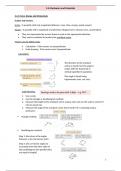
3.4 Mechanics and Materials
3.4.1 Force, Energy and Momentum
Scalars and Vectors:
Scalar = A quantity with only magnitude (distance, mass, time, energy, speed, power)
Vector = A quantity with a magnitude and direction (displacement, velocity, force, acceleration)
They are represented by arrows drawn to scale in the appropriate direction.
They can be combined to produce the resultant vector
Vectors can be added using:
Calculation - if the vectors are perpendicular
Scale drawing - if the vectors aren’t perpendicular
Calculation:
The direction of the resultant
vector is found from the angle it
makes with the horizontal or
vertical (specified in question).
This angle is found using
trigonometry (soh, cah, toa).
Scale Drawing: Bearings need to be given with 3 digits – e.g. 053°
1. Use a scale.
2. Use the triangle or parallelogram method.
3. Measure the length of the resultant vector using a ruler and use the scale to convert it
into its actual size.
4. Measure the angle of the resultant vector (from North if it’s a bearing) using a
protractor.
Triangle method:
Parallelogram method:
Step 1: Also draw in the angles
between a, the horizontal, and b
Step 2: Use co-interior angles to
accurately draw the other sides of
the parallelogram (the parallel sides
are equal in length).
1
, When you subtract a vector, you reverse its direction and then add it (the reversed version) head to
tail with the other vector.
Resolving Vectors:
You can ‘resolve’ a vector by splitting it into its horizontal and vertical component. This is done using
trigonometry.
Horizontal component: Fx = F cos θ
Vertical component: Fy = F sin θ
Forces on an Inclined Plane:
An inclined plane is a flat surface titled at an angle, Ɵ. We can think about it as:
Horizontal component = perpendicular to the slope
Vertical component = Parallel to the slope
R (normal force) will be the same as W (weight)
Equilibrium:
Forces are in equilibrium (resultant force is 0N) if the object is at rest or moving at a constant
velocity. If the vectors, when joined together, form a closed triangle, they are in equilibrium.
3N 4N
Moving forces into a triangle: 3N
To move forces in a
triangle, draw them head
to tail. 5N
To find the angles, imagine 4N
extending the vector arrow
(dashed lines).
5N
2
3.4.1 Force, Energy and Momentum
Scalars and Vectors:
Scalar = A quantity with only magnitude (distance, mass, time, energy, speed, power)
Vector = A quantity with a magnitude and direction (displacement, velocity, force, acceleration)
They are represented by arrows drawn to scale in the appropriate direction.
They can be combined to produce the resultant vector
Vectors can be added using:
Calculation - if the vectors are perpendicular
Scale drawing - if the vectors aren’t perpendicular
Calculation:
The direction of the resultant
vector is found from the angle it
makes with the horizontal or
vertical (specified in question).
This angle is found using
trigonometry (soh, cah, toa).
Scale Drawing: Bearings need to be given with 3 digits – e.g. 053°
1. Use a scale.
2. Use the triangle or parallelogram method.
3. Measure the length of the resultant vector using a ruler and use the scale to convert it
into its actual size.
4. Measure the angle of the resultant vector (from North if it’s a bearing) using a
protractor.
Triangle method:
Parallelogram method:
Step 1: Also draw in the angles
between a, the horizontal, and b
Step 2: Use co-interior angles to
accurately draw the other sides of
the parallelogram (the parallel sides
are equal in length).
1
, When you subtract a vector, you reverse its direction and then add it (the reversed version) head to
tail with the other vector.
Resolving Vectors:
You can ‘resolve’ a vector by splitting it into its horizontal and vertical component. This is done using
trigonometry.
Horizontal component: Fx = F cos θ
Vertical component: Fy = F sin θ
Forces on an Inclined Plane:
An inclined plane is a flat surface titled at an angle, Ɵ. We can think about it as:
Horizontal component = perpendicular to the slope
Vertical component = Parallel to the slope
R (normal force) will be the same as W (weight)
Equilibrium:
Forces are in equilibrium (resultant force is 0N) if the object is at rest or moving at a constant
velocity. If the vectors, when joined together, form a closed triangle, they are in equilibrium.
3N 4N
Moving forces into a triangle: 3N
To move forces in a
triangle, draw them head
to tail. 5N
To find the angles, imagine 4N
extending the vector arrow
(dashed lines).
5N
2


