

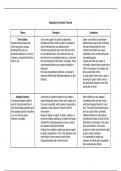
Evaluation of Genetic Theories
Theory Strengths Limitations
Twin Studies: - Give some support for genetic explanations, - Higher concordance rate between
Genetic theories argue that Ishikawa and Raine found a higher concordance identical twins may be due to sharing
crime has genetic causes. rate for identical than non-identical twins the same home/school etc, their
Identical (MZ) twins are - Parents treat identical twins more alike than they shared environment may cause
genetically identical, so if one is do non-identical twins. Also identical twins may similarities in their criminal behaviour
criminal, we should find that the feel closer than non-identical twins do, so one twin not identical genes
other is too. may be influenced by the other's criminality. These - If genes were the only cause of
environmental factors may produce similarity in criminality, identical twins would show
behaviour. 100% concordance, but studies only
- MZ twins are genetically identical, it is logical to show around half or less.
examine whether their offending behaviour is also - In early studies, there was no way of
identical knowing for certain if twins were in
fact genetically identical, since DNA
testing did not exist.
Adoption Studies: - Overcome the problems faced by twin studies, - Many children are not adopted
Comparing adopted children’s where biologically identical twins are brought up in immediately after birth but remain
level of criminality with that of the same household, which makes it impossible to with their biological family for some
both their biological parents and separate out the influence of genes from the time. This early environment may be
their adoptive parents may allow environment the true cause of their criminality.
us to see how far genes - Research design is logical. In theory, it allows us - Adopted children are often placed
influence criminality. to see the relative importance of nature (the genes environments similar to those of their
inherited from biological parents) versus ‘nurture’ birth family, with families of the same
(the adoptive family environment) class and ethnicity, in the same
- Findings from adoption studies give some support locality etc similar environments might
to genetic explanations. They show adoptees were produce similar behaviour
more likely to have criminal records if their - It is impossible to isolate and
biological parents had criminal records. measure the effect genes separately
from environmental effects.
Theory Strengths Limitations
Twin Studies: - Give some support for genetic explanations, - Higher concordance rate between
Genetic theories argue that Ishikawa and Raine found a higher concordance identical twins may be due to sharing
crime has genetic causes. rate for identical than non-identical twins the same home/school etc, their
Identical (MZ) twins are - Parents treat identical twins more alike than they shared environment may cause
genetically identical, so if one is do non-identical twins. Also identical twins may similarities in their criminal behaviour
criminal, we should find that the feel closer than non-identical twins do, so one twin not identical genes
other is too. may be influenced by the other's criminality. These - If genes were the only cause of
environmental factors may produce similarity in criminality, identical twins would show
behaviour. 100% concordance, but studies only
- MZ twins are genetically identical, it is logical to show around half or less.
examine whether their offending behaviour is also - In early studies, there was no way of
identical knowing for certain if twins were in
fact genetically identical, since DNA
testing did not exist.
Adoption Studies: - Overcome the problems faced by twin studies, - Many children are not adopted
Comparing adopted children’s where biologically identical twins are brought up in immediately after birth but remain
level of criminality with that of the same household, which makes it impossible to with their biological family for some
both their biological parents and separate out the influence of genes from the time. This early environment may be
their adoptive parents may allow environment the true cause of their criminality.
us to see how far genes - Research design is logical. In theory, it allows us - Adopted children are often placed
influence criminality. to see the relative importance of nature (the genes environments similar to those of their
inherited from biological parents) versus ‘nurture’ birth family, with families of the same
(the adoptive family environment) class and ethnicity, in the same
- Findings from adoption studies give some support locality etc similar environments might
to genetic explanations. They show adoptees were produce similar behaviour
more likely to have criminal records if their - It is impossible to isolate and
biological parents had criminal records. measure the effect genes separately
from environmental effects.


