
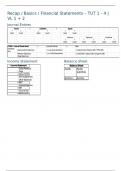
Recap / Basics / Financial Statements – TUT 1 - 4 |
VL 1 + 2
Journal Entries
Assets = Liabilities + Equity
↑ ↓ ↓ ↑ ↓ ↑
Debit Credit Debit Credit Debit Credit
Revenue Expenses Dividends
↓ ↑ ↑ ↓ ↑ ↓
Debit Credit Debit Credit Debit Credit
COGS- Cost of Goods Sold → Journal Entries → Bsp.
bestehen
Depreciation Expenses 1. aus Asset abziehen 1. Depreciation Exense 500- PP&E 500
aus
Material Expenses 2. in COGS überführen 2. COGS 500- Depreciation Expense 500
Wage Expenses
Income Statement Balance Sheet
Income Statement Balance Sheet
Sales/Revenue Assets Equity
- Cogs Liabilities
=Gross Profit
- Selling Expenses
Summe = Summe
- Other Expenses
=EBIT
- Interest Expense
=EBT
- Income Tax
=Net Income
, Cash Flow Statement
CashFlowStatement
Old Cash (Cash t-1)
+Net Income
+Interest Expense after tax
+Depreciation
+Change in Provision
- Change in Accounts receivable
- Change in inventories
+Increase in Accounts paypable
=Cash from Operations
- Investments in PP&E
=Cash from Investments
- Share buyback
+Acquiringlong-term loan
- payback long-termloan
- divdend paid
- interest expense after tax
=Cash from Financing
Change in Cash from Cash from Cash from
- +
Cash= Operations Investments Financing
Clean Surplus Relation + Accrual Accounting
Allgemeine Formeln/Kennzahlen
Interest Expense
= Interest Expense * (1- TaxRate)
after tax
RetainedEarnings t = Retained Earnings t-1 + Net Income t - Dividends t
Share Capital t = Share Capital t-1 + issued shares
Dividends = Net Income - Retained Earnings
Net Sales = COGS + Gross Profit
Sales Revenue = Net sales + Sales returns
Sales Return = Sales Revenues - Net Sale
COGS = Net Sales - Gross Profit on sales
CleanSurplus
Relation = Equityt-1 + Net Income t - Dividends t + Capital Contributions
Equityt
Accrual Accounting Kennzahlen
Net profit margin = Net Income / Sales/Revenue * 100
Asset turnover = Sales / Total Assets
Leverage = Total Assets / Total Equity
ReturnonEquity(ROE) = Net profit margin * Asset turnover * Leverage
= Net Income / Total Equity
,Effective Annual Interest Rate Method
Effective Annual Interest Rate Method Bsp. Interest Rate - 7%- 1M Investment at 142,375 annual payment
Remaining
Cash Interest Repayment
Date Carrying
Inflow (A) Expense (B) (A-B)
amount
01.01.2024 1.000.000
31.12.2024 142.375,00 70.000,00 72.375,00 927.625,00
31.12.2025 142.375,00 64.933,75 77.441,25 850.183,75
31.12.2026 142.375,00 59.512,86 82.862,14 767.321,61
31.12.2027 142.375,00 53.712,51 88.662,49 678.659,13
Discount Factor
Discount Factor -->for comparing investments with alternative investment interests
N: Laufzeit
Discount Factor: 1/ (1+i)^n
Annuity Factor
um die jährlich Rückzahlung auszurechnen
n
i∗(1+i )
(1+i)n−1
Closing the books
Closing the Books immer nur die Balance
Bsp.
Revenue 14500 Income Summary 14500
Income Summary
7825 Expenses 7825
Balance 6675
Owner's Capital6675 Income Summary 6675
Owner's Drawings
2000 Owner's Capital 2000
Balance 4675
, Revenue Recognition | TUT 5 + 6 | VL 3
Framework
1. Identify the Contract with a Customer
2. Identify Separate Performance Obligations
a. A performance obligation is a promise to transfer a distinct good or service to the
customer.
b. Goods or services are distinct if:
i. The customer can benefit from the good or service on its own.
ii. The promise to transfer the good or service is separately identifiable from
other promises in the contract.
3. Determine the Transaction Price
4. Allocate the Transaction Price to Performance Obligations:
a. Allocate based on the relative stand-alone selling prices.
b. If stand-alone prices are not observable, estimate using:
i. Adjusted market assessment approach.
ii. Expected cost plus a margin approach.
iii. Residual approach (under certain conditions).
5. Recognize Revenue When (or as) Each Performance Obligation is Satisfied:
a. Recognize revenue over time or at a point in time, depending on when control of
the goods or services is transferred to the customer.
b. Methods to recognitze revenue over time
i. Output Method
1. Work certified to date / Total contract revenue
ii. Input / Cost Method
a. Costs to date / Total estimated costs
Example I – Airbus
1. Identify Contract: Signed contract on May 2, 20x2.
2. Performance Obligation: Deliver airplanes.
3. Transaction Price: EUR 3.6bn.
4. Allocate Price: Single obligation - entire price allocated to delivery.
5. Recognize Revenue: Upon delivery on January 15, 20x3.
Journal Entries:
1. On contract signing (May 2, 20x2):
a. No journal entry required as no performance obligation has been satisfied.
2. On delivery of planes (January 15, 20x3):
a. Dr. Accounts Receivable (+CA) EUR 3.6bn - Cr. Sales Revenue (+NI, +E) EUR
3.6bn
b. Dr. Cost of Goods Sold (-NI, -E) [Cost of planes] - Cr. Inventory (-CA) [Cost of
planes]
3. On payment receipt (March 15, 20x3):
a. Dr. Cash (+CA) EUR 3.6bn - Cr. Accounts Receivable (-CA) EUR 3.6bn
VL 1 + 2
Journal Entries
Assets = Liabilities + Equity
↑ ↓ ↓ ↑ ↓ ↑
Debit Credit Debit Credit Debit Credit
Revenue Expenses Dividends
↓ ↑ ↑ ↓ ↑ ↓
Debit Credit Debit Credit Debit Credit
COGS- Cost of Goods Sold → Journal Entries → Bsp.
bestehen
Depreciation Expenses 1. aus Asset abziehen 1. Depreciation Exense 500- PP&E 500
aus
Material Expenses 2. in COGS überführen 2. COGS 500- Depreciation Expense 500
Wage Expenses
Income Statement Balance Sheet
Income Statement Balance Sheet
Sales/Revenue Assets Equity
- Cogs Liabilities
=Gross Profit
- Selling Expenses
Summe = Summe
- Other Expenses
=EBIT
- Interest Expense
=EBT
- Income Tax
=Net Income
, Cash Flow Statement
CashFlowStatement
Old Cash (Cash t-1)
+Net Income
+Interest Expense after tax
+Depreciation
+Change in Provision
- Change in Accounts receivable
- Change in inventories
+Increase in Accounts paypable
=Cash from Operations
- Investments in PP&E
=Cash from Investments
- Share buyback
+Acquiringlong-term loan
- payback long-termloan
- divdend paid
- interest expense after tax
=Cash from Financing
Change in Cash from Cash from Cash from
- +
Cash= Operations Investments Financing
Clean Surplus Relation + Accrual Accounting
Allgemeine Formeln/Kennzahlen
Interest Expense
= Interest Expense * (1- TaxRate)
after tax
RetainedEarnings t = Retained Earnings t-1 + Net Income t - Dividends t
Share Capital t = Share Capital t-1 + issued shares
Dividends = Net Income - Retained Earnings
Net Sales = COGS + Gross Profit
Sales Revenue = Net sales + Sales returns
Sales Return = Sales Revenues - Net Sale
COGS = Net Sales - Gross Profit on sales
CleanSurplus
Relation = Equityt-1 + Net Income t - Dividends t + Capital Contributions
Equityt
Accrual Accounting Kennzahlen
Net profit margin = Net Income / Sales/Revenue * 100
Asset turnover = Sales / Total Assets
Leverage = Total Assets / Total Equity
ReturnonEquity(ROE) = Net profit margin * Asset turnover * Leverage
= Net Income / Total Equity
,Effective Annual Interest Rate Method
Effective Annual Interest Rate Method Bsp. Interest Rate - 7%- 1M Investment at 142,375 annual payment
Remaining
Cash Interest Repayment
Date Carrying
Inflow (A) Expense (B) (A-B)
amount
01.01.2024 1.000.000
31.12.2024 142.375,00 70.000,00 72.375,00 927.625,00
31.12.2025 142.375,00 64.933,75 77.441,25 850.183,75
31.12.2026 142.375,00 59.512,86 82.862,14 767.321,61
31.12.2027 142.375,00 53.712,51 88.662,49 678.659,13
Discount Factor
Discount Factor -->for comparing investments with alternative investment interests
N: Laufzeit
Discount Factor: 1/ (1+i)^n
Annuity Factor
um die jährlich Rückzahlung auszurechnen
n
i∗(1+i )
(1+i)n−1
Closing the books
Closing the Books immer nur die Balance
Bsp.
Revenue 14500 Income Summary 14500
Income Summary
7825 Expenses 7825
Balance 6675
Owner's Capital6675 Income Summary 6675
Owner's Drawings
2000 Owner's Capital 2000
Balance 4675
, Revenue Recognition | TUT 5 + 6 | VL 3
Framework
1. Identify the Contract with a Customer
2. Identify Separate Performance Obligations
a. A performance obligation is a promise to transfer a distinct good or service to the
customer.
b. Goods or services are distinct if:
i. The customer can benefit from the good or service on its own.
ii. The promise to transfer the good or service is separately identifiable from
other promises in the contract.
3. Determine the Transaction Price
4. Allocate the Transaction Price to Performance Obligations:
a. Allocate based on the relative stand-alone selling prices.
b. If stand-alone prices are not observable, estimate using:
i. Adjusted market assessment approach.
ii. Expected cost plus a margin approach.
iii. Residual approach (under certain conditions).
5. Recognize Revenue When (or as) Each Performance Obligation is Satisfied:
a. Recognize revenue over time or at a point in time, depending on when control of
the goods or services is transferred to the customer.
b. Methods to recognitze revenue over time
i. Output Method
1. Work certified to date / Total contract revenue
ii. Input / Cost Method
a. Costs to date / Total estimated costs
Example I – Airbus
1. Identify Contract: Signed contract on May 2, 20x2.
2. Performance Obligation: Deliver airplanes.
3. Transaction Price: EUR 3.6bn.
4. Allocate Price: Single obligation - entire price allocated to delivery.
5. Recognize Revenue: Upon delivery on January 15, 20x3.
Journal Entries:
1. On contract signing (May 2, 20x2):
a. No journal entry required as no performance obligation has been satisfied.
2. On delivery of planes (January 15, 20x3):
a. Dr. Accounts Receivable (+CA) EUR 3.6bn - Cr. Sales Revenue (+NI, +E) EUR
3.6bn
b. Dr. Cost of Goods Sold (-NI, -E) [Cost of planes] - Cr. Inventory (-CA) [Cost of
planes]
3. On payment receipt (March 15, 20x3):
a. Dr. Cash (+CA) EUR 3.6bn - Cr. Accounts Receivable (-CA) EUR 3.6bn


