
100% satisfaction guarantee Immediately available after payment Both online and in PDF No strings attached 4.2 TrustPilot
logo-home
Exam (elaborations)

Pediatric CCRN Updated 2024/2025 Verified 100%

Rating
-
Sold
1
Pages
5
Grade
A+
Uploaded on
08-09-2024
Written in
2024/2025

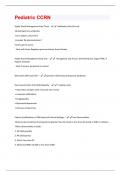
Septic Shock Management Step Three - -Antibiotics (first 60 min) -Broad Spectrum antibiotics -Try to obtain culture first -Consider IM administration if hard to get IV access - Start with Gram Negative spectrum before Gram Positive Septic Shock Management Step One - - Recognition and Access: Diminished LOC, begin HFNC, if hypoxic intubate - Start IV access: peripheral or central What does SIRS stand for? - Systemic Inflammatory Response Syndrome Key characteristics of Endotheliopathy - • Capillary leak • Vasomotor paralysis tone of vessels not normal • Leukocyte infiltrations • Coagulopathy • Myocardial depression • Immune-compromise Patient Qualifications of SIRS based off clinical findings. - Two Abnormalities -Must be abnormalities of temperature (greater than 38 rectal or less than 36 rectal) or WBC in children -Other abnormalities include: 1. HR (Tachycardia) 2. RR (Tachypnea) 3. PaCo2 Less than 32 4. Abnormal WBC>12,000 or less than 4,0005. WBC bands greater than 10% differential Management of SIRS - 1. Treat underlying Cause 2.Manage coagulopathies: thrombocytopenia← replace platelet, clot formation← give thrombolytic, bleeding 3. Mange the endothelipathies: stop inciting insult, fluid resuscitate, increase plasma oncotic pressure (colloid administration) 4. Promote Vasoconstriction: Alpha Agonist Septic Shock - - Sepsis plus CV dysfunction: Abnormal perfusion as well as hypotension. - Children able to maintain BP longer than Adults Septic Shock Management Step Two - - Fluid Resuscitation - Rapid administration 20mL/Kg bolus of isotonic crystalloid -Run over 5-10 minutes • 0.9% NaCL (normal saline) • Lactated ringers Septic Shock Management Step Four - 4. Inotropic Agent support WARM SHOCK - 1. High cardiac output 2. Low Systemic Vascular Resistance (SVR) Inotropic Agent for Warm Shock? - 1. Dopamine 2. Nor-epi *Utilize EPI or Vasopressin if not responsiveCOLD SHOCK (normal or Low BP) - 1. Low Cardiac Output 2. High Systemic Vascular Resistance (Normal or Low BP) Inotropic Agent for Cold Shock (normal or Low BP) ? - 1. Dopamine 2. Epi *Utilize Nor-epi or Dopamine if not responsive COLD SHOCK (Low BP) - 1. Low Cardiac Output 2. Low Systemic Vascular Resistance Inotropic Agent for Cold Shock (Low BP) - 1. Dopamine 2. EPI * Utilize Milronone or Dobutamine if not responsive Catecholamine Resistant Shock - - Septic Shock when patients don't respond to inotropes - Severe Septic Shock with Purpura - Have adrenal insufficiency or have been previusly treated with high dose steriods Types of Shock? - 1. Cardiogenic: Pump Failure 2. Distributive (anaphylaxis): Issue with vasculature of vessels. Dilated vessel bad! (Tubing issue) 3. Hypovolemic: Fluid Loss 4. Septic: Failure of pump, vessels loose tone, and fluid loss What is Hypovolemic Shock? - •Decreased intravascular volume→Decrease preload→ decrease CO Causes of Hypovolemic Shock - 1. External fluid loss 2. Internal fluid loss3. Greater than Year: Hemorrhage from trauma 4. Less than a Year: Gastroenteritis or D/V 5. Other Causes: Hyperthermia- heat stroke, burn, nephrotic syndrome, DI Dehydration manifestions (depends on severity) - 1. Mental Status: Irritability, change in LOC (moderate-severe) 2. HR: Tachycardia 3. RR: Normal-Rapid 4. BP: (hypotension late sign) 5. Mucous Membrane: Dry (moderate-severe) 6. Fontanel/eyes: Sunken (moderate-severe) 7. Tears: absent (moderate-severe) 8. Pulses: Palpable decreased peripherally (moderate) Weak to absent in severe 9. Urine output: decrease amount (moderate) Oliguria to anuria in severe 10. Weight loss: ALOT Causes of Distributive Shock - •Anaphylaxis •Neurologic injury (above t1 and brainstem) •Loss of sympathetic vascular tone •Hyperthermia •Infection- component of sepsis •Adrenal Insufficiency •Pancreatitis •SIRS Anaphylactic shock - - Histamine release→ vasodilation

Show more Read less
Institution
Pediatric CCRN
Module
Pediatric CCRN


Whoops! We can’t load your doc right now. Try again or contact support.

Written for

Institution
Pediatric CCRN
Module
Pediatric CCRN

Document information

Uploaded on
September 8, 2024
Number of pages
5
Written in
2024/2025
Type
Exam (elaborations)
Contains
Questions & answers

Content preview

Pediatric CCRN
Septic Shock Management Step Three - -Antibiotics (first 60 min)

-Broad Spectrum antibiotics

-Try to obtain culture first

-Consider IM administration if

hard to get IV access

- Start with Gram Negative spectrum before Gram Positive


Septic Shock Management Step One - - Recognition and Access: Diminished LOC, begin HFNC, if
hypoxic intubate

- Start IV access: peripheral or central


What does SIRS stand for? - Systemic Inflammatory Response Syndrome


Key characteristics of Endotheliopathy - • Capillary leak

• Vasomotor paralysis tone of vessels not normal

• Leukocyte infiltrations

• Coagulopathy

• Myocardial depression

• Immune-compromise


Patient Qualifications of SIRS based off clinical findings. - Two Abnormalities

-Must be abnormalities of temperature (greater than 38 rectal or less than 36 rectal) or WBC in children

-Other abnormalities include:

1. HR (Tachycardia)

2. RR (Tachypnea)

3. PaCo2 Less than 32

4. Abnormal WBC>12,000 or less than 4,000

, 5. WBC bands greater than 10% differential


Management of SIRS - 1. Treat underlying Cause

2.Manage coagulopathies: thrombocytopenia← replace platelet, clot formation← give thrombolytic,
bleeding

3. Mange the endothelipathies: stop inciting insult, fluid resuscitate, increase plasma oncotic pressure
(colloid administration)

4. Promote Vasoconstriction: Alpha Agonist


Septic Shock - - Sepsis plus CV dysfunction: Abnormal perfusion as well as hypotension.

- Children able to maintain BP longer than Adults


Septic Shock Management Step Two - - Fluid Resuscitation

- Rapid administration 20mL/Kg bolus of isotonic crystalloid

-Run over 5-10 minutes

• 0.9% NaCL (normal saline)

• Lactated ringers


Septic Shock Management Step Four - 4. Inotropic Agent support


WARM SHOCK - 1. High cardiac output

2. Low Systemic Vascular Resistance (SVR)


Inotropic Agent for Warm Shock? - 1. Dopamine

2. Nor-epi

*Utilize EPI or Vasopressin if not responsive

Get to know the seller

Seller avatar
Reputation scores are based on the amount of documents a seller has sold for a fee and the reviews they have received for those documents. There are three levels: Bronze, Silver and Gold. The better the reputation, the more your can rely on the quality of the sellers work.
ACADEMICMATERIALS City University New York
View profile
Follow You need to be logged in order to follow users or courses
Sold
562
Member since
2 year
Number of followers
186
Documents
10590
Last sold
2 weeks ago

4.1

95 reviews

5
53
4
11
3
21
2
3
1
7

Recently viewed by you

Why students choose Stuvia

Created by fellow students, verified by reviews

Quality you can trust: written by students who passed their exams and reviewed by others who've used these revision notes.

Didn't get what you expected? Choose another document

No problem! You can straightaway pick a different document that better suits what you're after.

Pay as you like, start learning straight away

No subscription, no commitments. Pay the way you're used to via credit card and download your PDF document instantly.

Student with book image

“Bought, downloaded, and smashed it. It really can be that simple.”

Alisha Student

Frequently asked questions

