
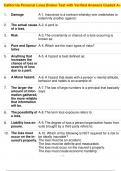
California Personal Lines Broker Test with Verified Answers Graded A+
1. Damage A-1. Insurance is a contract whereby one undertakes to
indemnify another against:
2. The actual cause A-2. A peril is:
of a loss.
3. Risk A-3. The uncertainty or chance of a loss occurring is
known as:
4. Pure and Specu- A-4. Which are the main types of risks?
lative
5. Anything that A-5. A hazard is best defined as:
increases the
chance of loss or
severity of loss
due to a peril.
6. A Moral hazard. A-6. A hazard that deals with a person`s mental attitude,
behavior and habits is an example of:
7. The larger the A-7. The law of large numbers is a principal that basically
amount of infor- says:
mation gathered,
the more reliable
that information
will be.
8. The possibility of A-8. The term loss exposure refers to:
a loss.
9. Liability loss ex- A-9. The degree of loss a person/organization faces from
posure. suits brought by a third party refers to:
10. The loss must A-10. Which of the following is NOT required for a risk to
occur on the in- be ideally insurable?
sured's property. The loss must be an accident.
The loss must be definite and measurable.
The loss must occur on the insured`s property.
The loss must create economic hardship.
,11. The more insur- A-11. Any contingent or unknown event, whether past or
able it becomes. future, which may damnify a person having an insurable
interest or create a liability against him/her, may be in-
sured against. The more unpredictable a loss becomes:
12. Indemnification A-12. Restoring the insured back to the condition he or
she was in before the loss occurred is known as:
13. Underwriting A-13. The process of reviewing applications for insurance
and the information on the application is:
14. Bond Insurance A-14. Which of the following is NOT a known private
companies are insurer?
not considered Reciprocal Insurance Exchanges
insurers. Mutual Insurance Companies
Bond Insurance Companies
Stock Insurance Companies
15. Adverse selec- A-15. Bob is thinking about obtaining insurance because
tion he just found out he needs extensive surgery that will re-
quire several days in the hospital. This situation of waiting
until the last minute to obtain insurance is known as:
16. Taking the nec- A-16. Loss control refers to:
essary precau-
tions that will re-
duce the risk of a
loss.
17. Deductible A-17. Which of the following is the amount of money the
insured pays before the insurer pays for the rest of the
claim?
18. Reinsurance is A-18. What is reinsurance?
the process
whereby the in-
surer transfers
all or part of the
, risk to another
company.
19. A contract. A-19. Which of the following is defined as `an agreement
between two or more parties enforceable by law?`
20. Intentional and A-20. What are the two types of torts?
Unintentional.
21. Consideration A-21. What is the binding force of a contract?
22. When one par- A-22. What is fraud?
ty intentionally
gives the other
party false in-
formation in or-
der to benefit
from the unlaw-
ful gain.
23. Estoppel A-23. When a right or privilege has been given up, a party
cannot reassert that right or privilege. The process of pre-
venting the party from reasserting that right or privilege is
known as:
24. Once signed a A-24. Either party may rescind a contract for what rea-
contract can nev- sons?
er be rescinded.
25. Breach of con- A-25. Examples of tort law include all of the following
tract. EXCEPT:
Libel and slander
Bodily injury
Personal injury
Breach of contract
26. Insurance A-26. Substitution of a small certain loss for a large uncer-
tain loss is:
27. Exposure A-27. The state of being subject to a loss is considered:
, 28. Aleatory A-28. Performance depends upon an uncertain future
event is the feature:
29. Property loss ex- A-29. Type of loss exposure pertaining to land and struc-
posure. tures attached to it is:
30. All are examples. A-30. Which of the following is an example of an adverse
underwriting decision?
Charging a higher rate
Rejecting the risk
Issuing with limitations
All of these are examples
31. Casualty is not A-31. Which of the following is not a class of insurance?
a class of insur- Casualty
ance. Fire
Marine
Auto
32. $25,000 fine or 1 A-32. Punishment for twisting or misrepresentation would
year in jail. be:
33. Implied warranty. A-33. A beautician stating that this conditioner fixes badly
damaged hair is a:
34. the influence of A-34. Materiality is determined by the disadvantage
the facts, not by placed on the other party and
the event.
35. A waiver. A-35. When an insured rejects uninsured motorist in writ-
ing this is considered:
36. An independent B-1. In which of the following marketing distribution sys-
agency tems does the agent represent more than one insurer and
more than one company?
Direct mailing system
Direct writing system
Exclusive agency
Independent agency
1. Damage A-1. Insurance is a contract whereby one undertakes to
indemnify another against:
2. The actual cause A-2. A peril is:
of a loss.
3. Risk A-3. The uncertainty or chance of a loss occurring is
known as:
4. Pure and Specu- A-4. Which are the main types of risks?
lative
5. Anything that A-5. A hazard is best defined as:
increases the
chance of loss or
severity of loss
due to a peril.
6. A Moral hazard. A-6. A hazard that deals with a person`s mental attitude,
behavior and habits is an example of:
7. The larger the A-7. The law of large numbers is a principal that basically
amount of infor- says:
mation gathered,
the more reliable
that information
will be.
8. The possibility of A-8. The term loss exposure refers to:
a loss.
9. Liability loss ex- A-9. The degree of loss a person/organization faces from
posure. suits brought by a third party refers to:
10. The loss must A-10. Which of the following is NOT required for a risk to
occur on the in- be ideally insurable?
sured's property. The loss must be an accident.
The loss must be definite and measurable.
The loss must occur on the insured`s property.
The loss must create economic hardship.
,11. The more insur- A-11. Any contingent or unknown event, whether past or
able it becomes. future, which may damnify a person having an insurable
interest or create a liability against him/her, may be in-
sured against. The more unpredictable a loss becomes:
12. Indemnification A-12. Restoring the insured back to the condition he or
she was in before the loss occurred is known as:
13. Underwriting A-13. The process of reviewing applications for insurance
and the information on the application is:
14. Bond Insurance A-14. Which of the following is NOT a known private
companies are insurer?
not considered Reciprocal Insurance Exchanges
insurers. Mutual Insurance Companies
Bond Insurance Companies
Stock Insurance Companies
15. Adverse selec- A-15. Bob is thinking about obtaining insurance because
tion he just found out he needs extensive surgery that will re-
quire several days in the hospital. This situation of waiting
until the last minute to obtain insurance is known as:
16. Taking the nec- A-16. Loss control refers to:
essary precau-
tions that will re-
duce the risk of a
loss.
17. Deductible A-17. Which of the following is the amount of money the
insured pays before the insurer pays for the rest of the
claim?
18. Reinsurance is A-18. What is reinsurance?
the process
whereby the in-
surer transfers
all or part of the
, risk to another
company.
19. A contract. A-19. Which of the following is defined as `an agreement
between two or more parties enforceable by law?`
20. Intentional and A-20. What are the two types of torts?
Unintentional.
21. Consideration A-21. What is the binding force of a contract?
22. When one par- A-22. What is fraud?
ty intentionally
gives the other
party false in-
formation in or-
der to benefit
from the unlaw-
ful gain.
23. Estoppel A-23. When a right or privilege has been given up, a party
cannot reassert that right or privilege. The process of pre-
venting the party from reasserting that right or privilege is
known as:
24. Once signed a A-24. Either party may rescind a contract for what rea-
contract can nev- sons?
er be rescinded.
25. Breach of con- A-25. Examples of tort law include all of the following
tract. EXCEPT:
Libel and slander
Bodily injury
Personal injury
Breach of contract
26. Insurance A-26. Substitution of a small certain loss for a large uncer-
tain loss is:
27. Exposure A-27. The state of being subject to a loss is considered:
, 28. Aleatory A-28. Performance depends upon an uncertain future
event is the feature:
29. Property loss ex- A-29. Type of loss exposure pertaining to land and struc-
posure. tures attached to it is:
30. All are examples. A-30. Which of the following is an example of an adverse
underwriting decision?
Charging a higher rate
Rejecting the risk
Issuing with limitations
All of these are examples
31. Casualty is not A-31. Which of the following is not a class of insurance?
a class of insur- Casualty
ance. Fire
Marine
Auto
32. $25,000 fine or 1 A-32. Punishment for twisting or misrepresentation would
year in jail. be:
33. Implied warranty. A-33. A beautician stating that this conditioner fixes badly
damaged hair is a:
34. the influence of A-34. Materiality is determined by the disadvantage
the facts, not by placed on the other party and
the event.
35. A waiver. A-35. When an insured rejects uninsured motorist in writ-
ing this is considered:
36. An independent B-1. In which of the following marketing distribution sys-
agency tems does the agent represent more than one insurer and
more than one company?
Direct mailing system
Direct writing system
Exclusive agency
Independent agency


