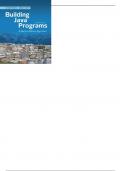
,Thank you for purchasing a new copy of Building Java Programs: A Back to Basics Approach by Stuart Reges,
Marty Stepp. The information below provides instruction on how to access the Companion site.
To access the Companion Website:
1. Go to http://www.pearsonhighered.com/regesstepp/
2. From here you can register as a First-Time User or Returning User.
3. Your student access code will be sent to you by CourseSmart. On the registration page, enter your student
access code. Do not type the dashes. You can use lower or uppercase letters.
4. Follow the on-screen instructions. If you need help during the online registration process, simply click on
Need Help?
5. Once your personal Login Name and Password are confirmed, you can begin viewing the Companion Web-
site.
To login to the website for the first time after you’ve registered:
Follow step 1 to return to the Companion Website. Then, follow the prompts for "Returning Users" to enter
your Login Name and Password.
Note to Instructors: For access to the Instructor Resource Center, contact your Pearson Representative.
IMPORTANT: The access code on this page can only be used once to establish a subscription to the Com-
panion Website for Building Java Programs: A Back to Basics Approach. If this access code has already been
redeemed, it will no longer be valid. If this is the case, you can purchase a subscription by going to the http://
www.pearsonhighered.com/regesstepp/ website and selecting "Get Access."
, Building Java Programs
A Back to Basics Approach
Stuart Reges | Marty Stepp
University of Washington
Addison-Wesley
Boston Columbus Indianapolis New York San Francisco Upper Saddle River
Amsterdam Cape Town Dubai London Madrid Milan Munich Paris Montreal Toronto
Delhi Mexico City Sao Paulo Sydney Hong Kong Seoul Singapore Taipei Tokyo
, Editor in Chief: Michael Hirsch Senior Media Buyer: Ginny Michaud
Acquisitions Editor: Matt Goldstein Text Designer: Susan Raymond
Editorial Assistant: Chelsea Bell Cover Designer: Elena Sidorova
Managing Editor: Jeffrey Holcomb Cover Image: © Roine Magnusson / Getty Images
Senior Production Project Manager: Marilyn Lloyd Interior CO Image: Stone Wall © Corbis
Media Producer: Katelyn Boller Project Management: Brendan Short/Aptara®, Inc.
Director of Marketing: Margaret Waples Full Service Vendor: Aptara®, Inc.
Marketing Coordinator: Kathryn Ferranti Printer/Binder: Edwards Brothers
Senior Manufacturing Buyer: Carol Melville Cover Printer: Lehigh-Phoenix Color/Hagerstown
Credits and acknowledgments borrowed from other sources and reproduced, with permission, in this textbook appear on
appropriate page within text.
The interior of this book was set in QuarkXpress 6.5 with ETM v2. The basal text is set in Times.
Copyright © 2011, 2008 Pearson Education, Inc., publishing as Addison-Wesley. All rights reserved. Manufactured in
the United States of America. This publication is protected by Copyright, and permission should be obtained from the
publisher prior to any prohibited reproduction, storage in a retrieval system, or transmission in any form or by any means,
electronic, mechanical, photocopying, recording, or likewise. To obtain permission(s) to use material from this work,
please submit a written request to Pearson Education, Inc., Permissions Department, 501 Boylston Street, Suite 900,
Boston, Massachusetts 02116.
Many of the designations by manufacturers and seller to distinguish their products are claimed as trademarks. Where
those designations appear in this book, and the publisher was aware of a trademark claim, the designations have been
printed in initial caps or all caps.
Library of Congress Cataloging-in-Publication Data
Reges, Stuart.
Building Java programs : a back to basics approach / Stuart Reges, Marty Stepp.—2nd ed.
p. cm.
Includes bibliographical references and index.
ISBN 978-0-13-609181-3 (alk. paper)
1. Java (Computer program language) I. Stepp, Martin. II. Title.
QA76.73.J38R447 2011
005.13'3—dc22 2010001081
10 9 8 7 6 5 4 3 2 1— EB—14 13 12 11 10
Addison-Wesley
is an imprint of
ISBN 13: 978-0-136-09181-3
ISBN 10: 0-136-09181-4
Marty Stepp. The information below provides instruction on how to access the Companion site.
To access the Companion Website:
1. Go to http://www.pearsonhighered.com/regesstepp/
2. From here you can register as a First-Time User or Returning User.
3. Your student access code will be sent to you by CourseSmart. On the registration page, enter your student
access code. Do not type the dashes. You can use lower or uppercase letters.
4. Follow the on-screen instructions. If you need help during the online registration process, simply click on
Need Help?
5. Once your personal Login Name and Password are confirmed, you can begin viewing the Companion Web-
site.
To login to the website for the first time after you’ve registered:
Follow step 1 to return to the Companion Website. Then, follow the prompts for "Returning Users" to enter
your Login Name and Password.
Note to Instructors: For access to the Instructor Resource Center, contact your Pearson Representative.
IMPORTANT: The access code on this page can only be used once to establish a subscription to the Com-
panion Website for Building Java Programs: A Back to Basics Approach. If this access code has already been
redeemed, it will no longer be valid. If this is the case, you can purchase a subscription by going to the http://
www.pearsonhighered.com/regesstepp/ website and selecting "Get Access."
, Building Java Programs
A Back to Basics Approach
Stuart Reges | Marty Stepp
University of Washington
Addison-Wesley
Boston Columbus Indianapolis New York San Francisco Upper Saddle River
Amsterdam Cape Town Dubai London Madrid Milan Munich Paris Montreal Toronto
Delhi Mexico City Sao Paulo Sydney Hong Kong Seoul Singapore Taipei Tokyo
, Editor in Chief: Michael Hirsch Senior Media Buyer: Ginny Michaud
Acquisitions Editor: Matt Goldstein Text Designer: Susan Raymond
Editorial Assistant: Chelsea Bell Cover Designer: Elena Sidorova
Managing Editor: Jeffrey Holcomb Cover Image: © Roine Magnusson / Getty Images
Senior Production Project Manager: Marilyn Lloyd Interior CO Image: Stone Wall © Corbis
Media Producer: Katelyn Boller Project Management: Brendan Short/Aptara®, Inc.
Director of Marketing: Margaret Waples Full Service Vendor: Aptara®, Inc.
Marketing Coordinator: Kathryn Ferranti Printer/Binder: Edwards Brothers
Senior Manufacturing Buyer: Carol Melville Cover Printer: Lehigh-Phoenix Color/Hagerstown
Credits and acknowledgments borrowed from other sources and reproduced, with permission, in this textbook appear on
appropriate page within text.
The interior of this book was set in QuarkXpress 6.5 with ETM v2. The basal text is set in Times.
Copyright © 2011, 2008 Pearson Education, Inc., publishing as Addison-Wesley. All rights reserved. Manufactured in
the United States of America. This publication is protected by Copyright, and permission should be obtained from the
publisher prior to any prohibited reproduction, storage in a retrieval system, or transmission in any form or by any means,
electronic, mechanical, photocopying, recording, or likewise. To obtain permission(s) to use material from this work,
please submit a written request to Pearson Education, Inc., Permissions Department, 501 Boylston Street, Suite 900,
Boston, Massachusetts 02116.
Many of the designations by manufacturers and seller to distinguish their products are claimed as trademarks. Where
those designations appear in this book, and the publisher was aware of a trademark claim, the designations have been
printed in initial caps or all caps.
Library of Congress Cataloging-in-Publication Data
Reges, Stuart.
Building Java programs : a back to basics approach / Stuart Reges, Marty Stepp.—2nd ed.
p. cm.
Includes bibliographical references and index.
ISBN 978-0-13-609181-3 (alk. paper)
1. Java (Computer program language) I. Stepp, Martin. II. Title.
QA76.73.J38R447 2011
005.13'3—dc22 2010001081
10 9 8 7 6 5 4 3 2 1— EB—14 13 12 11 10
Addison-Wesley
is an imprint of
ISBN 13: 978-0-136-09181-3
ISBN 10: 0-136-09181-4