

Types of experiments
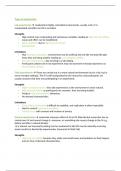
Lab experiments conducted in highly controlled environments, usually a lab. IV is
manipulated and effect on DV is recorded.
Strengths
- High control over confounding and extraneous variables, leading to high internal validity.
- Cause and effect can be established.
- Easily replicable due to high level of control.
- Standardised.
Limitations
- May lacks generalisability, environment may be artificial and not like everyday life ppts
know they are being studied, leading to low ecological validity.
- Demand characteristics due to being in a lab setting.
- Participants asked to be in lab experiment may not represent everyday experience so
low mundane realism.
Field experiments These are carried out in a more natural environment (not in a lab, but in
more everyday settings). The IV is still manipulated by the researcher and participants are
usually unaware that they are participating in an experiment.
Strengths
- Higher mundane realism than lab experiments as the environment is more natural.
- High external validity as participants are unaware, they are being studied.
- Produce valid and authentic behaviour.
- No demand characteristics.
Limitations
- Cause effect relationship is difficult to establish, and replication is often impossible.
- Hard to control extraneous variables.
- Ethical issues with consent and invasion of privacy
Natural experiments researcher measures effect of IV on DV (like lab) but researcher has no
control over IV and cannot change it, someone, or something else causes change in the IV e.g.,
before and after a natural disaster.
IV is natural, not necessarily setting (can be conducted in lab) DV may be naturally occurring
(exam results) or devised by experimenter (measured in field/ lab)
Strengths
- High external validity because they study real world issues and problems as they happen
and are free of demand characteristics.
Lab experiments conducted in highly controlled environments, usually a lab. IV is
manipulated and effect on DV is recorded.
Strengths
- High control over confounding and extraneous variables, leading to high internal validity.
- Cause and effect can be established.
- Easily replicable due to high level of control.
- Standardised.
Limitations
- May lacks generalisability, environment may be artificial and not like everyday life ppts
know they are being studied, leading to low ecological validity.
- Demand characteristics due to being in a lab setting.
- Participants asked to be in lab experiment may not represent everyday experience so
low mundane realism.
Field experiments These are carried out in a more natural environment (not in a lab, but in
more everyday settings). The IV is still manipulated by the researcher and participants are
usually unaware that they are participating in an experiment.
Strengths
- Higher mundane realism than lab experiments as the environment is more natural.
- High external validity as participants are unaware, they are being studied.
- Produce valid and authentic behaviour.
- No demand characteristics.
Limitations
- Cause effect relationship is difficult to establish, and replication is often impossible.
- Hard to control extraneous variables.
- Ethical issues with consent and invasion of privacy
Natural experiments researcher measures effect of IV on DV (like lab) but researcher has no
control over IV and cannot change it, someone, or something else causes change in the IV e.g.,
before and after a natural disaster.
IV is natural, not necessarily setting (can be conducted in lab) DV may be naturally occurring
(exam results) or devised by experimenter (measured in field/ lab)
Strengths
- High external validity because they study real world issues and problems as they happen
and are free of demand characteristics.


