Chapter 1 Introduction
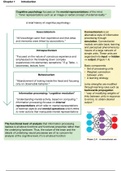
Cognitive psychology focuses on the mental representations of the mind.
• “Inner representations such as an image or verbal concept of external reality.”
A brief history of cognitive psychology:
Associationism Connectionism is an
alternative style of information
“All knowledge came from experience and that ideas processing through
and memories were linked by associations.” simulation. Connectionist
models simulate basic learning
and perceptual phenomena by
Introspectionism means of a large network of
simple units. These units are
“Focused on the nature of conscious experience and organized into input -> hidden
emphasized on the breaking down complex -> output. (Figure 1.4)
experiences into elementary sensations.” E.g: Table ->
brownness, texture, form Basic components
• Set of processing units
• Weighed connection
Behaviourism between units
• A learning strategy
“Abandonment of looking inside the head and focusing
only on observable behavior.” Links strengths are modified
through learning rules such as
backwards propagation
Information processing: “cognitive revolution” - “way of modifying weights of
links between units in response
“Understanding mental activity, based on computing.” to errors, to obtain desired
Information processing focuses on internal output.”
representations which refer to mental representations
of external objects and mental operations which refers
to inner actions that manipulate mental representations
The functional level of analysis that information processing
realizes is all about functions and functional properties rather than
the underlying hardware. Thus, the nature of the brain and the
details of underlying neural processes are of no concern for
analysis at the cognitive level, it’s is all about function
,Cognitive neuropsychology examines Functional imaging Structural imaging
the effects of brain damage on “Brain activity of time” “Static anatomy”
behaviour. Partly through brain imaging.
Several methods are being used to Electroencephalograph(EEG)
examine brain injury and it’s effects: Event-related potentials (ERP)
• Localization “Functional brain imaging method
“The view that specific mental functions showing waves of electrical activity.”
are tied to specific brain areas.
• Double dissociation Positron emission tomography
”When following a brain injury patient 1 (PET)
can do A but not B, patient 2 can do B
but not A. This indicates that A and B are “Functional imaging method which
doubly dissociated.” uses injection of radioactive substance
into blood stream and measuring brain
activity.”
The conclusions from imaging studies
are most of the time based on Functional magnetic resonance
deduction, called ‘reverse inference’. imaging (fMRI)
Although those conclusions are not
necessarily correct, they provide great
“Functional measuring brain activity
insight and generate new hypothesis.
trough oxygen levels of blood flow in
the brain. (BOLD-level)
,Chapter 2 Perception
The inverse problem refers to the problem of
perceiving and reconstructing information. Our
senses have limited capacities of perceiving
information, so some information about physical
properties get lost. In order to interact with the
physical world we have to reconstruct information.
E.g: “3D physical object -> 2D image retina
-> 3D inner representation physical object.”
The likelihood principle states that the likelihood
that an object or event will occur is important for
the perceptual processing of that object/event.
According to three components:
• Likelihood “Uncertainty in an image” We construct the world with Top-down
• Prior “Chances of perceiving certain image” and Bottom-up influences. The former is
• Decision-rule “Incentives perceiver” context driven, the latter data driven. As
seen below it is not one or the other, rather
E.g: Algorithm looking for cat images on internet: an interaction between the two.
High likelihood -> clear images E.g: “Perceiving facial expressions ->
High prior -> being on a cat-website inferring emotion -> further analyzing facial
Decision rule -> having enough time expressions.”
Result: high likelihood of finding cat image.
David Marr proposed an information processing
approach to the perceptual processing of vision.
The main question was, how could invariants
“regularities in visual world” lead to direct
perception “interpretation of the physical
property” He suggested that any information
processing device can be understood at three
levels.
First level - Computational theory
“What is the purpose of the computation?”
Second level - Choice of representation
“What representation is chosen with which
algorithm?”
Third level - Achieving the computations
“How can this chosen algorithm be realized?”
E.g: physically
, Below a general overview of the organization of perceptual systems.
Visual system Auditory system
Light falls on the retina and gets processed The encoding of auditory information starts in
by cones “neurons that extract color and the cochlea, this area contains nervous tissue
fine image detail” and rods “neurons that on which hair cells are located (basilar
extract motion and low-resolution” membrane) These hair cells move in response
to sound pressure and transduce vibration into
Afterwards signals are being send through a nervous signal sent along the auditory nerve
the thalumus to the visual cortex
The pitch of a sound is extracted depending
Further analysis are being done in two on what place the sound “falls” (Basiliar
streams, the ventral pathway “The what membrane). High frequency sounds are falling
stream that is involved in recognition of an on the base of cochlea and low frequency
object” and the dorsal pathway “The sounds on the apex of cochlea. The loudness
“where/how stream that is involved in of a sound is inferred through a high firing rate
locating and guiding how to use an object” of a nerve cell. Timbre is extracted out of
complex patterns of amplitude and frequency.
Some perceptual features like depth cues are
not exactly localized in the brain, thus, depth Aphasia is the inability to use verbal or written
cues must be combined to infer depth. (E.g: language
motion parallax, pictorial cues, stereo depth) Amusia is tone deafness, the deficit in
detecting fine-grained pitch changes.
However, recent evidence suggests that the Phonagnosia is the inability to recognize
dorsal pathway maybe can be subdivided in familiar voices
the control stream and planning stream
Cognitive psychology focuses on the mental representations of the mind.
• “Inner representations such as an image or verbal concept of external reality.”
A brief history of cognitive psychology:
Associationism Connectionism is an
alternative style of information
“All knowledge came from experience and that ideas processing through
and memories were linked by associations.” simulation. Connectionist
models simulate basic learning
and perceptual phenomena by
Introspectionism means of a large network of
simple units. These units are
“Focused on the nature of conscious experience and organized into input -> hidden
emphasized on the breaking down complex -> output. (Figure 1.4)
experiences into elementary sensations.” E.g: Table ->
brownness, texture, form Basic components
• Set of processing units
• Weighed connection
Behaviourism between units
• A learning strategy
“Abandonment of looking inside the head and focusing
only on observable behavior.” Links strengths are modified
through learning rules such as
backwards propagation
Information processing: “cognitive revolution” - “way of modifying weights of
links between units in response
“Understanding mental activity, based on computing.” to errors, to obtain desired
Information processing focuses on internal output.”
representations which refer to mental representations
of external objects and mental operations which refers
to inner actions that manipulate mental representations
The functional level of analysis that information processing
realizes is all about functions and functional properties rather than
the underlying hardware. Thus, the nature of the brain and the
details of underlying neural processes are of no concern for
analysis at the cognitive level, it’s is all about function
,Cognitive neuropsychology examines Functional imaging Structural imaging
the effects of brain damage on “Brain activity of time” “Static anatomy”
behaviour. Partly through brain imaging.
Several methods are being used to Electroencephalograph(EEG)
examine brain injury and it’s effects: Event-related potentials (ERP)
• Localization “Functional brain imaging method
“The view that specific mental functions showing waves of electrical activity.”
are tied to specific brain areas.
• Double dissociation Positron emission tomography
”When following a brain injury patient 1 (PET)
can do A but not B, patient 2 can do B
but not A. This indicates that A and B are “Functional imaging method which
doubly dissociated.” uses injection of radioactive substance
into blood stream and measuring brain
activity.”
The conclusions from imaging studies
are most of the time based on Functional magnetic resonance
deduction, called ‘reverse inference’. imaging (fMRI)
Although those conclusions are not
necessarily correct, they provide great
“Functional measuring brain activity
insight and generate new hypothesis.
trough oxygen levels of blood flow in
the brain. (BOLD-level)
,Chapter 2 Perception
The inverse problem refers to the problem of
perceiving and reconstructing information. Our
senses have limited capacities of perceiving
information, so some information about physical
properties get lost. In order to interact with the
physical world we have to reconstruct information.
E.g: “3D physical object -> 2D image retina
-> 3D inner representation physical object.”
The likelihood principle states that the likelihood
that an object or event will occur is important for
the perceptual processing of that object/event.
According to three components:
• Likelihood “Uncertainty in an image” We construct the world with Top-down
• Prior “Chances of perceiving certain image” and Bottom-up influences. The former is
• Decision-rule “Incentives perceiver” context driven, the latter data driven. As
seen below it is not one or the other, rather
E.g: Algorithm looking for cat images on internet: an interaction between the two.
High likelihood -> clear images E.g: “Perceiving facial expressions ->
High prior -> being on a cat-website inferring emotion -> further analyzing facial
Decision rule -> having enough time expressions.”
Result: high likelihood of finding cat image.
David Marr proposed an information processing
approach to the perceptual processing of vision.
The main question was, how could invariants
“regularities in visual world” lead to direct
perception “interpretation of the physical
property” He suggested that any information
processing device can be understood at three
levels.
First level - Computational theory
“What is the purpose of the computation?”
Second level - Choice of representation
“What representation is chosen with which
algorithm?”
Third level - Achieving the computations
“How can this chosen algorithm be realized?”
E.g: physically
, Below a general overview of the organization of perceptual systems.
Visual system Auditory system
Light falls on the retina and gets processed The encoding of auditory information starts in
by cones “neurons that extract color and the cochlea, this area contains nervous tissue
fine image detail” and rods “neurons that on which hair cells are located (basilar
extract motion and low-resolution” membrane) These hair cells move in response
to sound pressure and transduce vibration into
Afterwards signals are being send through a nervous signal sent along the auditory nerve
the thalumus to the visual cortex
The pitch of a sound is extracted depending
Further analysis are being done in two on what place the sound “falls” (Basiliar
streams, the ventral pathway “The what membrane). High frequency sounds are falling
stream that is involved in recognition of an on the base of cochlea and low frequency
object” and the dorsal pathway “The sounds on the apex of cochlea. The loudness
“where/how stream that is involved in of a sound is inferred through a high firing rate
locating and guiding how to use an object” of a nerve cell. Timbre is extracted out of
complex patterns of amplitude and frequency.
Some perceptual features like depth cues are
not exactly localized in the brain, thus, depth Aphasia is the inability to use verbal or written
cues must be combined to infer depth. (E.g: language
motion parallax, pictorial cues, stereo depth) Amusia is tone deafness, the deficit in
detecting fine-grained pitch changes.
However, recent evidence suggests that the Phonagnosia is the inability to recognize
dorsal pathway maybe can be subdivided in familiar voices
the control stream and planning stream