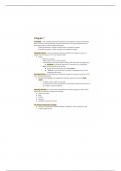
Chapter 1
Accounting- is the recording of business transactions, the preparation of reports summarizing
these transactions, and the analyzing of financial information. The reports prepared from the
accounting system are called <financial statements=
- Financial statements- available to people inside or outside the company
- Financial accounting- available to people only outside the company
Financing activities- are those transactions that raise funds for the company to operate or
expand. Can raise money by two ways: Equity & Debt
● Equity:
○ Refers to ownership
○ When it sells a stock, it sells ownership
○ Can benefit by receiving dividends or selling stock in the future at a higher price.
■ Dividends are payments made from a corporation to its stockholders.
○ Debt- borrowing money from investors
■ People who loan the money are called creditors
■ <Interest= is the amount that the creditor is charging the borrower for
loaning them the money.
Investing activities- are the transactions in which the company is investing in assets that it will
use in its business operations.
● Purchase land, buildings, and equipment to help them operate the business.( Fixed
Assets)
○ (1) likely to last a number of years and
○ (2) expected to be used in the operations of the business rather than sold as part of
the company’s general operations.
Operating activities- are all of the other transactions that a business engages in which cannot
specifically be classified as financing or investing.
● salaries and wages
● Rent
● Utilities
● Insurance
● purchases of goods to be resold.
The Setting of Financial Accounting:
● Securities and Exchange Commission(SER)- established in 1934, maintains fair and
truthful capital markets.
, ○ The SEC requires corporations to file a <Form 10K= annually (audited financial
report) and a <Form 10 Q= quarterly (unaudited financial reports covering the
most current quarter).
● SEC requires an Annual Report-which must be audited by an outside, independent
auditor.
○ (1) balance sheet,
○ (2) income statement
○ (3) statement of stockholders’ equity (or statement of retained earnings)
○ (4) statement of cash flows.
● Auditors are independent if they
○ (1) are not employees of the company they are auditing and
○ (2) do not own a substantial investment in this company.
Internal Auditors:
● These auditors are employed by the company, and they audit departments within the
company.
● The term <corporate governance= refers to the mechanisms in place within a company
which inspire managers to report the truth in their financial statements
○ Good reputation
○ threat of legal liability
○ Ethics
Generally Accepted Accounting Principles (GAAP)- gives direction on how to account for
both common and uncommon transactions of companies.
● Formally used in the USA since the formation of SEC
● <Rule-based system=
● GAAP is the responsibility of an organization called the <Financial Accounting Standards
Board= (<FASB=). When the Board makes a change to the standards, it does so only after
receiving input from anyone who might be interested
Conceptual Framework:
● The main objective of the Conceptual Framework is: "To provide financial information
about the reporting entity that is useful to existing and potential investors, lenders, and
other creditors in making decisions about providing resources to the entity."
● Two fundamentals
○ 1) relevance
○ 2) faithful representation
● qualitative characteristics to further enhance usefulness of financial information:
comparability, verifiability, timelines, and understandability
Accounting- is the recording of business transactions, the preparation of reports summarizing
these transactions, and the analyzing of financial information. The reports prepared from the
accounting system are called <financial statements=
- Financial statements- available to people inside or outside the company
- Financial accounting- available to people only outside the company
Financing activities- are those transactions that raise funds for the company to operate or
expand. Can raise money by two ways: Equity & Debt
● Equity:
○ Refers to ownership
○ When it sells a stock, it sells ownership
○ Can benefit by receiving dividends or selling stock in the future at a higher price.
■ Dividends are payments made from a corporation to its stockholders.
○ Debt- borrowing money from investors
■ People who loan the money are called creditors
■ <Interest= is the amount that the creditor is charging the borrower for
loaning them the money.
Investing activities- are the transactions in which the company is investing in assets that it will
use in its business operations.
● Purchase land, buildings, and equipment to help them operate the business.( Fixed
Assets)
○ (1) likely to last a number of years and
○ (2) expected to be used in the operations of the business rather than sold as part of
the company’s general operations.
Operating activities- are all of the other transactions that a business engages in which cannot
specifically be classified as financing or investing.
● salaries and wages
● Rent
● Utilities
● Insurance
● purchases of goods to be resold.
The Setting of Financial Accounting:
● Securities and Exchange Commission(SER)- established in 1934, maintains fair and
truthful capital markets.
, ○ The SEC requires corporations to file a <Form 10K= annually (audited financial
report) and a <Form 10 Q= quarterly (unaudited financial reports covering the
most current quarter).
● SEC requires an Annual Report-which must be audited by an outside, independent
auditor.
○ (1) balance sheet,
○ (2) income statement
○ (3) statement of stockholders’ equity (or statement of retained earnings)
○ (4) statement of cash flows.
● Auditors are independent if they
○ (1) are not employees of the company they are auditing and
○ (2) do not own a substantial investment in this company.
Internal Auditors:
● These auditors are employed by the company, and they audit departments within the
company.
● The term <corporate governance= refers to the mechanisms in place within a company
which inspire managers to report the truth in their financial statements
○ Good reputation
○ threat of legal liability
○ Ethics
Generally Accepted Accounting Principles (GAAP)- gives direction on how to account for
both common and uncommon transactions of companies.
● Formally used in the USA since the formation of SEC
● <Rule-based system=
● GAAP is the responsibility of an organization called the <Financial Accounting Standards
Board= (<FASB=). When the Board makes a change to the standards, it does so only after
receiving input from anyone who might be interested
Conceptual Framework:
● The main objective of the Conceptual Framework is: "To provide financial information
about the reporting entity that is useful to existing and potential investors, lenders, and
other creditors in making decisions about providing resources to the entity."
● Two fundamentals
○ 1) relevance
○ 2) faithful representation
● qualitative characteristics to further enhance usefulness of financial information:
comparability, verifiability, timelines, and understandability