

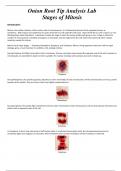
Onion Root Tip Analysis Lab
Stages of Mitosis
Introduction:
Mitosis, also called is division of the nucleus and its chromosomes. It is followed by division of the cytoplasm known as
cytokinesis. Both mitosis and cytokinesis are parts of the life of a cell called the Cell Cycle. Most of the life of a cell is spent in a non-
dividing phase called Interphase. Interphase includes G1 stage in which the newly divided cells grow in size, S stage in which the
number of chromosomes is doubled and appear as chromatin, and G2 stage where the cell makes the enzymes & other cellular
materials needed for mitosis.
Mitosis has 4 major stages --- Prophase, Metaphase, Anaphase, and Telophase. When a living organism needs new cells to repair
damage, grow, or just maintain its condition, cells undergo mitosis.
During Prophase, the DNA and proteins start to condense. The two centrioles move toward the opposite end of the cell in animals or
microtubules are assembled in plants to form a spindle. The nuclear envelope and nucleolus also start to break up.
Prophase
During Metaphase, the spindle apparatus attaches to sister chromatids of each chromosome. All the chromosomes are line up at the
equator of the spindle. They are now in their most tightly condensed form.
Metaphase
During Anaphase, the spindle fibers attached to the two sister chromatids of each chromosome contract and separate chromosomes
which move to opposite poles of the cell.
Anaphase
In Telophase, as the 2 new cells pinch in half (animal cells) or a cell plate forms (plant cells), the chromosomes become less
condensed again and reappear as chromatin. New membrane forms nuclear envelopes and the nucleolus is reformed.
Telophase
Stages of Mitosis
Introduction:
Mitosis, also called is division of the nucleus and its chromosomes. It is followed by division of the cytoplasm known as
cytokinesis. Both mitosis and cytokinesis are parts of the life of a cell called the Cell Cycle. Most of the life of a cell is spent in a non-
dividing phase called Interphase. Interphase includes G1 stage in which the newly divided cells grow in size, S stage in which the
number of chromosomes is doubled and appear as chromatin, and G2 stage where the cell makes the enzymes & other cellular
materials needed for mitosis.
Mitosis has 4 major stages --- Prophase, Metaphase, Anaphase, and Telophase. When a living organism needs new cells to repair
damage, grow, or just maintain its condition, cells undergo mitosis.
During Prophase, the DNA and proteins start to condense. The two centrioles move toward the opposite end of the cell in animals or
microtubules are assembled in plants to form a spindle. The nuclear envelope and nucleolus also start to break up.
Prophase
During Metaphase, the spindle apparatus attaches to sister chromatids of each chromosome. All the chromosomes are line up at the
equator of the spindle. They are now in their most tightly condensed form.
Metaphase
During Anaphase, the spindle fibers attached to the two sister chromatids of each chromosome contract and separate chromosomes
which move to opposite poles of the cell.
Anaphase
In Telophase, as the 2 new cells pinch in half (animal cells) or a cell plate forms (plant cells), the chromosomes become less
condensed again and reappear as chromatin. New membrane forms nuclear envelopes and the nucleolus is reformed.
Telophase


