

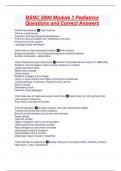
BSNC 5000 Module 1 Pediatrics
Questions and Correct Answers
Infants Neurological ✅Open sutures
Thinner cranial bones
Cognition and psychological development
Prone to injury as babies can't withdrawal from pain
Immature nervous system
Language under developed
Infant risks to due neurological factors ✅Brain injuries
Bulging fontanelles = incr intracranial pressure (cerebral edema)
Sunken fontanelles = dehydration
Infant Head-ears-eyes-nose-throat ✅Anterior Fontenelle still not fused (12-18Months)
Posterior may be fused or open (usually closes by 2 months)
Large and heavy head
Weak neck muscles
Large tongue
Epiglottis is floppy and U shape
Larynx is more anterior and higher (2nd and 3rd vertebrae)
Cricoid cartilage is narrower, trachea is like a funnel
Short Trachea
Developing vision
Narrower nasal passages
Infant risks due to Head-ears-eyes-nose-throat ✅Head injury as it will go down first
Less control of head too
Poor vision until about 6 months
Infant Respiratory ✅As baby matures resp rate will become regular
Trachea and chest wall more compliant
Bronchi and bronchioles are shorter and narrower
Fewer alveoli
Tidal Vol smaller
Higher metabolic rater & O2 consumption
Chest wall thinner and thorax smaller
Ribs cartilaginous and more horizontal
Intercoastal muscles immature
Nose breather till 3-4 months
Diaphragm major muscle in breathing
Infant risk due to respiratory ✅Airway obstructions (foreign bodies, swelling, tongue)
High larynx = decr visualization
, Cartilaginous airway makes it easier to collapse and obstruct
If stomach full, decr the diaphragm to contract
Inspiration lungs only move up (no out)
Shorter trachea can dislodge the endotracheal tube
Difficult to locate sounds on auscultation
Infant Cardiovascular ✅Peripheral capillaries closer to surface
Slow response to vasoconstriction
More surface area
Higher circulating Blood vol
Incr TBW
Stroke vol limited
More subcutaneous fat
Incr Cardiac output
Myocardium fibers are shorter and elastic
Infant risk due to cardiovascular ✅Any blood loss can be significant
Systemic vascular resistance incr as child grows
Limited SV means HR must incr to incr cardiac output
Hard to get vascular access
More susceptible to heat loss and insensible loses
Infant GI ✅Thinner abdominal wall
Pyloric sphincter and esophageal sphincter loos
Liver is immature (poorer gluconeogenesis)
High metabolic demand
Fast motility
Organs proportions and placement (liver, spleen, bladder)
Infant risk due to GI ✅Less muscles and subcutaneous fat = less protection for organs
(spleen, liver)
Spleen and liver sit below ribs
= incr risk for injury
Hypoglycemia (dbl glucose demands, and poor gluconeogenesis)
Infant GU ✅Faster motility
High ECF vol
Renal structure immature
Bladder location intraabdominal
Immature kidneys
Infant risk due to GU ✅Risk for bladder injury
Prone to dehydration (faster resp, higher surface area)
Smaller bladder = more peeing
Questions and Correct Answers
Infants Neurological ✅Open sutures
Thinner cranial bones
Cognition and psychological development
Prone to injury as babies can't withdrawal from pain
Immature nervous system
Language under developed
Infant risks to due neurological factors ✅Brain injuries
Bulging fontanelles = incr intracranial pressure (cerebral edema)
Sunken fontanelles = dehydration
Infant Head-ears-eyes-nose-throat ✅Anterior Fontenelle still not fused (12-18Months)
Posterior may be fused or open (usually closes by 2 months)
Large and heavy head
Weak neck muscles
Large tongue
Epiglottis is floppy and U shape
Larynx is more anterior and higher (2nd and 3rd vertebrae)
Cricoid cartilage is narrower, trachea is like a funnel
Short Trachea
Developing vision
Narrower nasal passages
Infant risks due to Head-ears-eyes-nose-throat ✅Head injury as it will go down first
Less control of head too
Poor vision until about 6 months
Infant Respiratory ✅As baby matures resp rate will become regular
Trachea and chest wall more compliant
Bronchi and bronchioles are shorter and narrower
Fewer alveoli
Tidal Vol smaller
Higher metabolic rater & O2 consumption
Chest wall thinner and thorax smaller
Ribs cartilaginous and more horizontal
Intercoastal muscles immature
Nose breather till 3-4 months
Diaphragm major muscle in breathing
Infant risk due to respiratory ✅Airway obstructions (foreign bodies, swelling, tongue)
High larynx = decr visualization
, Cartilaginous airway makes it easier to collapse and obstruct
If stomach full, decr the diaphragm to contract
Inspiration lungs only move up (no out)
Shorter trachea can dislodge the endotracheal tube
Difficult to locate sounds on auscultation
Infant Cardiovascular ✅Peripheral capillaries closer to surface
Slow response to vasoconstriction
More surface area
Higher circulating Blood vol
Incr TBW
Stroke vol limited
More subcutaneous fat
Incr Cardiac output
Myocardium fibers are shorter and elastic
Infant risk due to cardiovascular ✅Any blood loss can be significant
Systemic vascular resistance incr as child grows
Limited SV means HR must incr to incr cardiac output
Hard to get vascular access
More susceptible to heat loss and insensible loses
Infant GI ✅Thinner abdominal wall
Pyloric sphincter and esophageal sphincter loos
Liver is immature (poorer gluconeogenesis)
High metabolic demand
Fast motility
Organs proportions and placement (liver, spleen, bladder)
Infant risk due to GI ✅Less muscles and subcutaneous fat = less protection for organs
(spleen, liver)
Spleen and liver sit below ribs
= incr risk for injury
Hypoglycemia (dbl glucose demands, and poor gluconeogenesis)
Infant GU ✅Faster motility
High ECF vol
Renal structure immature
Bladder location intraabdominal
Immature kidneys
Infant risk due to GU ✅Risk for bladder injury
Prone to dehydration (faster resp, higher surface area)
Smaller bladder = more peeing


