

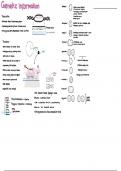
Genetic information prophase I I(S
((
<7)
·
·
nuclear envelop disolves
chromosomes condense
·
homologous chromosomes pair
bivalents
forming
m
Transcription · chiasmata occur
·
DNA helicase breaks It bonds
exposing bases
-
s
·
spindle forms
metaphase I ↳ bivalents line up on metaphase plate
template independent assortment
complimentary base
pairing (H bonds) to strand
·
·
· RNA
polymerase forms phosphodiester bonds > -
pre-mRNA ATCGTAGCA TemplateStrandsend anaphase I EiY
in-
1
x(
-
-
·
homologous chromosomes pulled to poles
at chiasmata-recombinant
·
exchange
chromatids
Translation !
telophase
romosomes
J uncl forms
&
·
leaves nucleus via nuclear pores
·
undergoes splicing removing introns
splicing
-
mRNA Cytokinesis
i
·
mRWA binds to ribosome
↓
& similar to mitosis which
ribosome reads first codon and binds it to prophase 11
in
·
V
complimentary tRNA anticodon
⑳
produces somatic cells
⑳
·
tRNA has specific amino acid , ribosome
⑳
⑧ S3 metaphasell
i containing 23 pairs of
↑
53 S 3 Not
Hydrogen
n
~
continues reading codons and adjacent homologous chromosomes
Sabad L
ii)
VAGGC AU CGU A A
amino acids form peptide bonds T anaphase /1
-
tRNA released
GC
·
polypeptide chain released
&
telophase
-
DNA helicase breaks
hydrogen bonds
Domain
Artificial classification-
betwee
n nucleotide bases
cytoynesis I 3 gamdid
has
!
Kingdom
>
objective
Phylum free nucleotides bind to
complimentary
Phylogenic classification > evolutionary
-
asser bases on the template strand
.
naming :
Famia
l
s genus , Species -
DNA
polymerase forms these phosphodiester bonds
((
<7)
·
·
nuclear envelop disolves
chromosomes condense
·
homologous chromosomes pair
bivalents
forming
m
Transcription · chiasmata occur
·
DNA helicase breaks It bonds
exposing bases
-
s
·
spindle forms
metaphase I ↳ bivalents line up on metaphase plate
template independent assortment
complimentary base
pairing (H bonds) to strand
·
·
· RNA
polymerase forms phosphodiester bonds > -
pre-mRNA ATCGTAGCA TemplateStrandsend anaphase I EiY
in-
1
x(
-
-
·
homologous chromosomes pulled to poles
at chiasmata-recombinant
·
exchange
chromatids
Translation !
telophase
romosomes
J uncl forms
&
·
leaves nucleus via nuclear pores
·
undergoes splicing removing introns
splicing
-
mRNA Cytokinesis
i
·
mRWA binds to ribosome
↓
& similar to mitosis which
ribosome reads first codon and binds it to prophase 11
in
·
V
complimentary tRNA anticodon
⑳
produces somatic cells
⑳
·
tRNA has specific amino acid , ribosome
⑳
⑧ S3 metaphasell
i containing 23 pairs of
↑
53 S 3 Not
Hydrogen
n
~
continues reading codons and adjacent homologous chromosomes
Sabad L
ii)
VAGGC AU CGU A A
amino acids form peptide bonds T anaphase /1
-
tRNA released
GC
·
polypeptide chain released
&
telophase
-
DNA helicase breaks
hydrogen bonds
Domain
Artificial classification-
betwee
n nucleotide bases
cytoynesis I 3 gamdid
has
!
Kingdom
>
objective
Phylum free nucleotides bind to
complimentary
Phylogenic classification > evolutionary
-
asser bases on the template strand
.
naming :
Famia
l
s genus , Species -
DNA
polymerase forms these phosphodiester bonds


