100% satisfaction guarantee Immediately available after payment Both online and in PDF No strings attached 4.2 TrustPilot
logo-home
Exam (elaborations)

AVIXA CTS-D: Human Perception of Sound (Questions & Answers) Rated 100%

Rating
-
Sold
-
Pages
7
Grade
A+
Uploaded on
25-08-2024
Written in
2024/2025

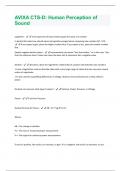
Logarithm - is the exponent of base 10 that equals the value of a number In decibel formulas how should values be logically arranged when comparing two numbers (V1 / V2) - If you expect a gain, place the higher number first. If you expect a loss, place the smaller number first. Explain negative decibel values - measurement just means "less than before," or in this case, "less than the reference level. It does not mean the basic unit it represents has a negative value Decibel - describes a base-ten logarithmic relationship of a power ratio between two numbers. -It uses a logarithmic scale to describe ratios with a very large range of values that can vary over several orders of magnitude. -It is also used for quantifying differences in voltage, distance and sound pressure as they relate to power. Decibels can measure what type of values? - Distance, Power, Pressure, or Voltage Pascal - SI Unit for Pressure Decibel Formula for Power - dB = 10 * log (P1 / Pr) Where: dB = The change in decibels P1 = The new or measured power measurement Pr = The original or reference power measurement if result is positive, the result is an increase, or gain. If it is negative, the result is a decrease, or loss.Decibel Formula for Distance - dB = 20 * log (D1 / D2) Where: dB = The change in decibels D1 = The original or reference distance D2 = The new or measured distance This as the same as: db= 10 * log (D1²/D²) Decibel Formula for Voltage - dB = 20 * log (V1 / Vr) Where: dB = The change in decibels V1 = The new or measured voltage Vr = The original or reference voltage db = 10 * log (V1²/V2²) Reference Level Sound Pressure: 0 dB SPL in Pascals - .00002 Pa / 2x10^-5 Pa / .02 mPa @ 1kHz Reference Level Voltage (Consumer Electronics): 0dBV in Volts - 1 V Reference Level Voltage (pro AV): 0 dBu in Volts - 0.775 VReference Level Power: 0 dBW in Watts - 1W Reference Level Power: 0 dBM in milliwatts - 1 mW / .001W Hearing Damage Threshold in dB - 120 - 140 dB Pro-Audio line level in dBu and volts - +4dBu and 1.23 Volts Consumer Line Level in dBV and milllivolts - -10dBV, 316 mV Threshold of human hearing - 0dB SPL @ 1kHZ, 20micropascals Sound Pressure Level (SPL) - Is a measurement of all the acoustic energy present in an environment. It is typically expressed in decibels. refers to that variation of level above and below ambient atmospheric pressure and is referenced to 20 µPa or 0.0000204 dynes/cm2, the threshold of human hearing. Sound Pressure - refers to the pressure deviation from the ambient atmospheric pressure caused by the vibration of air particles SPL Meter - Gives a single number measurement of the sound pressure at the measurement location. Class 0 SPL Meter - lab reference standard. It has the strictest tolerances and is used when extreme precision is neededClass 1 SPL Meter - is precision measurement. It is useful for taking flat, engineering-grade accuracy measurements instead of wide-range or field measurements Class 2 SPL Meter - is for general purpose. It has the widest tolerances with respect to level linearity and frequency response. Commonly used in AV measurements Class 3 SPL Meter - is intended for noise surveys. It is a simple sound level meter meant to determine if a noise problem exists. If a problem does exist, diagnosing it will require a higher class meter. A-Weighting on SPL Meter - Setting commonly used for environmental, hearing conservation and noise ordinance enforcement. Closely reflects the response of the human ear to noise and its insensitivity to lower frequencies at lower listening levels. C-Weighting on SPL Meter - More uniform response over the entire frequency range. Z-Weighting (0/Flat) on SPL Meter - unweighted setting (no filtering/compensation). SPL Meter: Fast response setting - To capture transient (momentary) levels. SPL Meter: Slow response setting - Similar to how your ears react. For more consistent noise levels or for averaging rapidly changing fluctuations in levels. SPL Meter performance response Standard: IEC - standard relates to frontal incidence correction the microphone have to be oriented directly on axis with the noise source SPL Meter performance response standard: US: ANSI - standard relates to random incidence correction the microphone can be off-axis up to a certain pointWeighting Curve Chart - depicts Frequency (Hz on X) and Gain (in dB on Y) to chart how different frequency response measure by a SPL meter

Show more Read less
Institution
AVIXA CTS-D: Human Perception Of Sound
Course
AVIXA CTS-D: Human Perception of Sound


Whoops! We can’t load your doc right now. Try again or contact support.

Written for

Institution
AVIXA CTS-D: Human Perception of Sound
Course
AVIXA CTS-D: Human Perception of Sound

Document information

Uploaded on
August 25, 2024
Number of pages
7
Written in
2024/2025
Type
Exam (elaborations)
Contains
Questions & answers

Subjects

Content preview

AVIXA CTS-D: Human Perception of
Sound

Logarithm - is the exponent of base 10 that equals the value of a number

In decibel formulas how should values be logically arranged when comparing two numbers (V1 / V2) -
If you expect a gain, place the higher number first. If you expect a loss, place the smaller number
first.

Explain negative decibel values - measurement just means "less than before," or in this case, "less
than the reference level. It does not mean the basic unit it represents has a negative value


Decibel - describes a base-ten logarithmic relationship of a power ratio between two numbers.

-It uses a logarithmic scale to describe ratios with a very large range of values that can vary over several
orders of magnitude.

-It is also used for quantifying differences in voltage, distance and sound pressure as they relate to
power.


Decibels can measure what type of values? - Distance, Power, Pressure, or Voltage


Pascal - SI Unit for Pressure


Decibel Formula for Power - dB = 10 * log (P1 / Pr)


Where:


dB = The change in decibels

P1 = The new or measured power measurement

Pr = The original or reference power measurement


if result is positive, the result is an increase, or gain. If it is negative, the result is a decrease, or loss.

, Decibel Formula for Distance - dB = 20 * log (D1 / D2)


Where:


dB = The change in decibels

D1 = The original or reference distance

D2 = The new or measured distance


This as the same as:

db= 10 * log (D1²/D²)


Decibel Formula for Voltage - dB = 20 * log (V1 / Vr)


Where:


dB = The change in decibels

V1 = The new or measured voltage

Vr = The original or reference voltage


db = 10 * log (V1²/V2²)


Reference Level Sound Pressure: 0 dB SPL in Pascals - .00002 Pa / 2x10^-5 Pa / .02 mPa @ 1kHz


Reference Level Voltage (Consumer Electronics): 0dBV in Volts - 1V


Reference Level Voltage (pro AV): 0 dBu in Volts - 0.775 V

Get to know the seller

Seller avatar
Reputation scores are based on the amount of documents a seller has sold for a fee and the reviews they have received for those documents. There are three levels: Bronze, Silver and Gold. The better the reputation, the more your can rely on the quality of the sellers work.
PatrickKaylian Delaware State University
View profile
Follow You need to be logged in order to follow users or courses
Sold
1821
Member since
2 year
Number of followers
1044
Documents
22126
Last sold
10 hours ago

3.8

317 reviews

5
147
4
60
3
54
2
16
1
40

Recently viewed by you

Why students choose Stuvia

Created by fellow students, verified by reviews

Quality you can trust: written by students who passed their tests and reviewed by others who've used these notes.

Didn't get what you expected? Choose another document

No worries! You can instantly pick a different document that better fits what you're looking for.

Pay as you like, start learning right away

No subscription, no commitments. Pay the way you're used to via credit card and download your PDF document instantly.

Student with book image

“Bought, downloaded, and aced it. It really can be that simple.”

Alisha Student

Frequently asked questions