
Introduction to Computers with Verified Answers
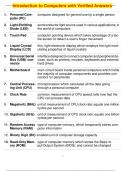
1. Personal Com- computer designed for general use by a single person
puter (PC)
2. Light-Emitting semiconductor light source used in various applications; in
Diode (LED) the world of computers
3. Touch Pad computer pointing device which takes advantage of a tac-
tile sensor to detect a user's finger movement
4. Liquid Crystal thin, light electronic display which employs the light mod-
Display (LCD) ulating properties of liquid crystals
5. Universal Serial interface designed to connect computer and peripheral de-
Bus (USB) con- vices, such as printers, mouses, keyboards and external
nector hard drives
6. Motherboard main circuit board inside personal computers which holds
the majority of computer components and provides con-
nectors for peripherals
7. Central Process- microprocessor which calculates all the data going
ing Unit (CPU) through a personal computer
8. Clock Rate common measurement of CPU speed; tells how fast the
CPU can process data
9. Megahertz (MHz) unit of measurement of CPU clock rate; equals one million
cycles per second
10. Gigahertz (GHz) unit of measurement of CPU clock rate; equals one billion
cycles per second.
11. Random Access type of computer memory, which temporarily stores com-
Memory (RAM) puter information
12. Binary Digit (Bit) smallest unit of computer storage capacity
13. Read-Only Mem- type of computer memory which stores the Basic In-
ory (ROM) put/Output System (BIOS); and cannot be changed
1/4
1. Personal Com- computer designed for general use by a single person
puter (PC)
2. Light-Emitting semiconductor light source used in various applications; in
Diode (LED) the world of computers
3. Touch Pad computer pointing device which takes advantage of a tac-
tile sensor to detect a user's finger movement
4. Liquid Crystal thin, light electronic display which employs the light mod-
Display (LCD) ulating properties of liquid crystals
5. Universal Serial interface designed to connect computer and peripheral de-
Bus (USB) con- vices, such as printers, mouses, keyboards and external
nector hard drives
6. Motherboard main circuit board inside personal computers which holds
the majority of computer components and provides con-
nectors for peripherals
7. Central Process- microprocessor which calculates all the data going
ing Unit (CPU) through a personal computer
8. Clock Rate common measurement of CPU speed; tells how fast the
CPU can process data
9. Megahertz (MHz) unit of measurement of CPU clock rate; equals one million
cycles per second
10. Gigahertz (GHz) unit of measurement of CPU clock rate; equals one billion
cycles per second.
11. Random Access type of computer memory, which temporarily stores com-
Memory (RAM) puter information
12. Binary Digit (Bit) smallest unit of computer storage capacity
13. Read-Only Mem- type of computer memory which stores the Basic In-
ory (ROM) put/Output System (BIOS); and cannot be changed
1/4


