

Written by students who passed Immediately available after payment Read online or as PDF Wrong document? Swap it for free 4.6 TrustPilot
logo-home
Document preview thumbnail
Preview 1 out of 3 pages
Exam (elaborations)

CSCI 2467 - Exam (CSCC Ver. Study Guide) Questions And Answers Rated A+ New Update Assured Satisfaction

Document preview thumbnail
Preview 1 out of 3 pages

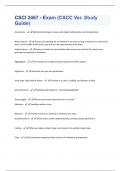
Association - Relationship between classes and objects (Abstraction and Composition) Binary Search - Process of searching for an element in an array as long as they are in order and it starts in the middle of the array, uses that as a key and searches from there. ActionListener - Source on which an event (action that occurs as a result of the user) occurs, generates a response to the event. Aggregation - The concept of an object being composed of other objects. Argument - Data that you pass into parameters. Array Data Type Default Values - Primitive is 0, char is /u0000, and boolean is false. Array Structure - DataType[ ]ArrayName = new DataType[index]; Array.Length - Returns how many subscripts are in an array. Attribute - Variables within a class. Behavior - Another name for a method in reference to a Class Break/Continue - Break ends a switch statement/loop, continue jumps back into it. Casting - When you take an object type, and convert it to another object type. Class - Self contained component that consists of methods and properties.Constructor - Initializes instances (objects) of that class. Encapsulation - Grouping objects along with their attributes and methods into a class extends - Creates a subclass of the base (parent) class. Abstraction - Process of hiding implementation (enforcing inheritance) details from the user. final - Makes a variable's value unchangeable. Functions - Equation that occurs within a method, has a return value. What are the three ways to copy an array? - 1. Use a loop 2. Use static array copy method 3. Use the clone method Identifiers - Names of variables, methods, classes, packages, and interfaces. Instantiation - Creating an object (data that has a storage location). Object - Combination of data and methods, it has a state and behavior, created from classes. Reference - When passing an argument/array you use the class or array as a parameter. Wrapper Class - Class whose object contains a primitive data type, converts primitive data types into objects. (EX:double example = printDouble) Static - Allows variable to be accessed before any objects of its class are created, and without any reference to any object. this. - Allows variables not in methods to act like they are in a method

Content preview

CSCI 2467 - Exam (CSCC Ver. Study
Guide)
Association - Relationship between classes and objects (Abstraction and Composition)


Binary Search - Process of searching for an element in an array as long as they are in order and it
starts in the middle of the array, uses that as a key and searches from there.

ActionListener - Source on which an event (action that occurs as a result of the user) occurs,
generates a response to the event.


Aggregation - The concept of an object being composed of other objects.


Argument - Data that you pass into parameters.


Array Data Type Default Values - Primitive is 0, char is /u0000, and boolean is false.


Array Structure - DataType[ ]ArrayName = new DataType[index];


Array.Length - Returns how many subscripts are in an array.

Attribute - Variables within a class.


Behavior - Another name for a method in reference to a Class

Break/Continue - Break ends a switch statement/loop, continue jumps back into it.


Casting - When you take an object type, and convert it to another object type.


Class - Self contained component that consists of methods and properties.

Document information

Uploaded on
August 21, 2024
Number of pages
3
Written in
2024/2025
Type
Exam (elaborations)
Contains
Questions & answers
$8.49

Wrong document? Swap it for free Within 14 days of purchase and before downloading, you can choose a different document. You can simply spend the amount again.
Written by students who passed
Immediately available after payment
Read online or as PDF

Seller avatar
Reputation scores are based on the amount of documents a seller has sold for a fee and the reviews they have received for those documents. There are three levels: Bronze, Silver and Gold. The better the reputation, the more your can rely on the quality of the sellers work.
Brainarium
3.8
(336)
Sold
2019
Followers
1047
Items
24138
Last sold
14 hours ago


Why students choose Stuvia

Created by fellow students, verified by reviews

Quality you can trust: written by students who passed their tests and reviewed by others who've used these notes.

Didn't get what you expected? Choose another document

No worries! You can instantly pick a different document that better fits what you're looking for.

Pay as you like, start learning right away

No subscription, no commitments. Pay the way you're used to via credit card and download your PDF document instantly.

Student with book image

“Bought, downloaded, and aced it. It really can be that simple.”

Alisha Student

Working on your references?

Create accurate citations in APA, MLA and Harvard with our free citation generator.

Working on your references?

Frequently asked questions

