
• Wrong document? Swap it for free
  • Written by students who passed
  • Immediately available after payment
  • Read online or as PDF
Sell
Where do you study
Your language
Document preview thumbnail
Preview 1 out of 4 pages
Exam (elaborations)

Biology 1320 Lab 6: Homeostasis Questions With Correct Solutions, Already Passed!!

Document preview thumbnail
Preview 1 out of 4 pages

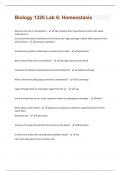
What are cells role in homeostasis? - Take nutrients from tissue fluid and return their waste molecules to it. surround the thin tissue membranes of the alveoli; site of gas exchange in blood. (Rich network of tiny blood vessels) - pulmonary capillaries A tendency to maintain a balanced or constant internal state - Homeostasis What is tissue fluids role in homeostasis? - Exchange molecules with blood movement of substances between blood and interstitial fluid - capillary exchange What is the primary thing lungs contribute to homeostasis? - Gas exchange organs through which an animal gets oxygen from the air. - Lung any of the many tiny air sacs of the lungs which allow for rapid gaseous exchange. - Alvioli What makes up the alveoli? - Single layer of squamous epithelium supported by mesh of fine elastic fibers Red blood cells - Erythrocytes Airways in the lungs that lead from the bronchi to the alveoli. - Bronchioles Is blood more acidic when carrying carbon dioxide? Explain - Yes CO2 reacts with water to form carbonic acidIs blood less acidic when the carbon dioxide exits? - Yes H+ are recombined to make H2CO3 What is the secondary thing lungs contribute to homeostasis? - Regulation of blood pH Produces bile - Liver Which love of the liver is bigger, left or right? - Right liver cells - hepatic cells the vein that collects blood from the liver and returns it to the heart - hepatic vein Blood vessel that transports O2- rich blood to the liver - branch of hepatic artery Blood vessel that transports blood containing nutrients from the intestine to the liver - branch of hepatic portal vein A tube that carries bile from the liver and gallbladder to the intestine - bile duct Primary way liver contributes to homeostasis? - Removal of toxic amino groups Secondary way the liver contributes to homeostasis. - Controls glucose in blood What helps glucose turn to glycogen? - Insulin after eating What turns glycogen to glucose? - Glucagon before eatingTakes blood from Aorta to the intestine - mesenteric artery Takes blood from liver to inferior vena cava - hepatic vein What blood vessel would contain the most glucose before eating? - Hepatic vein because it takes nutrients from the liver Which blood vessel would contain the most glucose after eating? - Hepatic portal vein because it takes sugars from the intestine to the liver Outer layer of kidney - Renal cortex inner portion of the kidney - renal medulla Central collecting region in the kidney - Renal pelvis Path of blood of a nepheron - Renal artery Afferent artiole Glomerulus Efferent artiole Peritubular capillary network Venule Renal vein What would happen to cells if the body lost all its nutrients by way of the kidneys? - Failure to thrive What molecule is reabsorbed the least by peritubular capillary? - UreaLies between intestine and liver - hepatic portal vein What would happen to blood volume and blood pressure if water were not reabsorbed? - Volume and blood pressure would decrease What substances are too large to leave the glomerulus? - Cells and protei

Content preview

Biology 1320 Lab 6: Homeostasis

What are cells role in homeostasis? - Take nutrients from tissue fluid and return their waste
molecules to it.

surround the thin tissue membranes of the alveoli; site of gas exchange in blood. (Rich network of tiny
blood vessels) - pulmonary capillaries


A tendency to maintain a balanced or constant internal state - Homeostasis


What is tissue fluids role in homeostasis? - Exchange molecules with blood


movement of substances between blood and interstitial fluid - capillary exchange


What is the primary thing lungs contribute to homeostasis? - Gas exchange


organs through which an animal gets oxygen from the air. - Lung


any of the many tiny air sacs of the lungs which allow for rapid gaseous exchange. - Alvioli


What makes up the alveoli? - Single layer of squamous epithelium supported by mesh of fine
elastic fibers

Red blood cells - Erythrocytes


Airways in the lungs that lead from the bronchi to the alveoli. - Bronchioles


Is blood more acidic when carrying carbon dioxide? Explain - Yes

CO2 reacts with water to form carbonic acid

Document information

Uploaded on
August 18, 2024
Number of pages
4
Written in
2024/2025
Type
Exam (elaborations)
Contains
Questions & answers
$8.49

Wrong document? Swap it for free Within 14 days of purchase and before downloading, you can choose a different document. You can simply spend the amount again.
Written by students who passed
Immediately available after payment
Read online or as PDF

Seller avatar
Reputation scores are based on the amount of documents a seller has sold for a fee and the reviews they have received for those documents. There are three levels: Bronze, Silver and Gold. The better the reputation, the more your can rely on the quality of the sellers work.
ACADEMICMATERIALS
4.0
(101)
Sold
627
Followers
185
Items
10510
Last sold
18 hours ago


Why students choose Stuvia

Created by fellow students, verified by reviews

Quality you can trust: written by students who passed their tests and reviewed by others who've used these notes.

Didn't get what you expected? Choose another document

No worries! You can instantly pick a different document that better fits what you're looking for.

Pay as you like, start learning right away

No subscription, no commitments. Pay the way you're used to via credit card and download your PDF document instantly.

Student with book image

“Bought, downloaded, and aced it. It really can be that simple.”

Alisha Student

Working on your references?

Create accurate citations in APA, MLA and Harvard with our free citation generator.

Working on your references?

Frequently asked questions

