Tax Unit 1
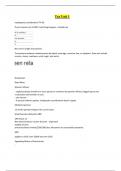
Inadequate consideration ITA 69
If you transact not at FMV, bad things happen = double tax
Non-arm's length transactions
Transactions between related parties by blood, marriage, common-law, or adoption. Does not include
cousins, nieces, nephews, uncle roger, and aunts.
Brainpower
Read More
Spousal rollover
- capital property transfers to your spouse or common law partner without triggering any tax
-transaction will transfer at cost
- can opt out
- if spousal rollover applies, inadequate consideration doesn't apply
Medical expenses
12 month period ending in the current year
Small business deduction SBD
19% lesser of:
Net active business income (income - expenses)
taxable income
annual business limited ($500,000) less allocations to associated companies
GRR
applies to CCPC over $500k and non-CCPC
Appealing Notice of Assessment
-
, -Call CRA
-File notice of objection within 90 days that the assessment is mailed or within 1 year of the due date of
the return
- Tax court of Canada - within 90 days of the notice of objection or if the CRA hasn't responded yet
-Federal court of appeal - 30 days bring it it within 30 days
Sandra operates Sleepy as a proprietorship. Which of the following would be fully deductible in
calculating Sleepy's net income for tax purposes?
Question options:
a)
The salary of $75,000 paid this year to Sandra's husband for 20 hours per week of general office work
and bookkeeping services
b)
The $1,000 contribution made to the Liberal Party of Canada on behalf of Sandra's business
c)
The $2,500 of membership fees paid this year to the local tennis club where Sandra meets existing and
potential clients
d)
The additional $1,500 of interest costs incurred this year when Sandra refinanced the mortgage on her
home to provide funds to purchase office equipment and furniture for use in the business
d)
The additional $1,500 of interest costs incurred this year when Sandra refinanced the mortgage on her
home to provide funds to purchase office equipment and furniture for use in the business
Answer a) is incorrect. ITA 67 only allows deduction of expenditures that are considered reasonable in
the circumstances. Given Sandra's husband's limited involvement in the business (that is, working only
50% of typical full-time hours), $75,000 is likely to be considered an excessive salary for general office
work and bookkeeping services. Answer d) is correct. Interest paid on borrowed funds is deductible
against business income, provided the borrowed money was used to earn business income. It does not
matter that the source of the funds was through a refinancing of the mortgage on Sandra's home
because Sandra can directly tie the use of the borrowed money to the acquisition of assets (office
furniture and equipment) used in her business.
A corporation sold all of its Class 50 assets for $80,000. If the original cost and the undepreciated capital
cost (UCC) balance of the assets were $150,000 and $100,000, respectively, immediately before the
disposition, the tax consequence of the disposition would be:
Question options:
a)
Recapture of $20,000
b)
Terminal loss of $20,000
c)
Capital loss of $70,000
d)
A CCA claim of $55,000 and recapture of $35,000
Inadequate consideration ITA 69
If you transact not at FMV, bad things happen = double tax
Non-arm's length transactions
Transactions between related parties by blood, marriage, common-law, or adoption. Does not include
cousins, nieces, nephews, uncle roger, and aunts.
Brainpower
Read More
Spousal rollover
- capital property transfers to your spouse or common law partner without triggering any tax
-transaction will transfer at cost
- can opt out
- if spousal rollover applies, inadequate consideration doesn't apply
Medical expenses
12 month period ending in the current year
Small business deduction SBD
19% lesser of:
Net active business income (income - expenses)
taxable income
annual business limited ($500,000) less allocations to associated companies
GRR
applies to CCPC over $500k and non-CCPC
Appealing Notice of Assessment
-
, -Call CRA
-File notice of objection within 90 days that the assessment is mailed or within 1 year of the due date of
the return
- Tax court of Canada - within 90 days of the notice of objection or if the CRA hasn't responded yet
-Federal court of appeal - 30 days bring it it within 30 days
Sandra operates Sleepy as a proprietorship. Which of the following would be fully deductible in
calculating Sleepy's net income for tax purposes?
Question options:
a)
The salary of $75,000 paid this year to Sandra's husband for 20 hours per week of general office work
and bookkeeping services
b)
The $1,000 contribution made to the Liberal Party of Canada on behalf of Sandra's business
c)
The $2,500 of membership fees paid this year to the local tennis club where Sandra meets existing and
potential clients
d)
The additional $1,500 of interest costs incurred this year when Sandra refinanced the mortgage on her
home to provide funds to purchase office equipment and furniture for use in the business
d)
The additional $1,500 of interest costs incurred this year when Sandra refinanced the mortgage on her
home to provide funds to purchase office equipment and furniture for use in the business
Answer a) is incorrect. ITA 67 only allows deduction of expenditures that are considered reasonable in
the circumstances. Given Sandra's husband's limited involvement in the business (that is, working only
50% of typical full-time hours), $75,000 is likely to be considered an excessive salary for general office
work and bookkeeping services. Answer d) is correct. Interest paid on borrowed funds is deductible
against business income, provided the borrowed money was used to earn business income. It does not
matter that the source of the funds was through a refinancing of the mortgage on Sandra's home
because Sandra can directly tie the use of the borrowed money to the acquisition of assets (office
furniture and equipment) used in her business.
A corporation sold all of its Class 50 assets for $80,000. If the original cost and the undepreciated capital
cost (UCC) balance of the assets were $150,000 and $100,000, respectively, immediately before the
disposition, the tax consequence of the disposition would be:
Question options:
a)
Recapture of $20,000
b)
Terminal loss of $20,000
c)
Capital loss of $70,000
d)
A CCA claim of $55,000 and recapture of $35,000