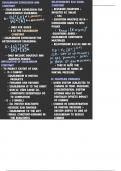
Equilibrium expression and Relationships b/w equil.
constant Constant
- equilibrium expression for - reversed equation =
homogenous equilibria: inverted kc value
[C) [ D ] d f products
C - 1/kc
K =
- equation multiple by n =
[ B] b c- Reactants
(A)
a
expression raise to nth
- only for gases power "
- k is the equilibrium - knew (
= K original)
constant -equations added =
- equilibrium expression for equilibrium constants
heterogenous equilibria: multiplied
' d - relationship b/w kc and kp:
K =
[ C) [ D] n
[AT [ BT
a b
Kp =
Kc ( RT )
n = sum of coefficients
- only include aqueous and sum
gas products
-
gaseous phases of
Reactants
Application of equilibrium of coeff Of gas
.
constant - this is also the
- to predict extent of rxn: expression in terms of
- k>1 (large) partial pressure
-equilibrium is mostly
products Le chatelier principle
- forward rxn favored - when system subjected to
- equilibrium is to the right change in temp, pressure,
- rxn w/ very large eq. concentration, system
Constants essentially go attains new eq that
to completion partially offsets impact
- k < 1 (small) of change
- eq. Mostly reactants - change in concentration
-reverse rxn favored or partial pressure =
- equilibrium to the left system shifts to side of
-small constant=remains in equilibrium to reduce
the reactants change
constant Constant
- equilibrium expression for - reversed equation =
homogenous equilibria: inverted kc value
[C) [ D ] d f products
C - 1/kc
K =
- equation multiple by n =
[ B] b c- Reactants
(A)
a
expression raise to nth
- only for gases power "
- k is the equilibrium - knew (
= K original)
constant -equations added =
- equilibrium expression for equilibrium constants
heterogenous equilibria: multiplied
' d - relationship b/w kc and kp:
K =
[ C) [ D] n
[AT [ BT
a b
Kp =
Kc ( RT )
n = sum of coefficients
- only include aqueous and sum
gas products
-
gaseous phases of
Reactants
Application of equilibrium of coeff Of gas
.
constant - this is also the
- to predict extent of rxn: expression in terms of
- k>1 (large) partial pressure
-equilibrium is mostly
products Le chatelier principle
- forward rxn favored - when system subjected to
- equilibrium is to the right change in temp, pressure,
- rxn w/ very large eq. concentration, system
Constants essentially go attains new eq that
to completion partially offsets impact
- k < 1 (small) of change
- eq. Mostly reactants - change in concentration
-reverse rxn favored or partial pressure =
- equilibrium to the left system shifts to side of
-small constant=remains in equilibrium to reduce
the reactants change