Luna & Peracchio (1999)
What’s in a Bilingual Mind?: How Bilingual Consumers Process Information
“Should we translate our ads into our consumer’s first language even though they understand
English?”
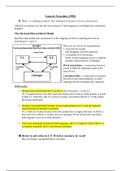
The Revised Hierarchical Model
Specifies and explains the asymmetries in the mapping of form to meaning between an
individuals L1 and L2.
There are two levels of representation
1. Lexical level (words
each language is stored separately
2. Conceptual level (meaning)
words of each language access a common
semantic representation of meaning
Word associations = connections between
words in different languages made at the
lexical level
Conceptual links = connections in memory
between lexical representations in either
language and the meanings they represent.
RHM results:
1. Stronger lexical link from the L2 to the L1 than from the L1 to the L2.
L2 acquisition has the effect that individuals learn words by relating them to words
in their L1. Therefore, the L2 words are closely associated with the L1 words, hence
the strong connection.
2. Stronger conceptual links between lexical representations of L1 and the semantic
representations in memory (concepts)
L2 links are weaker because only after people have a high proficiency in their L2
they rely less on their L1 to gain access to meaning. So the lexical and conceptual
links depend on the level of proficiency.
3. Even if an individual is fluent in both languages, the L1 is superior. Only if the L1 is
not spoken regularly, the L2 can become dominant.
Better to advertise in L1! better memory & recall
(due to stronger conceptual link to concepts)
, 1. Need for cognition
Low-NFC individuals will remember ads in their L1 better.
High-NFC individuals will remember ads in their L1 and L2 equally well.
2. Extrinsic motivation
Individuals with low processing motivation will remember ads in their L1 better.
Individuals with high processing motivation will remember ads in their L1 and
L2 equally well.
3. Cue Centrality
Individuals with high processing motivation, will remember L2 ads with strong
peripheral cues better than L2 ads with weak peripheral cues.
Individuals with high processing motivation will remember L1 ads with strong
central cues better than L1 ads with weak central cues and/or strong peripheral
cues.
Individuals with low processing motivation will remember ads with strong
peripheral cues better than ads with weak peripheral cues and/or strong central
cues, regardless of the language.
4. Copy-Picture Agreement (brand name + picture can be consistent
with each other)
Bilingual individuals will remember interactive ads better than non-interactive
ads.
Interactivity of an ad will benefit memory for L2 more than for L1.
L1 inconsistent ads will be remembered better than L1 consistent ads.
L2 inconsistent ads will be remembered worse than L2 consistent ads.
What’s in a Bilingual Mind?: How Bilingual Consumers Process Information
“Should we translate our ads into our consumer’s first language even though they understand
English?”
The Revised Hierarchical Model
Specifies and explains the asymmetries in the mapping of form to meaning between an
individuals L1 and L2.
There are two levels of representation
1. Lexical level (words
each language is stored separately
2. Conceptual level (meaning)
words of each language access a common
semantic representation of meaning
Word associations = connections between
words in different languages made at the
lexical level
Conceptual links = connections in memory
between lexical representations in either
language and the meanings they represent.
RHM results:
1. Stronger lexical link from the L2 to the L1 than from the L1 to the L2.
L2 acquisition has the effect that individuals learn words by relating them to words
in their L1. Therefore, the L2 words are closely associated with the L1 words, hence
the strong connection.
2. Stronger conceptual links between lexical representations of L1 and the semantic
representations in memory (concepts)
L2 links are weaker because only after people have a high proficiency in their L2
they rely less on their L1 to gain access to meaning. So the lexical and conceptual
links depend on the level of proficiency.
3. Even if an individual is fluent in both languages, the L1 is superior. Only if the L1 is
not spoken regularly, the L2 can become dominant.
Better to advertise in L1! better memory & recall
(due to stronger conceptual link to concepts)
, 1. Need for cognition
Low-NFC individuals will remember ads in their L1 better.
High-NFC individuals will remember ads in their L1 and L2 equally well.
2. Extrinsic motivation
Individuals with low processing motivation will remember ads in their L1 better.
Individuals with high processing motivation will remember ads in their L1 and
L2 equally well.
3. Cue Centrality
Individuals with high processing motivation, will remember L2 ads with strong
peripheral cues better than L2 ads with weak peripheral cues.
Individuals with high processing motivation will remember L1 ads with strong
central cues better than L1 ads with weak central cues and/or strong peripheral
cues.
Individuals with low processing motivation will remember ads with strong
peripheral cues better than ads with weak peripheral cues and/or strong central
cues, regardless of the language.
4. Copy-Picture Agreement (brand name + picture can be consistent
with each other)
Bilingual individuals will remember interactive ads better than non-interactive
ads.
Interactivity of an ad will benefit memory for L2 more than for L1.
L1 inconsistent ads will be remembered better than L1 consistent ads.
L2 inconsistent ads will be remembered worse than L2 consistent ads.