Wk8: Alphas, Betas, and Gammas Abbreviations:
Wednesday, November 25, 2020 8:04 PM b/w = between
w/ = with
INC = increase
• These particles are emitted by an unstable nuclei when they undergo radioactive decay: DEC = decrease
○ Alpha (a): a He nucleus.
○ Beta (b): an electron.
○ Gamma (g): a high-energy photon.
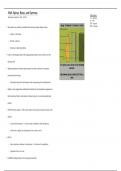
• In lab we will distinguish them by their range(penetration depth), or how far they travel when
entering a solid.
• Alphas and gammas are emitted at single-energy levels; betas are emitted over a spectrum
(continuous distr) of energy.
○ Can interpret energy of the beta's range to be the average energy of the continuous distr.
• Alphas are easily stopped when emitted(easily absorbed), betas are intermediate, and gammas are
fairly penetrating. Neutrons, other product of radioactive decay, is even more penetrating than
gammas.
• ALPHA Positively-charged -> When it enters matter it loses energy to the atomic electrons in the
material.
○ a are heavier than electrons. -> a travel in nearly a straight line, while slowing down.
○ a slow down so quickly, they only penetrate a few centimeters of air.
• BETAS
○ b slow down due to collisions w/ other electrons. -> Do not travel in a straight line.
○ b penetrate a few meters of air.
• GAMMAS Uncharged and do not lose energy electrostatically.
Wednesday, November 25, 2020 8:04 PM b/w = between
w/ = with
INC = increase
• These particles are emitted by an unstable nuclei when they undergo radioactive decay: DEC = decrease
○ Alpha (a): a He nucleus.
○ Beta (b): an electron.
○ Gamma (g): a high-energy photon.
• In lab we will distinguish them by their range(penetration depth), or how far they travel when
entering a solid.
• Alphas and gammas are emitted at single-energy levels; betas are emitted over a spectrum
(continuous distr) of energy.
○ Can interpret energy of the beta's range to be the average energy of the continuous distr.
• Alphas are easily stopped when emitted(easily absorbed), betas are intermediate, and gammas are
fairly penetrating. Neutrons, other product of radioactive decay, is even more penetrating than
gammas.
• ALPHA Positively-charged -> When it enters matter it loses energy to the atomic electrons in the
material.
○ a are heavier than electrons. -> a travel in nearly a straight line, while slowing down.
○ a slow down so quickly, they only penetrate a few centimeters of air.
• BETAS
○ b slow down due to collisions w/ other electrons. -> Do not travel in a straight line.
○ b penetrate a few meters of air.
• GAMMAS Uncharged and do not lose energy electrostatically.