
Qld Bar Exam - Evidence.pdf file:///C:/Users/HP/Desktop/TYPA%20NEW/Qld%20Bar%20Exam
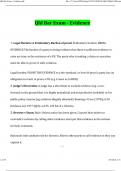
Qld Bar Exam - Evidence
1. Legal Burden vs Evidentiary Burden of proof: Evidentiary burden: BRING
EVIDENCE.The burden of a party to bring evidence that there is sufficient evidence to
raise an issue as the existence of a FII. The party who is making a claim or assertion
must be able to prove it with evidence.
Legal burden: PROVE THE EVIDENCE to a the standard, or level of proof a party has an
obligation to reach to prove a FII (e.g. Crown as to BRD).
2. Judge's Discretion: A judge has a discretion to exclude evidence (eg. a con-
fession) on the ground that it is highly prejudicial and not probative (reliable) or for
public policy reasons (eg. evidence illegally obtained): Bunning v Cross (1978); s130
Evidence Act 1977 (Qld); ss135-139 EA; R v Christie.
3. Browne v Dunn: Rule: Unless notice has been given, Counsel that wishes to
contradict a witness by calling other evidence must put that evidence to the witness
for their comment.
Rationale: Anti-ambush rule for fairness. Allows other party to call evidence so they can
explain it.
1 of 29 8/8/2024, 3:31
,Qld Bar Exam - Evidence.pdf file:///C:/Users/HP/Desktop/TYPA%20NEW/Qld%20Bar%20Exam
Court can then enjoy joinder evidence/FII.
Consequences of non-compliance:
Ethical and evidentiary implications; can be given less weight, denial of right to
respond by party/witness, other party may be entitled recall evidence/put rebuttal
evidence. Potential mistrial, appeal or jury warning given.
Provide an example.
4. Jones v Dunkel [1959]: Rule: In certain circumstances, a party that provides an
unexplained failure to provide evidence may lead to an inference that the uncalled
evidence would not have assisted the party's case.
Rationale: Deterrence against parties tempted to withhold evidence; promotes fair-
ness, discourages parties from hiding or suppressing evidence that could weaken their
position, and promotes transparency.
Provide example.
5. When does Jones v Dunkel not apply?: Limited application in criminal proceed-
ings, can be used against Crown.
Also does not apply in the appropriate circumstances: 1) when the party is 'required
2 of 29 8/8/2024, 3:31
,Qld Bar Exam - Evidence.pdf file:///C:/Users/HP/Desktop/TYPA%20NEW/Qld%20Bar%20Exam
to explain or contradict something' and 2) it is within their power to tender it, and 3)
there is no adequate explanation as to failure.
6. Bunning v Cross [1978]: Rule: Evidence that was obtained unlawfully/improperly
must not be admitted unless the importance/probative value > factors (public inter-
est, unfairness and prejudice). Codified in s138 CEA. Factors are: deliberateness of the
conduct, probative value of the evidence, ease with which compliance with law might
have been achieved, nature of the offence charged, purpose of the legislative
restrictions.
Rationale: Striking a balance between enforcing public interest with fair policing/dis-
closure against exclusion of evidence otherwise not manifestly unfair/prejudicial (eg
niche technical points). Operative deterrence against bad policing and reliance on
exclusionary rules of evidence.
7. Exclusion of Relevant Evidence: 1) R v Christie: prejudicial value > probative
value.
2) Unfairness in s 130 EAQ/s 135 EAC. Provide
example of each.
8. Admissibility of expert evidence: 7 conditions, also in s 79 EAC.
1) Expert opinion is in field of specialised knowledge.
3 of 29 8/8/2024, 3:31
Qld Bar Exam - Evidence
1. Legal Burden vs Evidentiary Burden of proof: Evidentiary burden: BRING
EVIDENCE.The burden of a party to bring evidence that there is sufficient evidence to
raise an issue as the existence of a FII. The party who is making a claim or assertion
must be able to prove it with evidence.
Legal burden: PROVE THE EVIDENCE to a the standard, or level of proof a party has an
obligation to reach to prove a FII (e.g. Crown as to BRD).
2. Judge's Discretion: A judge has a discretion to exclude evidence (eg. a con-
fession) on the ground that it is highly prejudicial and not probative (reliable) or for
public policy reasons (eg. evidence illegally obtained): Bunning v Cross (1978); s130
Evidence Act 1977 (Qld); ss135-139 EA; R v Christie.
3. Browne v Dunn: Rule: Unless notice has been given, Counsel that wishes to
contradict a witness by calling other evidence must put that evidence to the witness
for their comment.
Rationale: Anti-ambush rule for fairness. Allows other party to call evidence so they can
explain it.
1 of 29 8/8/2024, 3:31
,Qld Bar Exam - Evidence.pdf file:///C:/Users/HP/Desktop/TYPA%20NEW/Qld%20Bar%20Exam
Court can then enjoy joinder evidence/FII.
Consequences of non-compliance:
Ethical and evidentiary implications; can be given less weight, denial of right to
respond by party/witness, other party may be entitled recall evidence/put rebuttal
evidence. Potential mistrial, appeal or jury warning given.
Provide an example.
4. Jones v Dunkel [1959]: Rule: In certain circumstances, a party that provides an
unexplained failure to provide evidence may lead to an inference that the uncalled
evidence would not have assisted the party's case.
Rationale: Deterrence against parties tempted to withhold evidence; promotes fair-
ness, discourages parties from hiding or suppressing evidence that could weaken their
position, and promotes transparency.
Provide example.
5. When does Jones v Dunkel not apply?: Limited application in criminal proceed-
ings, can be used against Crown.
Also does not apply in the appropriate circumstances: 1) when the party is 'required
2 of 29 8/8/2024, 3:31
,Qld Bar Exam - Evidence.pdf file:///C:/Users/HP/Desktop/TYPA%20NEW/Qld%20Bar%20Exam
to explain or contradict something' and 2) it is within their power to tender it, and 3)
there is no adequate explanation as to failure.
6. Bunning v Cross [1978]: Rule: Evidence that was obtained unlawfully/improperly
must not be admitted unless the importance/probative value > factors (public inter-
est, unfairness and prejudice). Codified in s138 CEA. Factors are: deliberateness of the
conduct, probative value of the evidence, ease with which compliance with law might
have been achieved, nature of the offence charged, purpose of the legislative
restrictions.
Rationale: Striking a balance between enforcing public interest with fair policing/dis-
closure against exclusion of evidence otherwise not manifestly unfair/prejudicial (eg
niche technical points). Operative deterrence against bad policing and reliance on
exclusionary rules of evidence.
7. Exclusion of Relevant Evidence: 1) R v Christie: prejudicial value > probative
value.
2) Unfairness in s 130 EAQ/s 135 EAC. Provide
example of each.
8. Admissibility of expert evidence: 7 conditions, also in s 79 EAC.
1) Expert opinion is in field of specialised knowledge.
3 of 29 8/8/2024, 3:31


