
UCI BioSci D170, Williams Muscles
Reading: Chapter 11
What are the seven criteria for naming skeletal muscles?
Names of skeletal muscles give way to their location, shape, relative size, direction of
fascicles/fibers, location of attachments, name of origins and action.
What are the compartments of the upper limb? Of the lower limb? What actions do they
perform?
The upper limb has an anterior compartment that flexes the arm at the shoulder/flexes
the forearm at the elbow and a posterior compartment that extends the elbow and wrist.
The lower limb consists of the anterior compartment that flexes the thigh at the
hip/extends the leg at the knee, the medial compartment adducts the thigh, and the
posterior compartment extends the thigh at the hip/flexes the leg at the knee (plantar
flexion by gastrocnemius too).
Complete the following tables about the muscles of the body. These are the muscles that you
will be responsible for identifying, as well as for being able to describe their actions. For the
shoulder joint you will also learn origins and insertions. You can find this information from the
tables between pages 274 and 332 of the book.
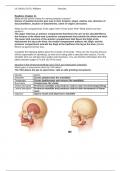
Muscles of the temporomandibular joint (TMJ) and mastication (chewing)
What types of movements does the TMJ allow?
The TMJ allows the jaw to open/close, side-to-side grinding movements.
Muscle Action
Masseter Closes jaw(elevates the mandible)
Temporalis Closes jaw(elevates and retracts the mandible)
Buccinator Compresses the cheek
Medial pterygoid Protracts mandible and produces side-to-side movements(grinding)
Lateral pterygoid Protracts mandible and produces side-to-side movements of lower
teeth
Digastric Opens mouth and depresses mandible
, UCI BioSci D170, Williams Muscles
Muscles of the anterior and posterior thorax: movement of the scapula
What types of movements can the scapula undergo?
The scapula undergoes elevation, depression, protraction/abduction(anterolateral
movement), retraction/adduction(posteromedial movement), upward(inferior angle
moves laterally) and downward(inferior angle moves medially) rotation.
Muscle_Description Action
Pectoralis minor Protracts and rotates scapula downward. Deep to major,
attached to ribs 3-5.
Serratus anterior Rotates scapula upward. On top of rib 1-8.
Subclavius Stabilizes and depresses the pectoral girdle. Under the
clavicle.
Trapezius(posterior) Stabilizes, elevates, retracts, and rotates scapula. Convergent,
runs along the vertebral column.
Levator Elevates and adducts scapula. Straplike, connects to C1-C4.
scapulae(posterior)
Rhomboids(posterior) Stabilize scapula. Minor connects to C7-T1, major connects to
T2-T5. Straplike.
Reading: Chapter 11
What are the seven criteria for naming skeletal muscles?
Names of skeletal muscles give way to their location, shape, relative size, direction of
fascicles/fibers, location of attachments, name of origins and action.
What are the compartments of the upper limb? Of the lower limb? What actions do they
perform?
The upper limb has an anterior compartment that flexes the arm at the shoulder/flexes
the forearm at the elbow and a posterior compartment that extends the elbow and wrist.
The lower limb consists of the anterior compartment that flexes the thigh at the
hip/extends the leg at the knee, the medial compartment adducts the thigh, and the
posterior compartment extends the thigh at the hip/flexes the leg at the knee (plantar
flexion by gastrocnemius too).
Complete the following tables about the muscles of the body. These are the muscles that you
will be responsible for identifying, as well as for being able to describe their actions. For the
shoulder joint you will also learn origins and insertions. You can find this information from the
tables between pages 274 and 332 of the book.
Muscles of the temporomandibular joint (TMJ) and mastication (chewing)
What types of movements does the TMJ allow?
The TMJ allows the jaw to open/close, side-to-side grinding movements.
Muscle Action
Masseter Closes jaw(elevates the mandible)
Temporalis Closes jaw(elevates and retracts the mandible)
Buccinator Compresses the cheek
Medial pterygoid Protracts mandible and produces side-to-side movements(grinding)
Lateral pterygoid Protracts mandible and produces side-to-side movements of lower
teeth
Digastric Opens mouth and depresses mandible
, UCI BioSci D170, Williams Muscles
Muscles of the anterior and posterior thorax: movement of the scapula
What types of movements can the scapula undergo?
The scapula undergoes elevation, depression, protraction/abduction(anterolateral
movement), retraction/adduction(posteromedial movement), upward(inferior angle
moves laterally) and downward(inferior angle moves medially) rotation.
Muscle_Description Action
Pectoralis minor Protracts and rotates scapula downward. Deep to major,
attached to ribs 3-5.
Serratus anterior Rotates scapula upward. On top of rib 1-8.
Subclavius Stabilizes and depresses the pectoral girdle. Under the
clavicle.
Trapezius(posterior) Stabilizes, elevates, retracts, and rotates scapula. Convergent,
runs along the vertebral column.
Levator Elevates and adducts scapula. Straplike, connects to C1-C4.
scapulae(posterior)
Rhomboids(posterior) Stabilize scapula. Minor connects to C7-T1, major connects to
T2-T5. Straplike.


