

Unit 20 – Assignment 2 – Urinalysis – Osman Yousuf
Urinalysis
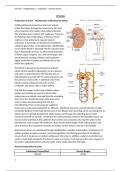
Production of Urine – Maintenance of Biochemical Values Figure 1 - Kidney and Nephron
Unfiltered blood pumped from the heart (Aorta)
enters the kidney through the renal artery, the renal
artery branches into smaller tubes called arterioles.
The arterioles are in contact with nephrons. These are
the filtering units of the kidney. At the start of the
nephron, it has a Bowmans Capsule made of
podocytes, it surrounds an abundance of capillaries
called the glomerulus. In the glomerulus, ultrafiltration
occurs which blood is squeezed into the capsular space
due to hydrostatic pressure, to allow small molecules
of water, sugar, inorganic ions, and salt through, and
simultaneously creating a filtrate, and leaving the
bigger molecules of protein and blood cells to stay
within the capillaries. Figure 2 - Nephron Structure
The filtrate is passed to the proximal convoluted
tubule where selective reabsorption occurs, glucose
and water is reabsorbed into the bloodstream via
mitochondria to provide ATP for active transport, and
the presence of microvilli, in epithelial cells of the
tubule, leaving unwanted molecules of urea,
creatinine, and excess salts or water behind.
This will also happen in the Loop of Henle, where
sodium and chloride are used to control water.
Sodium ions are actively removed from the ascending
limb, thus, the medulla becomes salty and causes
water to leave the descending limb into the
interstitial fluid, then carried away by capillaries.
Some ions re-enter descending limb via diffusion. The filtrate becomes concentrated due to high
osmolarity (bottom of the loop) but becomes more diluted when travelling up the ascending limb as
sodium ions are actively pumped out. Water passes out through the collecting ducts (under
hormonal control) via osmosis, resulting in low water potential, however the interstitial space also
has low water potential as the capillaries that connect are constantly returning the water to the
bloodstream, and so water will continue to leave for the entire length of the collecting duct, the
urine travels to the renal pelvis and exits the kidney via the ureter to end up in the bladder.
Biochemical values are maintained through ultrafiltration, selective reabsorption, maintenance of
sodium gradient to induce osmosis, and osmoregulation. The filtering processes of the kidneys
ensure there is no glucose or protein ending up in the urine. In addition, sodium is controlled and
used to create high osmolarity, if sodium or water is in excess it will end up in the urine, however if
the body is dehydrated these salts and water will be reabsorbed into the body.
Normal Composition of Urine
Substances/Composition Normal Ranges
Volume 0.8-2L
1
, Unit 20 – Assignment 2 – Urinalysis – Osman Yousuf
pH 4.5-8.0
Specific Gravity 1.002–1.030 g/ml
Osmolality 150–1150 mOsm/kg
Urea 10–35 g/d
Uric Acid <750 mg/d
Creatinine Males: 955–2936 mg/d
Females: 601–1689 mg/d
Citrate 221–1191 mg/d
Sodium 41–227 mmol/d
Potassium 17–77 mmol/d
Ammonium 15–56 mmol/d
Calcium Males:<250 mg/d
Females:<200 mg/d
Magnesium 51–269 mg/d
Chloride 40–224 mmol/d
Protein -
Glucose -
Leukocytes Esterase -
Nitrile -
Ketones -
A Urine test (urinalysis) is an important test, frequently used when diagnosing patients or treating
them. The urine are waste products and could potentially contain substances which indicate a
medical condition or disease, and drug use. In urine samples, the colour, appearance (turbid/hazy or
clear) will be analysed. For example, if the composition of urine has glucose, has a sweet odour, and
is cloudy, it could indicate diabetes as glucose is reabsorbed by the nephron in normal, healthy
adults. Another substance that should not end up in urine in high quantities is protein, levels of
protein (Above 8mg/dl of albumin) in urine causes urine to appear cloudy and indicates renal
diseases. Components of nitrile and leukocytes can indicate ongoing infections. Not only can it
indicate diseases in diagnosis, but it can also be used to treat conditions and urinalysis is done to
monitor progression to see if the condition/disease is improving or advancing. Colour is important in
health too as if its dark it shows the individual is dehydrated, or if its clear and light, it shows they are
hydrated, and the body has the appropriate levels of salt and water.
Virtual Urinalysis Tests
Macroscopic observations
Urine Colour Intensity Turbidity Odour
A Pale Yellow Dull Moderately Nutty
Cloudy
Chemstix
Specific Gravity 1.030
pH 7.5
Protein -
Glucose -
2
Urinalysis
Production of Urine – Maintenance of Biochemical Values Figure 1 - Kidney and Nephron
Unfiltered blood pumped from the heart (Aorta)
enters the kidney through the renal artery, the renal
artery branches into smaller tubes called arterioles.
The arterioles are in contact with nephrons. These are
the filtering units of the kidney. At the start of the
nephron, it has a Bowmans Capsule made of
podocytes, it surrounds an abundance of capillaries
called the glomerulus. In the glomerulus, ultrafiltration
occurs which blood is squeezed into the capsular space
due to hydrostatic pressure, to allow small molecules
of water, sugar, inorganic ions, and salt through, and
simultaneously creating a filtrate, and leaving the
bigger molecules of protein and blood cells to stay
within the capillaries. Figure 2 - Nephron Structure
The filtrate is passed to the proximal convoluted
tubule where selective reabsorption occurs, glucose
and water is reabsorbed into the bloodstream via
mitochondria to provide ATP for active transport, and
the presence of microvilli, in epithelial cells of the
tubule, leaving unwanted molecules of urea,
creatinine, and excess salts or water behind.
This will also happen in the Loop of Henle, where
sodium and chloride are used to control water.
Sodium ions are actively removed from the ascending
limb, thus, the medulla becomes salty and causes
water to leave the descending limb into the
interstitial fluid, then carried away by capillaries.
Some ions re-enter descending limb via diffusion. The filtrate becomes concentrated due to high
osmolarity (bottom of the loop) but becomes more diluted when travelling up the ascending limb as
sodium ions are actively pumped out. Water passes out through the collecting ducts (under
hormonal control) via osmosis, resulting in low water potential, however the interstitial space also
has low water potential as the capillaries that connect are constantly returning the water to the
bloodstream, and so water will continue to leave for the entire length of the collecting duct, the
urine travels to the renal pelvis and exits the kidney via the ureter to end up in the bladder.
Biochemical values are maintained through ultrafiltration, selective reabsorption, maintenance of
sodium gradient to induce osmosis, and osmoregulation. The filtering processes of the kidneys
ensure there is no glucose or protein ending up in the urine. In addition, sodium is controlled and
used to create high osmolarity, if sodium or water is in excess it will end up in the urine, however if
the body is dehydrated these salts and water will be reabsorbed into the body.
Normal Composition of Urine
Substances/Composition Normal Ranges
Volume 0.8-2L
1
, Unit 20 – Assignment 2 – Urinalysis – Osman Yousuf
pH 4.5-8.0
Specific Gravity 1.002–1.030 g/ml
Osmolality 150–1150 mOsm/kg
Urea 10–35 g/d
Uric Acid <750 mg/d
Creatinine Males: 955–2936 mg/d
Females: 601–1689 mg/d
Citrate 221–1191 mg/d
Sodium 41–227 mmol/d
Potassium 17–77 mmol/d
Ammonium 15–56 mmol/d
Calcium Males:<250 mg/d
Females:<200 mg/d
Magnesium 51–269 mg/d
Chloride 40–224 mmol/d
Protein -
Glucose -
Leukocytes Esterase -
Nitrile -
Ketones -
A Urine test (urinalysis) is an important test, frequently used when diagnosing patients or treating
them. The urine are waste products and could potentially contain substances which indicate a
medical condition or disease, and drug use. In urine samples, the colour, appearance (turbid/hazy or
clear) will be analysed. For example, if the composition of urine has glucose, has a sweet odour, and
is cloudy, it could indicate diabetes as glucose is reabsorbed by the nephron in normal, healthy
adults. Another substance that should not end up in urine in high quantities is protein, levels of
protein (Above 8mg/dl of albumin) in urine causes urine to appear cloudy and indicates renal
diseases. Components of nitrile and leukocytes can indicate ongoing infections. Not only can it
indicate diseases in diagnosis, but it can also be used to treat conditions and urinalysis is done to
monitor progression to see if the condition/disease is improving or advancing. Colour is important in
health too as if its dark it shows the individual is dehydrated, or if its clear and light, it shows they are
hydrated, and the body has the appropriate levels of salt and water.
Virtual Urinalysis Tests
Macroscopic observations
Urine Colour Intensity Turbidity Odour
A Pale Yellow Dull Moderately Nutty
Cloudy
Chemstix
Specific Gravity 1.030
pH 7.5
Protein -
Glucose -
2


