

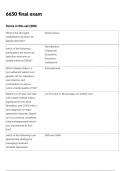
6630 final exam
Terms in this set (200)
What is the strongest Family history
established risk factor for
bipolar disorder?
Nortriptyline
which of the following
Citalopram
medications are known as
Duloxetine
selective serotonin re-
fluoxetine
uptake inibitors (SSRIs)?
venlafaxine
Which disease state o a Schizophrenia
non-adherent patient is at
greater risk for substance
use violence, and
victimization as well as
worse overall quality of life?
Patient is a 72 year old male not TCA due to fib and age, not ADHD med
with a past medical history
significant for the atrial
fibrillation and COPD with a
new diagnosis of major
depression disorder. Based
on his comorbid conditions,
what antidepressant would
you recommend as first-
line?
which of the following is an SSRI and SNRI
appropriate strategy for
managing treatment
resistant depression
,which of the following antidepressants might contribute to an increase in mood
medications is best to episode freq1uency
AVOID in maintenance
treatment of bipolar
disorder and why
An 8-year-old patient ANS: b.
presents with severe Methylphenidate (Ritalin, Concerta)
hyperactivity, described as
"ants in his pants." Based on
self-report from the patient,
his parents, and his teacher;
attention deficit
hyperactivity disorder
(ADHD) is suspected. What
medication is the PMNHP
most likely to prescribe?
Kevin is an adolescent who ANS: d.
has been diagnosed with "Naltrexone may be an appropriate option to discuss."
kleptomania. His parents
are interested in seeking
pharmacological treatment.
What does the PMHNP tell
the parents regarding his
treatment options?
Which of the following ANS: c.
substances has the highest Nicotine
probability of becoming
dependent after a single
use?
The nursing staff asks the ANS: c.
PMHNP for additional The nurse should attempt to determine how the patient's
education regarding the environment may be impacting the patient's mood.
treatment of agitation in
dementia patients. Which of
the following is correct?
, A patient on chronic ANS: c.
opioids is currently on The patient is somnolent and has 7 respirations per
oxycodone ER (OxyContin). minute.
The PMHNP is consulted to
treat underlying depression.
Under which circumstance
should the PMHNP order
naloxone (NARCAN)?
A patient with chronic ANS: a.
insomnia asks the PMHNP if "You can get melatonin over the counter, which will help
they can first try an over with sleep onset."
the-counter (OTC)
medication before one that
needs to be prescribed to
help the patient sleep.
Which is the best response
by the PMHNP?
The PMHNP is caring for a ANS: b.
patient who experiences Avoiding prescribing the patient a drug that blocks H1
too much overstimulation receptors
and anxiety during daytime
hours. The patient agrees to
a pharmacological
treatment but states, "I don't
want to feel sedated or
drowsy from the medicine."
Which decision made by
the PMHNP demonstrates
proper knowledge of this
patient's symptoms and
appropriate treatment
options?
Which of these statements ANS: d.
is correct? Sedation is unusual with aripiprazole (ABILIFY)
Terms in this set (200)
What is the strongest Family history
established risk factor for
bipolar disorder?
Nortriptyline
which of the following
Citalopram
medications are known as
Duloxetine
selective serotonin re-
fluoxetine
uptake inibitors (SSRIs)?
venlafaxine
Which disease state o a Schizophrenia
non-adherent patient is at
greater risk for substance
use violence, and
victimization as well as
worse overall quality of life?
Patient is a 72 year old male not TCA due to fib and age, not ADHD med
with a past medical history
significant for the atrial
fibrillation and COPD with a
new diagnosis of major
depression disorder. Based
on his comorbid conditions,
what antidepressant would
you recommend as first-
line?
which of the following is an SSRI and SNRI
appropriate strategy for
managing treatment
resistant depression
,which of the following antidepressants might contribute to an increase in mood
medications is best to episode freq1uency
AVOID in maintenance
treatment of bipolar
disorder and why
An 8-year-old patient ANS: b.
presents with severe Methylphenidate (Ritalin, Concerta)
hyperactivity, described as
"ants in his pants." Based on
self-report from the patient,
his parents, and his teacher;
attention deficit
hyperactivity disorder
(ADHD) is suspected. What
medication is the PMNHP
most likely to prescribe?
Kevin is an adolescent who ANS: d.
has been diagnosed with "Naltrexone may be an appropriate option to discuss."
kleptomania. His parents
are interested in seeking
pharmacological treatment.
What does the PMHNP tell
the parents regarding his
treatment options?
Which of the following ANS: c.
substances has the highest Nicotine
probability of becoming
dependent after a single
use?
The nursing staff asks the ANS: c.
PMHNP for additional The nurse should attempt to determine how the patient's
education regarding the environment may be impacting the patient's mood.
treatment of agitation in
dementia patients. Which of
the following is correct?
, A patient on chronic ANS: c.
opioids is currently on The patient is somnolent and has 7 respirations per
oxycodone ER (OxyContin). minute.
The PMHNP is consulted to
treat underlying depression.
Under which circumstance
should the PMHNP order
naloxone (NARCAN)?
A patient with chronic ANS: a.
insomnia asks the PMHNP if "You can get melatonin over the counter, which will help
they can first try an over with sleep onset."
the-counter (OTC)
medication before one that
needs to be prescribed to
help the patient sleep.
Which is the best response
by the PMHNP?
The PMHNP is caring for a ANS: b.
patient who experiences Avoiding prescribing the patient a drug that blocks H1
too much overstimulation receptors
and anxiety during daytime
hours. The patient agrees to
a pharmacological
treatment but states, "I don't
want to feel sedated or
drowsy from the medicine."
Which decision made by
the PMHNP demonstrates
proper knowledge of this
patient's symptoms and
appropriate treatment
options?
Which of these statements ANS: d.
is correct? Sedation is unusual with aripiprazole (ABILIFY)


