
Written by students who passed Immediately available after payment Read online or as PDF Wrong document? Swap it for free 4.6 TrustPilot
logo-home
Document preview thumbnail
Preview 1 out of 4 pages
Exam (elaborations)

General Biology Genetics Review

Document preview thumbnail
Preview 1 out of 4 pages

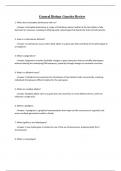
General Biology Genetics Review 1. What does incomplete dominance refer to? - Answer: Incomplete dominance is a type of inheritance where neither of the two alleles is fully dominant or recessive, resulting in offspring with a phenotype that blends the traits of both parents. 2. How is co-dominance defined? - Answer: Co-dominance occurs when both alleles in a gene pair fully contribute to the phenotype of an organism. 3. What is epigenetics? - Answer: Epigenetics involves heritable changes in gene expression that can modify phenotypes without altering the underlying DNA sequence, primarily through changes in chromatin structure. 4. What is a dihybrid cross? - Answer: A dihybrid cross examines the inheritance of two distinct traits concurrently, involving individuals that possess different alleles for the same gene. 5. What are multiple alleles? - Answer: Multiple alleles refer to a gene that can have three or more different forms, which all influence a single trait. 6. Define a pedigree. - Answer: A pedigree is a graphical representation that maps out the occurrence of a genetic trait across multiple generations within a family. 7. What signifies a sex-linked gene? - Answer: A sex-linked gene is located on one of the sex chromosomes, predominantly the X chromosome. 8. What is a karyotype? - Answer: A karyotype is a visual organization of the chromosome pairs in a cell, arranged according to size and shape. 9. How do you define phenotype? - Answer: The phenotype encompasses an organism's observable traits or physical characteristics. 10. What constitutes a genotype? - Answer: The genotype is the specific genetic composition of an organism, represented by its allele combinations. 11. What is selective breeding? - Answer: Selective breeding is a technique that involves choosing specific organisms with desired traits to produce the next generation. 12. What does the term genome include? - Answer: The genome contains all of the genetic material found within an organism, including all of its chromosomes. 13. What does it mean to be heterozygous? - Answer: An organism is considered heterozygous when it has two different alleles for a particular trait. 14. What is a hybrid in genetic terms? - Answer: The term hybrid is another way to describe a heterozygous organism. 15. What defines homozygous? - Answer: An organism is homozygous if it has two identical alleles for a specific trait. 16. What is a pure-line? - Answer: Pure-line is an alternative term used to describe homozygous organisms. 17. What describes a dominant allele? - Answer: A dominant allele is one that is expressed in the phenotype whenever it is present in the genotype. 18. How is a recessive allele characterized? - Answer: A recessive allele is one that is concealed when a dominant allele is present. 19. What is artificial selection? - Answer: Artificial selection involves breeding organisms with specific traits to produce offspring that exhibit those same traits. 20. What are autosomes? - Answer: Autosomes are chromosomes that are not involved in determining the sex of an individual. 21. What is the role of sex chromosomes? - Answer: Sex chromosomes are one of the 23 pairs of chromosomes in humans that carry genes responsible for determining an individual's sex. 22. What is a polygenic trait? - Answer: Polygenic traits are characteristics influenced by two or more different genes. 23. What is the Principle of Dominance? - Answer: The Principle of Dominance is Mendel's second conclusion, stating that some alleles are dominant while others are recessive. 24. What is the Principle of Independent Assortment? - Answer: The Principle of Independent Assortment asserts that alleles for one gene segregate independently of alleles for another gene during gamete formation. 25. What is the Principle of Segregation? - Answer: The Principle of Segregation states that during meiosis, chromosome pairs divide into separate gametes, ensuring that each gamete contains only one allele for each trait.

Content preview

General Biology Genetics Review
1. What does incomplete dominance refer to?

- Answer: Incomplete dominance is a type of inheritance where neither of the two alleles is fully
dominant or recessive, resulting in offspring with a phenotype that blends the traits of both parents.


2. How is co-dominance defined?

- Answer: Co-dominance occurs when both alleles in a gene pair fully contribute to the phenotype of
an organism.


3. What is epigenetics?

- Answer: Epigenetics involves heritable changes in gene expression that can modify phenotypes
without altering the underlying DNA sequence, primarily through changes in chromatin structure.


4. What is a dihybrid cross?

- Answer: A dihybrid cross examines the inheritance of two distinct traits concurrently, involving
individuals that possess different alleles for the same gene.


5. What are multiple alleles?

- Answer: Multiple alleles refer to a gene that can have three or more different forms, which all
influence a single trait.


6. Define a pedigree.

- Answer: A pedigree is a graphical representation that maps out the occurrence of a genetic trait
across multiple generations within a family.


7. What signifies a sex-linked gene?

- Answer: A sex-linked gene is located on one of the sex chromosomes, predominantly the X
chromosome.


8. What is a karyotype?

Document information

Study
Uploaded on
August 3, 2024
Number of pages
4
Written in
2024/2025
Type
Exam (elaborations)
Contains
Questions & answers
$11.30

Wrong document? Swap it for free Within 14 days of purchase and before downloading, you can choose a different document. You can simply spend the amount again.
Written by students who passed
Immediately available after payment
Read online or as PDF

Seller avatar
Reputation scores are based on the amount of documents a seller has sold for a fee and the reviews they have received for those documents. There are three levels: Bronze, Silver and Gold. The better the reputation, the more your can rely on the quality of the sellers work.
bestscores1
4.4
(5)
Sold
18
Followers
0
Items
1369
Last sold
1 month ago


Why students choose Stuvia

Created by fellow students, verified by reviews

Quality you can trust: written by students who passed their exams and reviewed by others who've used these revision notes.

Didn't get what you expected? Choose another document

No problem! You can straightaway pick a different document that better suits what you're after.

Pay as you like, start learning straight away

No subscription, no commitments. Pay the way you're used to via credit card and download your PDF document instantly.

Student with book image

“Bought, downloaded, and smashed it. It really can be that simple.”

Alisha Student

Working on your references?

Create accurate citations in APA, MLA and Harvard with our free citation generator.

Working on your references?

Frequently asked questions
