
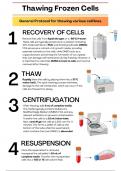
Thawing Frozen Cells
General Protocol for thawing various cell lines
RECOVERY OF CELLS
1 Remove the cells from liquid nitrogen or a -80ºC freezer.
These cells are typically preserved in a solution containing
10% Fetal Calf Serum (FCS) and dimethyl sulfoxide (DMSO).
FCS serves as a nutrient-rich growth media, providing
essential nutrients to the cells, while DMSO acts as a
cryoprotectant, preventing the formation of ice crystals
that can damage cell membranes during freezing. However, it
is important to note that DMSO is toxic to cells and must be
removed after thawing.
THAW
2 Rapidly thaw the cells by placing them into a 37ºC
water bath. This quick thawing process minimises
damage to the cell membranes, which can occur if the
cells are thawed too slowly.
CENTRIFUGATION
3 After thawing, add 5 mL of complete media.
This media typically contains Dulbecco’s
Modified Eagle Medium (DMEM), FCS, and any
relevant antibiotics to prevent contamination.
Transfer the cells to a 15 mL falcon tube.
Next, centrifuge the cells at 1,200 rom for 3
minutes. This forms a pellet of cells at the
bottom of the tube while the supernatant,
which contains the toxic DMSO, is discarded.
RESUSPENSION
4 Once the supernatant is removed,
resuspend the cell pellet in 10 mL of
complete media. Transfer the resuspended
cells into a T25 or 75 cell culture flask.


