

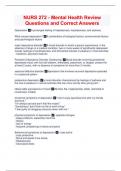
NURS 272 - Mental Health Review Questions and Correct Answers Depression ✅A prolonged feeling of helplessness, hopelessness, and sadness What causes depression? ✅A combination of biological factors, environmental factors and psychological factors major depressive disorder ✅A mood disorder in which a person experiences, in the absence of drugs or a medical condition, two or more weeks of significantly depressed moods, feelings of worthlessness, and diminished interest or pleasure in most activities. - Catatonic, psychotic features Persistent Depressive Disorder (Dysthymia) ✅Mood disorder involving persistently depressed mood, with low self -esteem, withdrawal, pessimism, or despair, present for at least 2 years, with no absence of symptoms for more than 2 months. seasonal affective disorder ✅depression that involves recurrent depressive episodes in a seasonal pattern postpartum depression ✅a mood disorder characterized by feelings of sadness and the loss of pleasure in normal activities that can occur shortly after giving birth Observable expressions of mood ✅Blunted, flat, inappropriate, labile, restricted or constricted, irritable emotional symptoms of depression ✅"I don't enjoy spending time with my friends anymore." "I'm always sad and don't feel like myself." "Sometimes I don't think my life is worth living." "I feel guilty for dragging everyone down with me." physical symptoms of depression ✅- appetite changes - sleep problems, especially insomnia - fatigue - loss of energy - frequent complaining of aches and pains Behavioural symptoms of depression ✅- Less active - Less productive - Move and speak more slowly - Restlessness - Decreased libido cognitive symptoms of depression ✅decreased focus and concentration, hard time making decisions, memory problems, underperforming at regular tasks Depression treatment ✅Exercise, sleep, nutrition, social supports, stress reduction, Ruling out of medical causes, psychotherapy, vitamins/supplements, relaxation techniques, acupuncture, medication tricyclic antidepressants ✅Cyclic antidepressants block the absorption (reuptake) of the neurotransmitters serotonin and norepinephrine, increasing the levels of these two neurotransmitters in the brain Selective Serotonin Reuptake Inhibitors (SSRIs) ✅a group of second -generation antidepressant drugs that increase serotonin activity specifically, without affecting other neurotransmitters - Fluoxetine, sertraline, fluvoxamine (prozac), paroxetine (paxil), citalopram, escitalopram Monoamine Oxidase Inhibitors (MAOIs) ✅An enzyme called monoamine oxidase is involved in removing the neurotransmitters norepinephrine, serotonin and dopamine from the brain. MAOIs block the action of this enzyme, resulting in more of these neurotransmitters in the brain. - Phenelzine (Nardil), tranylcypromine (parnate) Atypical Antidepressants ✅miscellaneous group of drugs with antidepressant effects but only mild side effects - Trazodone, bupropion, nefazodone, venlafaxine, mirtazapine electroconvulsive therapy (ECT) ✅a procedure, done under general anesthesia, in which small electric currents are passed through the brain, intentionally triggering a brief seizure Phototherapy ✅Light therapy uses specialized artificial light to treat mood disorders, shift one's biological clock, or synchronize one's sleep -wake cycle with the day/light cycle. It may also be useful in normalizing sleep and behavior in people with dementia, although more research is needed. Bipolar disorder ✅Formerly called manic depression, a mental illness that causes extreme mood swings that include emotional highs (mania or hypomania) and lows (depression) Bipolar I disorder ✅Defined by manic episodes that last at least 7 days, or by manic symptoms that are so severe that the person needs immediate hospital care. Usually, depressive episodes occur as well, typically lasting at least 2 weeks. Episodes of
Preview 2 out of 12 pages
Exam (elaborations)
NURS 272 - Mental Health Review Questions and Correct Answers
Preview 2 out of 12 pages
Depression A prolonged feeling of helplessness, hopelessness, and sadness What causes depression? A combination of biological factors, environmental factors and psychological factors major depressive disorder A mood disorder in which a person experiences, in the absence of drugs or a medical condition, two or more weeks of significantly depressed moods, feelings of worthlessness, and diminished interest or pleasure in most activities. - Catatonic, psychotic features Persistent Depressive Disorder (Dysthymia) Mood disorder involving persistently depressed mood, with low self-esteem, withdrawal, pessimism, or despair, present for at least 2 years, with no absence of symptoms for more than 2 months. seasonal affective disorder depression that involves recurrent depressive episodes in a seasonal pattern postpartum depression a mood disorder characterized by feelings of sadness and the loss of pleasure in normal activities that can occur shortly after giving birth Observable expressions of mood Blunted, flat, inappropriate, labile, restricted or constricted, irritable emotional symptoms of depression "I don't enjoy spending time with my friends anymore." "I'm always sad and don't feel like myself." "Sometimes I don't think my life is worth living." "I feel guilty for dragging everyone down with me." physical symptoms of depression - appetite changes - sleep problems, especially insomnia - fatigue - loss of energy - frequent complaining of aches and pains Behavioural symptoms of depression - Less active - Less productive - Move and speak more slowly - Restlessness - Decreased libido
Content preview
Document information
- Uploaded on
- August 2, 2024
- Number of pages
- 12
- Written in
- 2024/2025
- Type
- Exam (elaborations)
- Contains
- Questions & answers
$10.49
Wrong document? Swap it for free
Within 14 days of purchase and before downloading, you can choose a different document. You can simply spend the amount again.
Written by students who passed
Immediately available after payment
Read online or as PDF

Reputation scores are based on the amount of documents a seller has sold for a fee and the reviews they have received for those documents. There are three levels: Bronze, Silver and Gold. The better the reputation, the more your can rely on the quality of the sellers work.
Available in package deal
Package deal
NURS 272 Q&A Bundle

