

Geriatric Nursing Final NS 272 Questions a nd Correct Answers Dementia Core Features ✅-Amnesia -Aphasia -Apraxia -Agnosia -Need to be assessed if concerns are noted Amnesia ✅-short -term and long -term memory loses Aphasia ✅-difficulty with language and speech -Expressive - speech not fluid, halting manner speech, frustrated, depressed -Receptive - speak fluently, not responding to question + Obvious when doing the MMSE - can not repeat/name a common object Apraxia ✅-Inability to perform a movement or task when asked despite having the desire and physical capability to carry it out (ADLs, eating with utensils) Agnosia ✅-the inability to recognize familiar objects or people Executive Dysfunction ✅-Inability to function well in a social environment, inability to organize oneself, calculations, disinhibited, violent, control emotions Dementia (Major & Mild) ✅-Course is chronic, progressive and irreversible -Major: "significant" cognitive decline in one or more cognitive domains, with impairment in independent living -Mild: "modest" cognitive decline in one or more cognitive domains - deficits do not interfere with capacity of independent living Neurocognitive Disorder (NCD) (Dementia) ✅-Age major factor*** -Early onset: < age of 60 + Less than 5% of all cases of AD + Strong genetic link*** + Tends to progress more rapidly -Late onset: after age 60 + Represents the majority of cases Dementia Cognitive Domains ✅-Learning and memory -Language -Executive Functioning -Complex Attention -Perceptual Motor -Social Cognition 10 Early Signs and Symptoms of AD ✅-Memory loss that disrupts daily life. -Challenges in planning or solving problems. -Difficulty completing familiar tasks at home, at work or at leisure -Confusion with time or place. -Trouble understanding visual images and spatial relationships. -New problems with words in speaking or writing. -Misplacing things and losing the ability to retrace steps. -Decreased or poor judgment. -Withdrawal from work or social activities. -Changes in mood and personality. Mini Mental State Exam ✅-Screening for cognitive impairment -Limitations of the MMSE + patient education level to low or very high Delirium Risk Factors ✅-Use of physical restraints -Indwelling bladder catheter -Polypharmacy -Pain -Dehydration -Electrolyte imbalances (NA+ and K+) -Immobilization -Post- operative -general anesthesia -Environment - noisy -Lack of sleep Azotemia ✅-an elevation of blood urea nitrogen (BUN) and serum creatinine levels. The reference range for BUN is 8 -20 mg/dL, and the normal range for serum creatinine is 0.7 -1.4 mg/dL. Delirium Nursing Interventions ✅-Orientation to reality - -Sleep -enhancement -Vision & Hearing - be sure glasses and hearing aids are in use. -Dehydration -Ambulation, whenever possible -Quiet calm environment - use calm voice, calm music -Pain management -Elimination of unnecessary medications -D/C urinary catheter -Consistent caregivers -Family interaction
Preview 2 out of 10 pages
Exam (elaborations)
Geriatric Nursing Final NS 272 Questions and Correct Answers
Preview 2 out of 10 pages
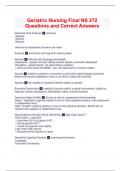
Dementia Core Features -Amnesia -Aphasia -Apraxia -Agnosia -Need to be assessed if concerns are noted Amnesia -short-term and long-term memory loses Aphasia -difficulty with language and speech -Expressive - speech not fluid, halting manner speech, frustrated, depressed -Receptive - speak fluently, not responding to question + Obvious when doing the MMSE - can not repeat/name a common object Apraxia -Inability to perform a movement or task when asked despite having the desire and physical capability to carry it out (ADLs, eating with utensils) Agnosia -the inability to recognize familiar objects or people Executive Dysfunction -Inability to function well in a social environment, inability to organize oneself, calculations, disinhibited, violent, control emotions Dementia (Major & Mild) -Course is chronic, progressive and irreversible -Major: "significant" cognitive decline in one or more cognitive domains, with impairment in independent living -Mild: "modest" cognitive decline in one or more cognitive domains- deficits do not interfere with capacity of independent living Neurocognitive Disorder (NCD) (Dementia) -Age major factor*** -Early onset: age of 60 + Less than 5% of all cases of AD + Strong genetic link*** + Tends to progress more rapidly -Late onset: after age 60 + Represents the majority of cases Dementia Cognitive Domains -Learning and memory -Language -Executive Functioning
Content preview
Document information
- Uploaded on
- August 1, 2024
- Number of pages
- 10
- Written in
- 2024/2025
- Type
- Exam (elaborations)
- Contains
- Questions & answers
$9.99
Wrong document? Swap it for free
Within 14 days of purchase and before downloading, you can choose a different document. You can simply spend the amount again.
Written by students who passed
Immediately available after payment
Read online or as PDF

Reputation scores are based on the amount of documents a seller has sold for a fee and the reviews they have received for those documents. There are three levels: Bronze, Silver and Gold. The better the reputation, the more your can rely on the quality of the sellers work.
Available in package deal
Package deal
NURS 272 Q&A Bundle

