

6.3 - Foreign exchange rates
6.3.1 Definition of foreign exchange rate
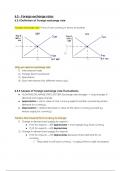
Foreign exchange rate: Price of one currency in terms of another
Why we need an exchange rate
1) International trade
2) Foreign direct investment
3) Speculation
4) Govt intervention (for different macro obj.)
6.3.3 Causes of foreign exchange rate fluctuations
● FLOATING EXCHANGE RATE SYSTEM: Exchange rate changes → only changes if
demand and supply change
● Appreciation = rise in value of one currency against another (caused by excess
demand for currency)
● Depreciation = relative decrease in value of the other currency (caused by
excess supply for currency)
Factors that cause D/S of currency to change
1) Change in demand and supply for exports
● If ↑D for exports → ER appreciates + more people buy local currency
● If ↓D for exports → ER depreciates
2) Change in demand and supply for imports
● If ↑D for imports → ER depreciates because of less demand for its
currency
○ They need to sell local currency → supply shifts to right (increases)
, 3) Change in relative inflation rate
● ↑ inflation → ER depreciates
○ Exports become more expensive → less demand for that country’s
products by foreign consumers → so there is less demand for the
currency
4) Change in relative interest rates
● ↑ r → ↑ ER
○ Increases in interest rates attracts foreign capital → more money
coming into the country + higher D for their currency
○ It attracts foreign investment because when they lend to firms, they
have a higher return relative to other countries
5) Foreign direct investment
● FDI into country: creates demand for currency → ER appreciates
● FDI by that country’s firms abroad: creates a supply of ER → ER
depreciate
6) Speculation
● Occurs when traders buy a currency in the expectation that it will be worth
more in the short to medium term, at which point they will sell it to make a
profit
● When they predict the future economic climate, they make decisions on
whether to purchase the currency now or later
7) Govt intervention
8) Country’s relative income level
● More demand for US dollar → increase in US income → rise in ER of US
dollar
○ No change in supply, only a shift of demand to the right
9) Capital outflow
● Too much capital outflow → leads to fall in ER
● Because more people sell their local currency in exchange for foreign
currency when capital leaves the country
6.3.4 Consequences of foreign exchange rate fluctuations
What will happen to ______ if the ER falls/rises? (6 marks)
WHENEVER ER FALLS → always INCREASE IN DEMAND for EXPORTS + DECREASE IN
DEMAND for IMPORTS
WHENEVER ER RISES → INCREASE IN PRICE OF IMPORTS
6.3.1 Definition of foreign exchange rate
Foreign exchange rate: Price of one currency in terms of another
Why we need an exchange rate
1) International trade
2) Foreign direct investment
3) Speculation
4) Govt intervention (for different macro obj.)
6.3.3 Causes of foreign exchange rate fluctuations
● FLOATING EXCHANGE RATE SYSTEM: Exchange rate changes → only changes if
demand and supply change
● Appreciation = rise in value of one currency against another (caused by excess
demand for currency)
● Depreciation = relative decrease in value of the other currency (caused by
excess supply for currency)
Factors that cause D/S of currency to change
1) Change in demand and supply for exports
● If ↑D for exports → ER appreciates + more people buy local currency
● If ↓D for exports → ER depreciates
2) Change in demand and supply for imports
● If ↑D for imports → ER depreciates because of less demand for its
currency
○ They need to sell local currency → supply shifts to right (increases)
, 3) Change in relative inflation rate
● ↑ inflation → ER depreciates
○ Exports become more expensive → less demand for that country’s
products by foreign consumers → so there is less demand for the
currency
4) Change in relative interest rates
● ↑ r → ↑ ER
○ Increases in interest rates attracts foreign capital → more money
coming into the country + higher D for their currency
○ It attracts foreign investment because when they lend to firms, they
have a higher return relative to other countries
5) Foreign direct investment
● FDI into country: creates demand for currency → ER appreciates
● FDI by that country’s firms abroad: creates a supply of ER → ER
depreciate
6) Speculation
● Occurs when traders buy a currency in the expectation that it will be worth
more in the short to medium term, at which point they will sell it to make a
profit
● When they predict the future economic climate, they make decisions on
whether to purchase the currency now or later
7) Govt intervention
8) Country’s relative income level
● More demand for US dollar → increase in US income → rise in ER of US
dollar
○ No change in supply, only a shift of demand to the right
9) Capital outflow
● Too much capital outflow → leads to fall in ER
● Because more people sell their local currency in exchange for foreign
currency when capital leaves the country
6.3.4 Consequences of foreign exchange rate fluctuations
What will happen to ______ if the ER falls/rises? (6 marks)
WHENEVER ER FALLS → always INCREASE IN DEMAND for EXPORTS + DECREASE IN
DEMAND for IMPORTS
WHENEVER ER RISES → INCREASE IN PRICE OF IMPORTS


