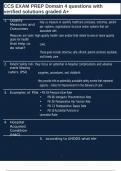
FAGD Exam - Orthodontics ANB angle greater than 4 degrees = ___? - Class II skeletal profile ANB angle less than 0 degrees = ___? - Class III skeletal profile Anterior cross bite in the primary dentition is often indicative of? - A skeletal growth problem or a developing class III malocclusion Anterior cross bite is often the result of? - - labially situated supernumerary tooth - traumatic injury - arch length discrepancy Anterior crossbite - - should be detected as soon as possible - should almost always be treated in the mixed dentition stage - most often associated with prolonged retention of a primary tooth - delayed treatment can lead to serious complications such as loss of arch length - most essential factor is space available mesiodistally - Benefits of the Hawley retainer? - - palatal coverage makes it possible to incorporate a bite plant lingual to the upper incisors to control bite depth - Causes of maxillary diastema? - - tooth -size discrepancy - mesiodens - abnormal frenum attachment - normal stage of development Cervical -pull headgear - consists of a cervical neck strap (as anchorage) and a standard facebow inserting into the headgear tubes of the maxillary first molar attachments. The objectives of treatment with these types of headgear are to restrict anterior growth of the maxilla and to distalize and erupt maxillary molars. A major disadvantage of treatment using cervical headgear is possible extrusion of the maxillary molars. Likely results include: opening the bite, first molars will move distally and forward growth of the maxilla will decrease. Indications: Class II malocclusions with deep bite Chin cup/chin cap - devices to utilize extra -oral traction to restrain or alter mandibular growth Indications: Class III malocclusions (due to excessive mandibular growth) Distal step occlusion = ? - Class II relationship Explain extrusion - displacement of the tooth from the socket in the direction of eruption Explain intrusion - Movement into the socket along the long axis of the tooth. Very difficult to accomplish. Explain rotational tooth movement - he only force system that can produce pure rotation (a moment with no net force) is a couple, which is two equal and opposite, noncollinear but parallel forces. Recurring tooth rotations after orthodontic correction occur because of the persistence of the elastic supracrestal gingival fibers (mainly free gingival and transseptal fibers). Important: Need adequate retention to prevent relapse
Exam (elaborations)
FAGD Exam - Orthodontics Questions And Answers With Verified Solutions Graded A+
Rating
Sold
-
Pages
9
Grade
A+
Uploaded on
30-07-2024
Written in
2023/2024
ANB angle greater than 4 degrees = ___? - Class II skeletal profile ANB angle less than 0 degrees = ___? - Class III skeletal profile Anterior cross bite in the primary dentition is often indicative of? - A skeletal growth problem or a developing class III malocclusion Anterior cross bite is often the result of? - - labially situated supernumerary tooth - traumatic injury - arch length discrepancy Anterior crossbite - - should be detected as soon as possible - should almost always be treated in the mixed dentition stage - most often associated with prolonged retention of a primary tooth - delayed treatment can lead to serious complications such as loss of arch length - most essential factor is space available mesiodistally - Benefits of the Hawley retainer? - - palatal coverage makes it possible to incorporate a bite plant lingual to the upper incisors to control bite depth - Causes of maxillary diastema? - - tooth-size discrepancy - mesiodens - abnormal frenum attachment - normal stage of developmentCervical-pull headgear - consists of a cervical neck strap (as anchorage) and a standard facebow inserting into the headgear tubes of the maxillary first molar attachments. The objectives of treatment with these types of headgear are to restrict anterior growth of the maxilla and to distalize and erupt maxillary molars. A major disadvantage of treatment using cervical headgear is possible extrusion of the maxillary molars. Likely results include: opening the bite, first molars will move distally and forward growth of the maxilla will decrease. Indications: Class II malocclusions with deep bite Chin cup/chin cap - devices to utilize extra-oral traction to restrain or alter mandibular growth Indications: Class III malocclusions (due to excessive mandibular growth) Distal step occlusion = ? - Class II relationship Explain extrusion - displacement of the tooth from the socket in the direction of eruption Explain intrusion - Movement into the socket along the long axis of the tooth. Very difficult to accomplish. Explain rotational tooth movement - he only force system that can produce pure rotation (a moment with no net force) is a couple, which is two equal and opposite, noncollinear but parallel forces. Recurring tooth rotations after orthodontic correction occur because of the persistence of the elastic supracrestal gingival fibers (mainly free gingival and transseptal fibers). Important: Need adequate retention to prevent relapseExplain tipping tooth movement - the crown moves in one direction while the root tip is displaced in the opposite direction due to rotation or pivoting of the tooth around the axis of resistance or axis of rotation (located somewhere in the apical one-third of the root). This creates two areas of compression and tension. Most readily accomplished with a removable appliance. Accomplished most easily with anterior incisor teeth. Explain torque tooth movement - controlled root movement labiolingually or mesiodistally while the crown is held relatively stable (mesial-distal root movement is also termed "uprighting"). Explain translation tooth movement - (bodily movement): a force through the center of resistance causes all points of the tooth to move the same amount in the same direction. This type of movement is called translation or bodily movement.
Show more
Read less
Institution
FAGD - Orthodontics
Module
FAGD - Orthodontics
Whoops! We can’t load your doc right now. Try again or contact support.
Written for
- Institution
- FAGD - Orthodontics
- Module
- FAGD - Orthodontics
Document information
- Uploaded on
- July 30, 2024
- Number of pages
- 9
- Written in
- 2023/2024
- Type
- Exam (elaborations)
- Contains
- Questions & answers
Subjects
Content preview
$7.99
Get access to the full document:
100% satisfaction guarantee
Immediately available after payment
Both online and in PDF
No strings attached

Also available in package deal
Package deal
FAGD Bundled with complete solutions;Updated 2024,2025
3
6
2024
$ 47.94
More info