
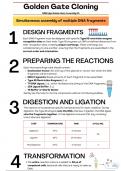
Golden Gate Cloning
NEBridge Golden Gate Assembly Kit
Simultaneous assembly of multiple DNA fragments
DESIGN FRAGMENTS
1 Each DNA fragment must be designed with specific Type IIS restriction enzyme
recognition sites at their ends. Type IIS enzymes cut DNA at defined distances from
their recognition sites, creating unique overhangs. These overhangs are
complementary to one another, ensuring that the fragments are assembled in the
correct order and orientation.
PREPARING THE REACTIONS
2 Each microcentrifuge tube should contain:
Destination Vector: 50-100 ng of the plasmid or vector into which the DNA
fragments will be inserted.
DNA fragments: Equal amounts of each fragment to be assembled
Type IIS Restriction Enzyme(s): 1 uL
T4 DNA Ligase: 1 uL, which facilitates the joining of the DNA fragments
10X Ligase Buffer: 2 uL
TE Buffer or Sterile Water
Gently tap the tube to mix the components without introducing bubbles
DIGESTION AND LIGATION
3 The reaction is incubated at specific temperatures for each condition. During
digestion, the Type IIS enzyme cuts the DNA whereas, in ligation, the DNA ligase
joins the fragments together. A final digestion ensures that any remaining
uncut sites are digested.
STEP TEMPERATURE TIME CYCLE NO.
Digestion 37ºC 5 minutes
30
Ligation 16ºC 10 minutes
Final Digestion 50ºC 5 minutes 1
TRANSFORMATION
4 1. The entire reaction mixture is added to 50 µL of
competent cells (bacterial cells that are ready to take up
DNA)


