

Written by students who passed Immediately available after payment Read online or as PDF Wrong document? Swap it for free 4.6 TrustPilot
logo-home
Document preview thumbnail
Preview 1 out of 4 pages
Summary

Summary - science electricity class 10

Document preview thumbnail
Preview 1 out of 4 pages

Certainly! Here's a detailed description of the entire document covering various topics in the CBSE Class 10 syllabus, including "Light: Refraction and Reflection," "Electricity," "Human Eye," and "Sources of Energy": --- ### **1. Light: Refraction and Reflection** **Refraction:** - **Definition:** The bending of light as it passes from one medium to another due to a change in its speed. - **Laws of Refraction:** Snell's Law states that ( frac{sin i}{sin r} = frac{v_1}{v_2} ), where (i) is the angle of incidence, (r) is the angle of refraction, and (v_1) and (v_2) are the velocities of light in the two media. - **Refractive Index:** A measure of how much a substance bends light, given by ( n = frac{c}{v} ), where (c) is the speed of light in a vacuum and (v) is the speed in the medium. - **Total Internal Reflection:** Occurs when light travels from a denser to a rarer medium and the angle of incidence exceeds the critical angle. **Reflection:** - **Definition:** The bouncing back of light when it hits a surface. - **Laws of Reflection:** - The angle of incidence is equal to the angle of reflection. - The incident ray, the reflected ray, and the normal all lie in the same plane. **Human Eye:** - **Structure:** Includes the cornea, iris, pupil, lens, retina, optic nerve, aqueous humor, vitreous humor, and sclera. - **Functioning:** Light enters the eye, is refracted by the cornea and lens, focused on the retina, and converted to electrical signals sent to the brain. - **Common Defects:** Myopia (nearsightedness), Hypermetropia (farsightedness), Astigmatism, and Presbyopia, with corrections including glasses, contact lenses, or surgery. **Electricity:** - **Basic Concepts:** Includes electric current, voltage, resistance, Ohm’s Law (( V = IR )), and power (( P = VI )). - **Electric Circuits:** Series and parallel circuits, their characteristics, and calculations for total resistance, current, and voltage. - **Magnetic Effects:** Includes the right-hand rule for determining the direction of the magnetic field around a current-carrying conductor and the operation of electric motors and generators. **Sources of Energy:** - **Conventional Sources:** Fossil fuels (coal, petroleum, natural gas), thermal power plants, hydropower, and nuclear power. - **Advantages:** Established technology, high energy density. - **Disadvantages:** Non-renewable, environmental pollution, high initial costs. - **Non-Conventional Sources:** Solar energy, wind energy, biomass energy, geothermal energy, and tidal/wave energy. - **Advantages:** Renewable, low emissions, diverse applications. - **Disadvantages:** Intermittent availability, high initial costs, location-specific limitations. - **Environmental Consequences:** Pollution, greenhouse gas emissions, resource depletion, and ecosystem disruption. - **Sustainable Energy:** Importance of diversifying energy sources, economic benefits, and protecting the environment. --- ### **Q&A Sections** **Light: Refraction and Reflection:** 1. **Refraction and Snell’s Law**: How does refraction occur and how is it measured? 2. **Reflection**: What are the laws of reflection and how do they apply to mirrors? **Electricity:** 1. **Ohm's Law**: How is Ohm's Law used to calculate current, voltage, and resistance? 2. **Electric Circuits**: What are the differences between series and parallel circuits? **Human Eye:** 1. **Structure and Function**: How do different parts of the eye contribute to vision? 2. **Common Defects**: What are common vision problems and their corrections? **Sources of Energy:** 1. **Fossil Fuels**: What are the main fossil fuels, and what are their advantages and disadvantages? 2. **Renewable Energy**: How do renewable energy sources work, and what are their limitations? --- The document provides a comprehensive overview of these topics, helping students understand fundamental concepts, applications, and implications related to light, electricity, the human eye, and various sources of energy. The Q&A sections are designed to reinforce key concepts and prepare students for exams.

Content preview

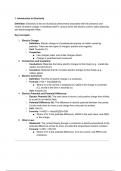
1. Introduction to Electricity

Definition: Electricity is the set of physical phenomena associated with the presence and
motion of electric charge. It manifests itself in various forms like electric current, static electricity,
and electromagnetic fields.

Key Concepts:

1. Electric Charge:
○ Definition: Electric charge is a fundamental property of matter carried by
particles. There are two types of charges: positive and negative.
○ Unit: Coulomb (C).
○ Properties:
■ Like charges repel, and unlike charges attract.
■ Charge is quantized and conserved.
2. Conductors and Insulators:
○ Conductors: Materials that allow electric charges to flow freely (e.g., metals like
copper and aluminum).
○ Insulators: Materials that do not allow electric charges to flow freely (e.g.,
rubber, glass).
3. Electric Current (I):
○ Definition: The flow of electric charge in a conductor.
○ Formula: I=QtI = \frac{Q}{t}I=tQ​
■ Where III is the current in amperes (A), QQQ is the charge in coulombs
(C), and ttt is the time in seconds (s).
○ Unit: Ampere (A).
4. Electric Potential and Potential Difference:
○ Electric Potential (V): The work done to move a unit positive charge from infinity
to a point in an electric field.
○ Potential Difference (V): The difference in electric potential between two points.
It is the work done to move a unit charge from one point to another.
○ Unit: Volt (V).
○ Formula: V=WQV = \frac{W}{Q}V=QW​
■ Where VVV is the potential difference, WWW is the work done, and QQQ
is the charge.
5. Ohm’s Law:
○ Statement: The current flowing through a conductor is directly proportional to the
potential difference across its ends, provided the temperature remains constant.
○ Formula: V=IRV = IRV=IR
■ Where VVV is the potential difference, III is the current, and RRR is the
resistance.


Document information

School year
4
Uploaded on
July 28, 2024
Number of pages
4
Written in
2023/2024
Type
Summary
$8.49

Wrong document? Swap it for free Within 14 days of purchase and before downloading, you can choose a different document. You can simply spend the amount again.
Written by students who passed
Immediately available after payment
Read online or as PDF

Sold
0
Followers
0
Items
5
Last sold
-


Why students choose Stuvia

Created by fellow students, verified by reviews

Quality you can trust: written by students who passed their tests and reviewed by others who've used these notes.

Didn't get what you expected? Choose another document

No worries! You can instantly pick a different document that better fits what you're looking for.

Pay as you like, start learning right away

No subscription, no commitments. Pay the way you're used to via credit card and download your PDF document instantly.

Student with book image

“Bought, downloaded, and aced it. It really can be that simple.”

Alisha Student

Working on your references?

Create accurate citations in APA, MLA and Harvard with our free citation generator.

Working on your references?

Frequently asked questions
