Geography Revision: Hazards
3.1.5.1 The concept of hazard in a geographical context
Nature, forms and potential impacts of natural hazards (geophysical, atmospheric and hydrological).
Hazard perception and its economic and cultural determinants. Characteristic human responses –
fatalism, prediction, adjustment/adaptation, mitigation, management, risk sharing – and their
relationship to hazard incidence, intensity, magnitude, distribution and level of development. The
Park model of human response to hazards. The Hazard Management Cycle.
Perception
Perception – the way in which an individual or a group views the threat of a hazard event
Fatalism – a view of a hazard event that suggests that people cannot influence or shape the
outcome, therefore nothing can be done to mitigate against it
Adaptation – the attempts by people or communities to live with hazard events by adjusting their
living conditions to reduce their levels of vulnerability
Fear – people feel so vulnerable to an event that they are no longer able to face living in the area
and move away to regions of ‘safety’
Management
Risk sharing – prearranged measures that aim to reduce the loss of life and property damage
through public education and awareness programmes, evacuation procedures, the provision of
supplies and the taking out of insurance
Prediction – the ability to give warnings so that action can be taken to reduce the impact of hazard
events (e.g. National Hurricane Centre in Florida)
Prevention – unrealistic idea of stopping the initial cause of the hazard event (e.g. cloud seeding to
cause more precipitation in potential tropical storms resulting in a weakened system)
Protection – the protect people, their possessions and the built environment from the impact of the
event
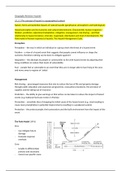
The Park Model (1991)
Pros
- Can mitigate future
damage
- Evaluate response
methods
Cons
- Unable to differentiate
primary and secondary
- Cannot see specific areas
3.1.5.1 The concept of hazard in a geographical context
Nature, forms and potential impacts of natural hazards (geophysical, atmospheric and hydrological).
Hazard perception and its economic and cultural determinants. Characteristic human responses –
fatalism, prediction, adjustment/adaptation, mitigation, management, risk sharing – and their
relationship to hazard incidence, intensity, magnitude, distribution and level of development. The
Park model of human response to hazards. The Hazard Management Cycle.
Perception
Perception – the way in which an individual or a group views the threat of a hazard event
Fatalism – a view of a hazard event that suggests that people cannot influence or shape the
outcome, therefore nothing can be done to mitigate against it
Adaptation – the attempts by people or communities to live with hazard events by adjusting their
living conditions to reduce their levels of vulnerability
Fear – people feel so vulnerable to an event that they are no longer able to face living in the area
and move away to regions of ‘safety’
Management
Risk sharing – prearranged measures that aim to reduce the loss of life and property damage
through public education and awareness programmes, evacuation procedures, the provision of
supplies and the taking out of insurance
Prediction – the ability to give warnings so that action can be taken to reduce the impact of hazard
events (e.g. National Hurricane Centre in Florida)
Prevention – unrealistic idea of stopping the initial cause of the hazard event (e.g. cloud seeding to
cause more precipitation in potential tropical storms resulting in a weakened system)
Protection – the protect people, their possessions and the built environment from the impact of the
event
The Park Model (1991)
Pros
- Can mitigate future
damage
- Evaluate response
methods
Cons
- Unable to differentiate
primary and secondary
- Cannot see specific areas