Geography Revision: Water and Carbon
3.1.1.1 Water and carbon cycles as natural systems
Systems concepts and their application to the water and carbon cycles (inputs – outputs, energy,
stores/components, flows/transfers, positive/negative feedback, dynamic equilibrium)
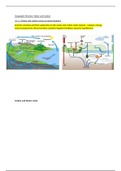
Carbon and Water cycles
, 3.1.1.2 The water cycle
Global distribution and size of major stores of water – lithosphere, hydrosphere, cryosphere and
atmosphere.
Major stores of water
Lithosphere – Outermost crust of the Earth including the crust and upper mantle
Hydrosphere – All the water on Earth in all forms (solid, liquid, gas/ saline or fresh)
Cryosphere – Portion of the Earths surface where water is in frozen form
69% world fresh water
Atmosphere – The layer of gas between the Earths surface and space
0.04% worlds fresh water
Processes driving change in the magnitude of these stores over time and space, including flows and
transfers: evaporation, condensation, cloud formation, causes of precipitation and Cryospheric
processes at hill slope, drainage basin and global scales with reference to varying timescales
involved.
Factors affecting water stores
Factor Effect Scale (time scale)
Evaporation/ Increases the amount of water stored Increased evaporation due to global
condensation in the atmosphere warming
Cloud Main flow of water from the Dependent on nuclei particles to form
formation atmosphere to the ground around, Occurs 3 times more on land
than on water
Cryospheric Accumulation – Input Very slow process driven by glacial
processes Ablation - Output periods
Drainage basin
3.1.1.1 Water and carbon cycles as natural systems
Systems concepts and their application to the water and carbon cycles (inputs – outputs, energy,
stores/components, flows/transfers, positive/negative feedback, dynamic equilibrium)
Carbon and Water cycles
, 3.1.1.2 The water cycle
Global distribution and size of major stores of water – lithosphere, hydrosphere, cryosphere and
atmosphere.
Major stores of water
Lithosphere – Outermost crust of the Earth including the crust and upper mantle
Hydrosphere – All the water on Earth in all forms (solid, liquid, gas/ saline or fresh)
Cryosphere – Portion of the Earths surface where water is in frozen form
69% world fresh water
Atmosphere – The layer of gas between the Earths surface and space
0.04% worlds fresh water
Processes driving change in the magnitude of these stores over time and space, including flows and
transfers: evaporation, condensation, cloud formation, causes of precipitation and Cryospheric
processes at hill slope, drainage basin and global scales with reference to varying timescales
involved.
Factors affecting water stores
Factor Effect Scale (time scale)
Evaporation/ Increases the amount of water stored Increased evaporation due to global
condensation in the atmosphere warming
Cloud Main flow of water from the Dependent on nuclei particles to form
formation atmosphere to the ground around, Occurs 3 times more on land
than on water
Cryospheric Accumulation – Input Very slow process driven by glacial
processes Ablation - Output periods
Drainage basin