KU BIOL 240 EXAM 1 QUESTIONS & ANSWERS RATED 100% CORRECT!!
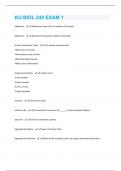
Abduction - Movement away from the midline of the body Adduction - Movement toward the midline of the body Aerolar Connective Tissue - Surrounds nerves/vessels •Binds skin to muscles •Subcutaneous layer of skin •Abundant blood vessels •Major site of inflamation Anatomical Position - 1) body erect 2) feet parallel 3) eyes forward 4) arms at side 5) palms forward Anterior - front of the body anterior side - A muscle that crosses on the _____ of a joint produces flexion. apocrine - entire cell excreted- puberty Appendicular Region - upper and lower limbs Appendicular Skeleton - Bones of the shoulder, pelvis, and upper and lower extremitiesArrector pili muscle - Causes hair to stand on end and goose bumps to appear (smooth muscle) Articulations (Joints) - point where two bones meet atrophy - decrease in cell size Axial Region - includes the head, neck, and trunk Axial Skeleton - Portion of the skeletal system that consists of the skull, rib cage, and vertebral column Axon - the neuron extension that passes messages through its branches to other neurons or to muscles or glands body cavities - house and support organs and compartmentalize organs, diseases cannot spread. Body Planes - Coronal = frontal Transverse = top & bottom Sagittal = left & right Parasagittal cardiac muscle tissue - specialized muscle tissue found only in the heart, striated and involuntary, single central nucleus, involuntary cell body of neuron - contains nucleus and organelles Cell layer 1 - simple squamous (1 layer of flat cells) simple cuboidal simple columnar (ciliated, nonciliated)pseudostratified (ciliated, nonciliated) Transitional Cell layers 2 - MORE THAN ONE LAYER IS ALWAYS FOR PROTECTION stratified squamous (keratinized, nonkeratinized) stratified cuboidal (more than 1 layer of cube shaped cells) stratified columnar cell shape- simple - squamous, cuboidal, columnar(ciliated and nonciliated) cell shape- stratified - squamous (keratinized, nonkeratinized, cuboidal, columnar Cell Shape-transitional and psuedotransitional - psuedotransitional- ciliated and nonciliated Cells (living) Matrix (non living intercellular substance) - tissues are composed of Cilia & Microvilli - increase surface area and act to move things along communication - function of nervous tissue Connective tissue - highly vascular,
Document information
- Uploaded on
- July 28, 2024
- Number of pages
- 10
- Written in
- 2023/2024
- Type
- Exam (elaborations)
- Contains
- Questions & answers