

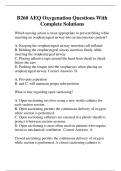
B260 AEQ Oxygenation Questions With Complete Solutions Which nursing action is most appropriate to prevent biting while inserting an oropharyngeal airway into an unconscious patient? A. Keeping the oropharyngeal airway insertion cuff inflated B. Holding the oropharyngeal airway insertion firmly while insert ing the oropharnygeal airway C. Placing adhesive tape around the head from cheek to cheek below the ears D. Pushing the tongue into the oropharynx when placing an oropharyngeal airway hhCorrect Answers hhD. A. Prevents aspiration B. and C. will maintain pr oper tube position What is true regarding open suctioning? A. Open suctioning involves using a new sterile catheter for each suction session. B. Open suctioning permits the continuous delivery of oxygen while suction is performed. C. Open suctioning cath eters are encased in a plastic sheath to protect it between suction sessions. D. Open suctioning is most often used on patients who require invasive mechanical ventilation. hhCorrect Answers hhA. Closed suctioning permits the continuous delivery of oxygen while suction is performed. A closed suctioning catheter is encased in a plastic sheath to protect it between suction sessions. It is most often used on patients who require invasive mechanical ventilation to support their respiratory efforts. Which nursin g action would be beneficial to prevent skin necrosis in a patient who has undergone a tracheostomy? A. Inserting the tracheostomy dressing under clean ties and faceplate B. Verifying the space of two snug finger widths under the neck strap C. Using a small brush to remove secretions inside and outside the cannula D. Patting at the skin and exposed surfaces of the outer cannula using wet 4 × 4 gauze hhCorrect Answers hhB. The dressing prevents pressure on the clavicle heads. The use of a trac heostomy brush provides mechanical force to remove thick or dried secretions in the tube. The dry 4 × 4 gauze should be used to prevent skin excoriation, not wet gauze. Which nursing intervention, if performed before suctioning, minimizes hypoxemia after suctioning? A. Lubricating the catheter B. Applying suction during the insertion C. Performing the suctioning too frequently D. Hyperoxygenating the patient before suctioning hhCorrect Answers hhD.
Preview 2 out of 12 pages
Exam (elaborations)
B260 AEQ Oxygenation Questions With Complete Solutions
Preview 2 out of 12 pages
B260 AEQ Oxygenation Questions With Complete Solutions
Content preview
Document information
- Uploaded on
- July 26, 2024
- Number of pages
- 12
- Written in
- 2023/2024
- Type
- Exam (elaborations)
- Contains
- Unknown
$12.49
Wrong document? Swap it for free
Within 14 days of purchase and before downloading, you can choose a different document. You can simply spend the amount again.
Written by students who passed
Immediately available after payment
Read online or as PDF

Reputation scores are based on the amount of documents a seller has sold for a fee and the reviews they have received for those documents. There are three levels: Bronze, Silver and Gold. The better the reputation, the more your can rely on the quality of the sellers work.

