

Engineering Management Reviewer
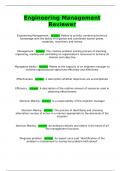
Engineering Management Refers to activity combining technical knowledge with the ability to organize and coordinate worker power, materials, machinery and money Management The creative problem solving process of planning, organizing, leading and controlling an organization's resources to achieve its mission and objective Managerial Ability Refers to the capacity of an engineer manager to achieve organizational objectives efficiently and effectively Effectiveness A description whether objectives are accomplished Efficiency A description of the relative amount of resources used in obtaining effectiveness Decision Making Is a responsibility of the engineer manager Decision Making The process of identifying and choosing alternative courses of action in a manner appropriate to the demands of the situation Decision Making According to Nickels and others is the heart of all the management functions Diagnose problem An expert once said "identification of the problem is tantamount to having the problem half-solved" Problem Exists when there is a difference between an actual situation and desired situation Analyze the Environment The environment where the organization is situated plays a very significant roke in the success or failure of such an organization. Therefore this must be undertaken. Identification of Constraints Objectives of environmental analysis, which may be internal or external - Internal Environment - External Environment Components of the Environment Internal Environment Refers to organizational activities within the firm that surrounds decision making External Environment Refers to variables that are outside the organization and not typically within the short run control of top management Organizational Aspects Structures, policies, procedures, rules, ability of management Marketing Aspects Product strategy, promotion strategy Personnel Aspects Recruitment practices, incentive systems Production Aspects Plan facility layout, inventory control Financial Aspects Liquidity, profitability Evaluate Alternatives After determining the viability of the alternatives and a revised list was made, an evaluation of the remaining alternatives is necessary. Choice Making Refers to the process of selecting among the alternatives representing potential solutions to a problem Implementation Refers to carrying out the decision so that the objectives sought will be achieved Feedback Refers to the process which requires checking at each stage of the process to assure that the alternatives generated, criteria used in evaluation, and the solution selected for implementation are in keeping with the goals and objectives originally specified Control Refers to actions made to ensure that activities performed match the desired activities or goals that have been set 1. Qualitative Approach 2. Quantitative Approach Approaches in solving problems Qualitative Approach Refers to evaluation of alternatives using intuition and subjective judgement Quantitative Approach Refers to the evaluation of alternatives using any technique in a group classified as rational and analytical Economic Order Quantity Model Used to calculate the number of items that should be ordered at one time to minimize the total yearly cost of placing orders and carrying the items in inventory Production Order Quantity Model An economic order quantity technique applied to production orders Back Order Inventory Model An inventory model used for planned shortages Quantity Discount Model An inventory model used to minimize the total cost when quantity discounts are offered by suppliers Queueing Theory Describes how to determine the number of service units that will minimize both customer waiting time and cost of service 1. The Program Evaluation Review Technique (PERT) 2. The Critical Path Method (CPM) Network models The Program Evaluation Review Technique Enables the engineer manager to schedule, monitor and control large and complex projects by employing three time estimates for each activity
Document information
- Uploaded on
- July 25, 2024
- Number of pages
- 11
- Written in
- 2023/2024
- Type
- Exam (elaborations)
- Contains
- Questions & answers


