
Brunner & Suddarth Ch 52 Endocrine Exam Questions With Correct Answers The nurse is caring for a patient diagnosed with hypothyroidism secondary to Hashimoto's thyroiditis. When assessing this patient, what sign or symptom would the nurse expect? A) Fatigue B) Bulging eyes C) Palpitations D) Flushed skin - ANSWER - A) Fatigue Symptoms of hypothyroidism include extreme fatigue, hair loss, brittle nails, dry skin, voice huskiness or hoarseness, menstrual disturbance, and numbness and tingling of the fingers. Bu lging eyes, palpitations, and flushed skin would be signs and symptoms of hyperthyroidism. A patient has been admitted to the post -surgical unit following a thyroidectomy. To promote comfort and safety, how should the nurse best position the patient? A) Side-lying (lateral) with one pillow under the head B) Head of the bed elevated 30 degrees and no pillows placed under the head C) Semi -Fowler's with the head supported on two pillows D) Supine, with a small roll supporting the neck - ANSWER - C) Semi -Fowle r's with the head supported on two pillows When moving and turning the patient, the nurse carefully supports the patient's head and avoids tension on the sutures. The most comfortable position is the semi -Fowler's position, with the head elevated and supp orted by pillows. A patient with thyroid cancer has undergone surgery and a significant amount of parathyroid tissue has been removed. The nurse caring for the patient should prioritize what question when addressing potential complications? A) "Do you fe el any muscle twitches or spasms?" B) "Do you feel flushed or sweaty?" C) "Are you experiencing any dizziness or lightheadedness?" D) "Are you having any pain that seems to be radiating from your bones?" - ANSWER - A) "Do you feel any muscle twitches or spa sms?" As the blood calcium level falls, hyperirritability of the nerves occurs, with spasms of the hands and feet and muscle twitching. This is characteristic of hypoparathyroidism. Flushing, diaphoresis, dizziness, and pain are atypical signs of the resu lting hypocalcemia. The nurse is caring for a patient with a diagnosis of Addison's disease. What sign or symptom is most closely associated with this health problem? A) Truncal obesity B) Hypertension C) Muscle weakness D) Moon face - ANSWER - C) Muscle weakness Patients with Addison's disease demonstrate muscular weakness, anorexia, gastrointestinal symptoms, fatigue, emaciation, dark pigmentation of the skin, and hypotension. Patients with Cushing syndrome demonstrate t runcal obesity, "moon" face, acne, abdominal striae, and hypertension. The nurse is caring for a patient with Addison's disease who is scheduled for discharge. When teaching the patient about hormone replacement therapy, the nurse should address what topi c? A) The possibility of precipitous weight gain B) The need for lifelong steroid replacement C) The need to match the daily steroid dose to immediate symptoms D) The importance of monitoring liver function - ANSWER - B) The need for lifelong steroid repla cement Because of the need for lifelong replacement of adrenal cortex hormones to prevent addisonian crises, the patient and family members receive explicit education about the rationale for replacement therapy and proper dosage. Doses are not adjusted on a short -term basis. Weight gain and hepatotoxicity are not common adverse effects. The nurse is teaching a patient that the body needs iodine for the thyroid to function. What food would be the best source of iodine for the body? A) Eggs B) Shellfish C) Table salt D) Red meat - ANSWER - C) Table salt The major use of iodine in the body is by the thyroid. Iodized table salt is the best source of iodine. A patient is prescribed corticosteroid therapy. What would be priority information for the nurse to gi ve the patient who is prescribed long -term corticosteroid therapy? A) The patient's diet should be low protein with ample fat.
Preview 2 out of 13 pages
Exam (elaborations)
Brunner & Suddarth Ch 52 Endocrine Exam Questions With Correct Answers
Preview 2 out of 13 pages
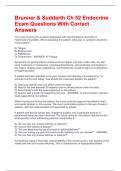
Brunner & Suddarth Ch 52 Endocrine Exam Questions With Correct Answers The nurse is caring for a patient diagnosed with hypothyroidism secondary to Hashimoto's thyroiditis. When assessing this patient, what sign or symptom would the nurse expect? A) Fatigue B) Bulging eyes C) Palpitations D) Flushed skin - ANSWER- A) Fatigue Symptoms of hypothyroidism include extreme fatigue, hair loss, brittle nails, dry skin, voice huskiness or hoarseness, menstrual disturbance, and numbness and tingling of the fingers. Bulging eyes, palpitations, and flushed skin would be signs and symptoms of hyperthyroidism. A patient has been admitted to the post-surgical unit following a thyroidectomy. To promote comfort and safety, how should the nurse best position the patient? A) Side-lying (lateral) with one pillow under the head B) Head of the bed elevated 30 degrees and no pillows placed under the head C) Semi-Fowler's with the head supported on two pillows D) Supine, with a small roll supporting the neck - ANSWER- C) Semi-Fowler's with the head supported on two pillows When moving and turning the patient, the nurse carefully supports the patient's head and avoids tension on the sutures. The most comfortable position is the semi-Fowler's position, with the head elevated and supported by pillows. A patient with thyroid cancer has undergone surgery and a significant amount of parathyroid tissue has been removed. The nurse caring for the patient should prioritize what question when addressing potential complications? A) "Do you feel any muscle twitches or spasms?" B) "Do you feel flushed or sweaty?" C) "Are you experiencing any dizziness or lightheadedness?" D) "Are you having any pain that seems to be radiating from your bones?" - ANSWER- A) "Do you feel any muscle twitches or spasms?" As the blood calcium level falls, hyperirritability of the nerves occurs, with spasms of the hands and feet and muscle twitching. This is characteristic of hypoparathyroidism.
Content preview
Document information
- Uploaded on
- July 24, 2024
- Number of pages
- 13
- Written in
- 2023/2024
- Type
- Exam (elaborations)
- Contains
- Questions & answers
$10.39
Wrong document? Swap it for free
Within 14 days of purchase and before downloading, you can choose a different document. You can simply spend the amount again.
Written by students who passed
Immediately available after payment
Read online or as PDF

Reputation scores are based on the amount of documents a seller has sold for a fee and the reviews they have received for those documents. There are three levels: Bronze, Silver and Gold. The better the reputation, the more your can rely on the quality of the sellers work.

