

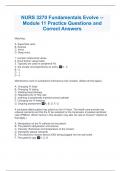
NURS 3270 Fundamentals Evolve -- Module 11 Practice Questions and Correct Answers
Matching: A. Superficial veins B. Arteries C. Veins D. Deep veins 1. Contain intraluminal valves 2. Have thicker vessel walls 3. Typically are used for peripheral IVs 4. Are usually accompanied by an artery A - 3 B - 2 C - 1 D - 4 Maintenance care of a peripheral intravenous site includes: (Select all that apply.) A. Changing IV fluids B. Changing IV tubing C. Initiating blood therapy D. Regulating the IV flow rate E. Inserting a peripherally inserted central catheter F. Changing the IV dressing G. Ongoing assessment A, B, D, F, G A confused elderly patient has pulled out her IV twice. The health care provider has ordered restraints and that the IV be restarted for the transfusion of packed red blood cells (PRBCs). Which factors in this situation may alter the rate of infusion? (Select all that apply.) A. Manipulation of the IV catheter by the patient B. The patient's dehydration and anemia C. Viscosity (thickness) and temperature of the infusion D. Improperly placed restraints E. The electronic infusion device (EID) being plugged into the wall outlet F. The patient's age A, C, D The nursing assistive personnel turned and repositioned the patient as requested. However, now the alarm on the electronic infusion device is sounding. Which of the following situations is most likely to have set off the alarm? A. The patient is probably developing phlebitis. B. There is now air in the tubing. C. The rate of infusion has increased. D. The patient is lying on the tubing. D. The patient is lying on the tubing. Which of the following is an acceptable IV site in a child, but not a routine site in adults? A. Hand B. Foot C. Forearm D. Scalp B. Foot A vital factor in the care of a peripheral IV infusion is the prevention of infection. Which of the following, if performed by the nurse, would indicate the nurse requires further instruction in IV fluid therapy management? The nurse: A. allows the IV site to air-dry for 30 seconds after cleaning with chlorhexidine. B. palpates the IV insertion site through the dressing daily. C. cleans the injection port with an alcohol swab prior to accessing the system. D. palpates the IV insertion site after the site is cleansed to verify vein location prior to needle insertion. D. palpates the IV insertion site after the site is cleansed to verify vein location prior to needle insertion. If a nurse fails to monitor a patient's IV infusion, what complications could develop? (Select all that apply.) A. None, if the patient has a volume-control device B. The patient may experience infiltration. C. None, if the patient has an inline filter D. The catheter may clot off. E. The patient may receive less than the prescribed amount of IV fluids. F. The patient may receive more than the prescribed amount of IV fluids. G. None, because the nursing assistive personnel may regulate the IV in the nurse's absence B, D, E, F
Document information
- Uploaded on
- July 21, 2024
- Number of pages
- 7
- Written in
- 2023/2024
- Type
- Exam (elaborations)
- Contains
- Questions & answers


