

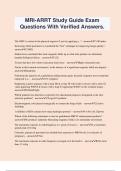
MRI-ARRT Study Guide Exam Questions With Verified Answers.
MRI-ARRT Study Guide Exam Questions With Verified Answers. The NMV is rotated to the physical negative Z axis by applying a...? - answerC)180 pulse Increasing which parameter is considered the "best" technique for improving image quality? - answerC)NEX Studies have concluded that static magnetic fields up to what tesla produce no substantial harmful biological effects. - answerC)2.0 Tissues that have low (short) relaxation times have: - answerHigher relaxation rates Nuclei in their natural enviroment ( in the absence of a significant magnetic field) are aligned... - answerRandomly Following the injection of a gadolinium enhancement agent, the pulse sequence most commonly employed is a... - answerC)T1 weighted Employing a pulse sequence with a long TR & a long TE will result in tissues with a short T2 value appearing WHAT & tissues with a long T2 appearing WHAT on the resultant image. - answerD)Dark/bright Which gradient axis direction is typically (for educational purposes) designated as the slice selection gradient? - answerC)Logical Z gradient Electromagnetic coils placed strategically to contain the fringe fields. - answer2)Active shielding 1 milliliter of H2O contains how many hydrogen protons? - answer6 ×10 to th 23power Which of the following statements is true for gadolinium MRI IV enhancement products? - answerB) produces randomly fluctuating magnetic fields in its immediate enviroment. The maximum exposure to radiofrequency in 1 gram of tissue is: - answerD) a maximum spatial peak of 8 w/kg Currently, patients & personnel arr exluded from exposure to MRI for the 1st trimester of pregnancy. - answerTrue The maximum exposure to radio frequency averaged over the head is: - answerB)No more than 3.2 w/kg The recieve signal amplitude for a pixel usually depends on thr substance's... - answerA) T1, T2 , proton density Small magnetic field intoduced to the hydrogen protons in order to cause them yo move from the low energy state to the high energy state is... - answerC) RF pulse at any one time, human body tissue, in general, is made up of 50%-90% of what substance? - answerHydrogen. once the patient's area of interest is placed in the main magnetic field of the MRI system, the hydrogen protons will... - answerprecess parallel to B sub zero In most tissues hydrogen concentration varies - answer10%- to 15% T1 is the measurement of time for the longitudinal component of the net magnetization vector to recover what percentage of its original value after the application of a 90 degree radio frequency pulse? - answer63% because of the spinning motion of the hydrogen proton, it has the same properties as a bar magnet. the hydrogen proton spinning motion gives it a... - answermagnetic moment Magnetic resonance imaging is derived from the process known as... - answerNuclear magnetic resonance normally enhancing structures post gadolinium - answerchoroid plexus because of only a 10% to 15% variation in most tissues, the tissue character that does not provide much contrast resolution... - answerhydrogen concentration An inversion recovery pulse sequence can be which of the following? - answerACC RF. average over the whole body is answer 1. averaged over the head is answer 2. in one gram (1gr) of tissue is answer 3. - answer1.C) no more than 0.4 w/kg 2.A) no more than 3.2w/kg 3.B) maximum spatial peak if 8 w/kg on T1 weighted images sub-acute hemorrhage will appear bright? - answerTRUE which characteristic of tissue, in MRI, is the result of fast transition phenomenon &/or entry phenomenon? - answerflow/velocity effects radio frequency RF coils that are placed close to the patient's body specifically for structures that are superficial & are receive coils only are... - answersurface coils chemical shift artifacts will show up on the image in what gradient direction? - answerB) frequency encoding coils that superimpose small magnetic fields within the patient during the MRI process & allow for special encoding are... - answergradient coils In an Inversion Recovery pulse sequence what TI will produce STIR fat-suppressed pulse sequence? - answer80-120 The Larmor precessional or resonance frequency of hydrogen protons in a static magnetic field of 0.5 is approximately... - answer21.288 MHz Residual, undesirable gradient magnetic fields that persist for a variable time duration after the pulse of electricity from the gradient power supply is terminated are known as... - answerEddy Currents which parameter in a pulse sequence helps to prevent "cross talk" between 2 adjacent images? - answerSlice intervals Patients that have implants such as a pacemaker or neurstimulator should not go beyond the... - answer5 gauss line when increasing the parameter matrix, the pixel size will... - answerdecrease once the MRI patient is comfortable & has no apparent problem with the overall procedure, it is acceptable for the technologist to leave the scanning area while a long scan is underway - answerfalse the time interval between 90 degree RF pulses. - answerTR the tissue characteristic which depends more on the state (solid, liquid, gas) of a tissue than other factor is... - answerT2 effects after a 90 degree radio frequency pulse, the net magnetization vector begins to return to equilibrium. When NMV is half-way between transverse & equilibrium, what are the magnitudes of the longitudinal component & the transverse component? - answerlongitudinal component= greater than zero transverse component = greater than zero which type of MRI magnet requires cryogens to cool magnetic coils to 4 degrees Kelvin? - answersuper conductive currently there is no evidence of threat to fetal development from MRI exposure - answertrue the T2 process is also known as... - answerspin-lattice
Document information
- Uploaded on
- July 20, 2024
- Number of pages
- 26
- Written in
- 2023/2024
- Type
- Exam (elaborations)
- Contains
- Questions & answers


