

Generic intro: Lord of the Flies, by William Golding, is a dystopian novel that takes place on
an uninhabited, tropical island in the Pacific Ocean, during a fictional worldwide war in the
late 1950's. Even though the novel is fictional, its exploration of the idea of human evil is
partly based on Golding's violent, real-life experience in the navy in World War II. In the
novel, a group of young boys arrive on the island when an airplane evacuating them
crashes. Free from the rules and structures of civilization and society, the boys descend into
savagery. The island therefore is a microcosm and arguably a political and religious allegory,
a metaphor for the workings of adult and human society; reflected by how everything in the
novel represents something or someone from Golding's world, such as behaviours of boys
and teachers from the boy’s Public school he taught at, politics, the government and
democracy, British civilisation and supremacy. The novel, alongside challenging these ideas,
responded as a parody to the 19th century book: The Coral Island by R.M Ballantyne. This
employs a similar plot, although the boys behave sensibly and as admirably as adults would,
unlike in Lord of the Flies, which uses shocking, violent events to present ideas about human
nature.
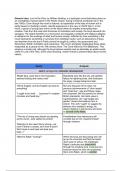
Quote Analysis
Jack’s (antagonist) character development
"Bright blue, eyes that in this frustration Beautifully blue like the sky, yet pathetic
seemed bolting and nearly mad" fallacy for lightning bolts, and forebodes
his angry, savage behaviour later.
“We're English; and the English are best at Not only because of his class, his
everything” previous achievements of “choir leader”
and “head boy”, age and fitness make
“I ought to be chief . . . because I'm chapter him important, like his parents he follows
chorister and head boy.” British standards. He holds value in
superficialness, his “cap badge was
golden” shows she believes he’s a
winner. The verb “ought” to suggest he
believes he’s entitled to things; he
doesn’t believe in democracy and does
in survival of the fittest.
“This toy of voting was almost as pleasing Foreshadows how democracy will
as the conch. Jack started to protest” crumble due to him. Asserts himself
through violence.
“Bollocks to the rules! We’re strong—we
hunt! If there’s a beast, we’ll hunt it down!
We’ll close in and beat and beat and
beat—!”
Yelled to Ralph “coming?” When the boys are discussing who will
go up the mountain and find the beast
Jack says he will go. He challenges
Ralph’s authority and masculinity
through his mocking tone, because he’s
insecure about his own and projecting
them onto Ralph, which is another
an uninhabited, tropical island in the Pacific Ocean, during a fictional worldwide war in the
late 1950's. Even though the novel is fictional, its exploration of the idea of human evil is
partly based on Golding's violent, real-life experience in the navy in World War II. In the
novel, a group of young boys arrive on the island when an airplane evacuating them
crashes. Free from the rules and structures of civilization and society, the boys descend into
savagery. The island therefore is a microcosm and arguably a political and religious allegory,
a metaphor for the workings of adult and human society; reflected by how everything in the
novel represents something or someone from Golding's world, such as behaviours of boys
and teachers from the boy’s Public school he taught at, politics, the government and
democracy, British civilisation and supremacy. The novel, alongside challenging these ideas,
responded as a parody to the 19th century book: The Coral Island by R.M Ballantyne. This
employs a similar plot, although the boys behave sensibly and as admirably as adults would,
unlike in Lord of the Flies, which uses shocking, violent events to present ideas about human
nature.
Quote Analysis
Jack’s (antagonist) character development
"Bright blue, eyes that in this frustration Beautifully blue like the sky, yet pathetic
seemed bolting and nearly mad" fallacy for lightning bolts, and forebodes
his angry, savage behaviour later.
“We're English; and the English are best at Not only because of his class, his
everything” previous achievements of “choir leader”
and “head boy”, age and fitness make
“I ought to be chief . . . because I'm chapter him important, like his parents he follows
chorister and head boy.” British standards. He holds value in
superficialness, his “cap badge was
golden” shows she believes he’s a
winner. The verb “ought” to suggest he
believes he’s entitled to things; he
doesn’t believe in democracy and does
in survival of the fittest.
“This toy of voting was almost as pleasing Foreshadows how democracy will
as the conch. Jack started to protest” crumble due to him. Asserts himself
through violence.
“Bollocks to the rules! We’re strong—we
hunt! If there’s a beast, we’ll hunt it down!
We’ll close in and beat and beat and
beat—!”
Yelled to Ralph “coming?” When the boys are discussing who will
go up the mountain and find the beast
Jack says he will go. He challenges
Ralph’s authority and masculinity
through his mocking tone, because he’s
insecure about his own and projecting
them onto Ralph, which is another


