
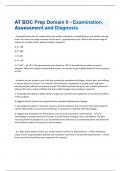
AT BOC Prep Domain II - Examination, Assessment and Diagnosis Questions & Answers Solved 100% Correct!!
. A baseball coach who is 6 weeks status post rotator cuff repair is rehabilitating in your athletic training room. You assess the range of motion of the coach ' s glenohumeral joint. What is the normal range of motion for shoulder flexion without scapular elevation? A. 0°-120° B. 0°-180° C. 0°-90° D. 0°-135° E. 0°-160° - A: The glenohumeral joint allows for 120° of forward fl exion without scapular elevation. When the scapula is permitted to elevate, the normal range of glenohumeral fl exion increases to 180°. . A patient you are seeing in your clinic has consistently complained of fatigue, chronic pain, and stiffness in various joints for the past 2 to 3 months. She notes pain to palpation of several joints, and some warmth and joint effusion are present as well. The patient has been doing her own research online and tells you that she is pretty confident that she has fibromyalgia. How would you respond? A. Encourage the patient to begin taking a magnesium and folic acid supplement to minimize the effects of the condition. B. Suggest that the patient see a psychiatrist for possible antidepressant therapy. C. Encourage the patient to share her concerns with her physician, but remind her that active evidence of joint inflammation such as heat and effusion is not present in patients with fibromyalgia. D. Suggest that the patient see her physician and ask to be screened for Lyme disease. - C: Fibromyalgia is characterized by a minimum 3-month history of fatigue, pain, and stiffness. The pain must be present to palpation at 11 of 18 identifi ed sites and must occur bilaterally above and below the waist without evidence of active joint infl ammation . As a high school athletic trainer, you receive a phone call from a local physician ' s office requesting copies of your preparticipation physical and evaluation notes from a 16-year-old football player ' s recent knee injury. How should you best respond to this request?A. A release of records must be signed by the athlete, and then they can be faxed to the requesting physician. B. The requested records may be faxed or mailed to the requesting physician ' s office. C. The athlete ' s mother may call and request the records be sent, and then the records can be faxed to the requesting physician D. The coach requests the records be sent on behalf of the athlete, and then the records can be faxed to the requesting physician. E. The athlete and a parent may come by the athletic training clinic and pick up copies of his records to take to the physician. - E: Because the athlete is under age, a parent or legal guardian must be present to request medical documentation. This complies with Health Insurance Portability and Accountability Act (HIPAA) regulations . You are evaluating a patient who complains of a "squeaky" sensation along the back of the lower leg into the foot. A palpable nodule can be felt along the distal tendon. Plantar flexion is painful and weak, and passive dorsiflexion is limited by pain at the end range. Which of the following is the most appropriate differential diagnosis for this patient? A. Heel spur, calcaneal stress fracture, fat pad syndrome, plantar fasciitis B. Os peroneum syndrome, lateral ankle, syndesmotic ankle sprain C. Osteochondritis dissecans, medial tibial stress syndrome, deep vein thrombosis D. Subcutaneous calcaneal bursitis, insertional Achilles tendonitis, Sever ' s disease - D: Each of the conditions listed is consistent with Achilles tendinopathies, which must be screened to determine the specifi c injury. A 12-year-old basketball camper reports anterior knee pain focused at the inferior insertion of the patellar tendon. What apophyseal injury should you suspect? A. Sever ' s disease B. Osgood-Schlatter disease C. Salter-Harris II fracture D. Larsen-Johansson disease E. Legg-Calvé-Perthes disease - B: Osgood-Schlatter disease is a common knee condition in adolescents. This condition is an apophysitis characterized by pain at the tibial tuberosity, the distal attachment of the patella tendonA 13-year-old adolescent athlete presents for evaluation of pain, stiffness, and swelling in multiple joints that have been present in varying degrees of intensity for more than 6 months without any mechanism of injury. Joint stability tests are within normal limits. Which of the following conditions would be in your differential diagnosis? A. Apophysitis B. Raynaud disease C. Juvenile idiopathic arthritis D. Multiple sclerosis - C: Juvenile idiopathic arthritis (JIA) should be included in the differential diagnosis any time a child younger than 16 years of age presents with unexplained joint pain for which other diagnoses have been excluded A 14-year-old skateboarder falls while performing a trick and externally rotates his foot. The anterior tibiofibular ligament is intact, but you suspect he may have sustained a fracture. Which fracture is most likely based on this information? A. Salter-Harris V fracture of the distal tibia B. Talar dome fracture C. Tillaux ' s fracture D. Fibular avulsion fracture E. Jones' fracture - C: Tillaux ' s fracture is a type III Salter-Harris fracture, typically caused by abduction and external rotation of the foot. This mechanism is also typical for an anterior tibiofi bular ligament tear. When the anterior tibiofi bular ligament does not tear, this typically results in an avulsion fracture of the anterior tibial tubercle
Document information
- Uploaded on
- July 19, 2024
- Number of pages
- 97
- Written in
- 2023/2024
- Type
- Exam (elaborations)
- Contains
- Questions & answers


