
CHAPTER 3: PRODUCTION, INCOME AND SPENDING IN THE MIXED ECONOMY
3.1 INTRODUCTION
How do things fit together in a mixed economy? There is interdependence, which can be illustrated
with simplified diagrams to understand the economy better.
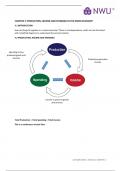
3.2 PRODUCTION, INCOME AND SPENDING
Spending to buy
produced goods and
services Production generates
income
Income is spent on goods
and services
Total Production = Total Spending = Total Income
This is a continuous circular flow
LECTURE NOTES | ECON 112 CHAPTER 3
, 3.3 SOURCES OF PRODUCTION
Factors of production are sources of production
i. Natural resources
= Gifts of nature, e.g. minerals (gold, platinum, coal), oil, natural gas, marine resources,
agricultural land.
Natural resources can be exploited and therefore preservation is important.
The quality of natural resources plays an important role, e.g. vast areas of land with little
agricultural value.
ii. Labour
= physical / intellectual effort of people to produce goods or services with the aim to earn
income.
Quantity of labour = labour force, the number of people willing and able to work.
Quality of labour = human capital, the abilities (skill, knowledge and health) of the workers.
iii. Capital (not money!)
= manufactured resources that are used in the production of other goods and services, e.g.
machines, tools and buildings.
Provision must be made for depreciation (replacing existing capital goods due to wear and
tear).
iv. Entrepreneurship
= people who see opportunity, innovators, people who launch new products and techniques
and take risks. Entrepreneurs organise and combine factors of production.
Notes:
Technology is sometimes considered the fifth factor of production. Technology sometimes forms
part of capital and entrepreneurship. Technology is innovation that enables factors of production to
be used more effectively.
Money is not a factor of production. It cannot produce goods and services. It is only a medium of
exchange.
The choice of HOW production will take place (labour intensive where more human labour is used
OR capital intensive where production is mainly done by machinery), depends on the cost, quality
and availability of capital and labour.
LECTURE NOTES | ECON 112 CHAPTER 3
3.1 INTRODUCTION
How do things fit together in a mixed economy? There is interdependence, which can be illustrated
with simplified diagrams to understand the economy better.
3.2 PRODUCTION, INCOME AND SPENDING
Spending to buy
produced goods and
services Production generates
income
Income is spent on goods
and services
Total Production = Total Spending = Total Income
This is a continuous circular flow
LECTURE NOTES | ECON 112 CHAPTER 3
, 3.3 SOURCES OF PRODUCTION
Factors of production are sources of production
i. Natural resources
= Gifts of nature, e.g. minerals (gold, platinum, coal), oil, natural gas, marine resources,
agricultural land.
Natural resources can be exploited and therefore preservation is important.
The quality of natural resources plays an important role, e.g. vast areas of land with little
agricultural value.
ii. Labour
= physical / intellectual effort of people to produce goods or services with the aim to earn
income.
Quantity of labour = labour force, the number of people willing and able to work.
Quality of labour = human capital, the abilities (skill, knowledge and health) of the workers.
iii. Capital (not money!)
= manufactured resources that are used in the production of other goods and services, e.g.
machines, tools and buildings.
Provision must be made for depreciation (replacing existing capital goods due to wear and
tear).
iv. Entrepreneurship
= people who see opportunity, innovators, people who launch new products and techniques
and take risks. Entrepreneurs organise and combine factors of production.
Notes:
Technology is sometimes considered the fifth factor of production. Technology sometimes forms
part of capital and entrepreneurship. Technology is innovation that enables factors of production to
be used more effectively.
Money is not a factor of production. It cannot produce goods and services. It is only a medium of
exchange.
The choice of HOW production will take place (labour intensive where more human labour is used
OR capital intensive where production is mainly done by machinery), depends on the cost, quality
and availability of capital and labour.
LECTURE NOTES | ECON 112 CHAPTER 3


