
Taak 3 verslaving is een hersenziekte
Nestler Is there a common molecular pathway for addiction?
Common actions on brain reward circuits
- Most attention has been given to the mesolimbic dopamine pathway, which includes
dopaminergic neurons in the ventral tegmental area (VTA) of the midbrain and their
targets in the limbic forebrain, especially the nucleus accumbens (NAc). This VTA-
NAc pathway is one of the most important substrates for the acute rewarding effects of
all drug of abuse, and research over the past several decades has delineated how each
drug, regardless of its distinct mechanism of action, converges on the VTA and NAc
with common acute functional effects Each drug activates dopaminergic transmission
in the NAc and many produce dopamine-like, yet dopamine-independent effects on
the same NAc neurons, in many cases via indirect, circuit-level actions. In addition,
several drugs seem to activate the brain’s endogenous opioid and cannabinoid systems
within the VTA-NAc pathway, as exemplified by reduced drug effects in cannabinoid
and opioid receptor knockout mice, which further underscores shared acute
mechanisms of drug action
- Chronic drug use makes changes in the VTA-NAc pathway.
- Growing evidence indicates that the VTA-NAc pathway and the other limbic regions
cited above similarly mediate, at least in part, the acute positive emotional effects of
natural rewards, such as food, sex and social interactions. These same regions have
also been implicated in the so-called ‘natural addictions’ such as pathological
overeating, pathological
gambling and sexual
addictions. Preliminary
findings suggest that shared
pathways may be involved.
early findings in the field
raise the possibility that the
similar behavioral pathology
that characterizes drug
addictions and certain natural
addictions may be mediated,
at least in part, by common
neural and molecular
mechanisms.
Common circuit level adaptations
- These adaptations seem to be
complex in that different
effects have been reported by numerous laboratories even for the same drug, partly
because of differing drug doses, routes of administration and dosing regimens.
- Chronic exposure to any of several drugs of abuse causes an impaired dopamine
system, which can be viewed as a homeostatic response to repeated drug activation of
the system. After chronic drug use, baseline levels of dopamine function are reduced,
and normal rewarding stimuli may be less effective at eliciting typical increases in
dopaminergic transmission. These changes may contribute to the negative emotional
symptoms observed between drug exposures or upon drug withdrawal. At the same
time, chronic drug exposure seems to sensitize the dopamine system, with greater
increases in dopaminergic transmission occurring in response to the drug in question
and to drug-associated cues. This sensitization can last long after drug-taking ceases
and may relate to drug craving and relapse.
1
, - Abrupt withdrawal from virtually any drug of abuse leads to activation of CRF
(corticotropin releasing factor) containing neurons in the amygdala. These neurons,
classically characterized for their involvement in fear and other aversive states,
innervate many forebrain and brainstem regions. We now know that activation of
these neurons during drug withdrawal partly mediates the negative emotional
symptoms as well as many of the somatic symptoms that occur upon drug withdrawal,
and may contribute to drug craving and relapse as well. CRF can therefore be viewed
as an example of ‘opponent process’–like changes that drugs induce in the brain that
serve to counteract drug effects and drive withdrawal symptoms when the drug is
discontinued.
- Another common adaptation to chronic drug use is cortical ‘hypofrontality’: namely,
reduced baseline activity of several regions of frontal cortex, as inferred from brain
imaging studies. chronic exposure to any of several drugs of abuse causes complex
changes in these frontal cortical regions and their glutamatergic outputs, which are
implicated in the profound impulsivity and compulsivity that characterizes a state of
addiction.
Common cellular and molecular adaptations
- Chronic administration of any of several drugs of abuse, including cocaine,
amphetamine, opiates, alcohol and nicotine, also increases levels of tyrosine
hydroxylase (TH), the rate-limiting enzyme in dopamine biosynthesis, in the VTA.
Concomitantly, decreased TH levels or activity in VTA nerve terminals in the NAc are
reported under certain experimental conditions. This latter adaptation could mediate
the reduction in dopaminergic signaling seen after chronic drug exposure.
- Reduced amounts of neurofilament proteins seen within the VTA after chronic opiate,
cocaine or alcohol exposure may be a biochemical marker of common morphological
changes to VTA neurons induced by these drugs.
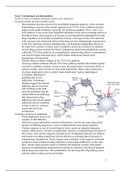
- Long term potentiation: long term firing of dopamine neurons. Door toename door
AMPA sensitiviteit. Dit is gerelateerd aan gesensitizeerde gedragsrespons.
neurotransmitter bindt aan AMPA. Als er long term potentiation is dan blijft die
stimulatie plaatsvinden. In de synaptische spleet houd je heel veel dopamine over.
Zodra glutamaat loslaat van AMPA bindt er meteen een nieuwe. Het postsynaptisch
membraan gaat signalen afgeven dat er minder glutamaat afgegeven hoeft te worden.
- Als CREB en FosB geactiveerd worden na lange long term potentiation dan wordt er
iets in het DNA verandert waardoor er minder receptoren zijn. Dus minder activatie.
Hierdoor ontstaat er weer een normale activatie. Het euforische gevoel van drugs
verdwijnt. -> cellulaire (minder receptoren) en moleculaire (minder glutamaat
afgegeven) tolerantie.
- In contrast to ∆FosB, cFos and other Fos family members are induced in NAc after
acute exposure to drugs or natural rewards, whereas ∆FosB accumulates in this region
uniquely after chronic exposure, when induction of the other family members shows
desensitization. ∆FosB accumulates during chronic exposure owing to its unique
stability at the protein level. There is now considerable evidence that ∆FosB
accumulation within NAc neurons contributes to a state of sensitization. induction of
∆FosB mediates many shared aspects of drug and natural addictions by regulating a
set of common target genes
2
Nestler Is there a common molecular pathway for addiction?
Common actions on brain reward circuits
- Most attention has been given to the mesolimbic dopamine pathway, which includes
dopaminergic neurons in the ventral tegmental area (VTA) of the midbrain and their
targets in the limbic forebrain, especially the nucleus accumbens (NAc). This VTA-
NAc pathway is one of the most important substrates for the acute rewarding effects of
all drug of abuse, and research over the past several decades has delineated how each
drug, regardless of its distinct mechanism of action, converges on the VTA and NAc
with common acute functional effects Each drug activates dopaminergic transmission
in the NAc and many produce dopamine-like, yet dopamine-independent effects on
the same NAc neurons, in many cases via indirect, circuit-level actions. In addition,
several drugs seem to activate the brain’s endogenous opioid and cannabinoid systems
within the VTA-NAc pathway, as exemplified by reduced drug effects in cannabinoid
and opioid receptor knockout mice, which further underscores shared acute
mechanisms of drug action
- Chronic drug use makes changes in the VTA-NAc pathway.
- Growing evidence indicates that the VTA-NAc pathway and the other limbic regions
cited above similarly mediate, at least in part, the acute positive emotional effects of
natural rewards, such as food, sex and social interactions. These same regions have
also been implicated in the so-called ‘natural addictions’ such as pathological
overeating, pathological
gambling and sexual
addictions. Preliminary
findings suggest that shared
pathways may be involved.
early findings in the field
raise the possibility that the
similar behavioral pathology
that characterizes drug
addictions and certain natural
addictions may be mediated,
at least in part, by common
neural and molecular
mechanisms.
Common circuit level adaptations
- These adaptations seem to be
complex in that different
effects have been reported by numerous laboratories even for the same drug, partly
because of differing drug doses, routes of administration and dosing regimens.
- Chronic exposure to any of several drugs of abuse causes an impaired dopamine
system, which can be viewed as a homeostatic response to repeated drug activation of
the system. After chronic drug use, baseline levels of dopamine function are reduced,
and normal rewarding stimuli may be less effective at eliciting typical increases in
dopaminergic transmission. These changes may contribute to the negative emotional
symptoms observed between drug exposures or upon drug withdrawal. At the same
time, chronic drug exposure seems to sensitize the dopamine system, with greater
increases in dopaminergic transmission occurring in response to the drug in question
and to drug-associated cues. This sensitization can last long after drug-taking ceases
and may relate to drug craving and relapse.
1
, - Abrupt withdrawal from virtually any drug of abuse leads to activation of CRF
(corticotropin releasing factor) containing neurons in the amygdala. These neurons,
classically characterized for their involvement in fear and other aversive states,
innervate many forebrain and brainstem regions. We now know that activation of
these neurons during drug withdrawal partly mediates the negative emotional
symptoms as well as many of the somatic symptoms that occur upon drug withdrawal,
and may contribute to drug craving and relapse as well. CRF can therefore be viewed
as an example of ‘opponent process’–like changes that drugs induce in the brain that
serve to counteract drug effects and drive withdrawal symptoms when the drug is
discontinued.
- Another common adaptation to chronic drug use is cortical ‘hypofrontality’: namely,
reduced baseline activity of several regions of frontal cortex, as inferred from brain
imaging studies. chronic exposure to any of several drugs of abuse causes complex
changes in these frontal cortical regions and their glutamatergic outputs, which are
implicated in the profound impulsivity and compulsivity that characterizes a state of
addiction.
Common cellular and molecular adaptations
- Chronic administration of any of several drugs of abuse, including cocaine,
amphetamine, opiates, alcohol and nicotine, also increases levels of tyrosine
hydroxylase (TH), the rate-limiting enzyme in dopamine biosynthesis, in the VTA.
Concomitantly, decreased TH levels or activity in VTA nerve terminals in the NAc are
reported under certain experimental conditions. This latter adaptation could mediate
the reduction in dopaminergic signaling seen after chronic drug exposure.
- Reduced amounts of neurofilament proteins seen within the VTA after chronic opiate,
cocaine or alcohol exposure may be a biochemical marker of common morphological
changes to VTA neurons induced by these drugs.
- Long term potentiation: long term firing of dopamine neurons. Door toename door
AMPA sensitiviteit. Dit is gerelateerd aan gesensitizeerde gedragsrespons.
neurotransmitter bindt aan AMPA. Als er long term potentiation is dan blijft die
stimulatie plaatsvinden. In de synaptische spleet houd je heel veel dopamine over.
Zodra glutamaat loslaat van AMPA bindt er meteen een nieuwe. Het postsynaptisch
membraan gaat signalen afgeven dat er minder glutamaat afgegeven hoeft te worden.
- Als CREB en FosB geactiveerd worden na lange long term potentiation dan wordt er
iets in het DNA verandert waardoor er minder receptoren zijn. Dus minder activatie.
Hierdoor ontstaat er weer een normale activatie. Het euforische gevoel van drugs
verdwijnt. -> cellulaire (minder receptoren) en moleculaire (minder glutamaat
afgegeven) tolerantie.
- In contrast to ∆FosB, cFos and other Fos family members are induced in NAc after
acute exposure to drugs or natural rewards, whereas ∆FosB accumulates in this region
uniquely after chronic exposure, when induction of the other family members shows
desensitization. ∆FosB accumulates during chronic exposure owing to its unique
stability at the protein level. There is now considerable evidence that ∆FosB
accumulation within NAc neurons contributes to a state of sensitization. induction of
∆FosB mediates many shared aspects of drug and natural addictions by regulating a
set of common target genes
2


