

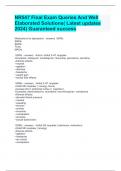
NR547 Final Exam Queries And Well Elaborated Solutions( Latest updates 2024) Guaranteed success
NR547 Final Exam Queries And Well Elaborated Solutions( Latest updates 2024) Guaranteed success Medications for depression - answers SSRIs SNRIs SDRIs TCAs MAOIs SSRIs - answers -Action: inhibit 5-HT reuptake -Examples: citalopram, escitalopram, fluoxetine, paroxetine, sertraline -Adverse effects: • nausea • agitation • diarrhea • headache • weight gain • sexual side effects SNRIs - answers -inhibit 5-HT reuptake -inhibit NE reuptake (↑ energy, focus) -increase DA in prefrontal cortex (↑ cognition) -Examples: desvenlafaxine, duloxetine, levomilnacipran, venlafaxine -Adverse effects: • elevated blood pressure • nausea • sweating • tremors • anxiety • insomnia • constipation • anorexia • sexual dysfunction SDRIs - answers -inhibit DA reuptake (↑alertness, motivation) -inhibit NE reuptake (↑energy) -Adverse effects: • agitation • headache • dry mouth • constipation • weight loss TCAs - answers -Action: inhibits the reuptake of serotonin and norepinephrine; blocks norepinephrine, histamine, and acetylcholine receptors -Examples: amitriptyline, clomipramine, desipramine, doxepin -Common Side Effects: • dry mouth • constipation • blurred vision • urinary retention • sedation • weight gain • hypotension • tachycardia • sexual dysfunction MAOIs - answers -Action: increases norepinephrine and serotonin by inhibiting the enzyme that inactivates it -Examples: isocarboxazid, phenelzine, tranylcypromine -Common Side Effects: • sedation • dizziness • sexual dysfunction • hypertensive crisis Prescribing pearls: citalopram (Celexa) - answers mild antihistamine effects Prescribing pearls: escitalopram (Lexapro) - answers no known drug interactions Prescribing pearls: fluoxetine (Prozac) - answers longest half-life Prescribing pearls: paroxetine (Paxil) - answers also treats social anxiety and insomnia Prescribing pearls: fluvoxamine (Luvox) - answers treats anxious depression smokers require increased dose Prescribing pearls: sertraline (Zoloft) - answers also treats social anxiety and hypersomnolence Prescribing pearls: bupropion (Wellbutrin) - answers NDRI may improve energy, alertness, and motivation; not first line treatment for anxiety; contraindicated in clients with a history of seizures Prescribing pearls: duloxetine (Cymbalta) - answers effective for atypical pain at higher doses; appropriate for clients who present with somatic symptoms of depression; effective for atypical pain, such as fibromyalgia and diabetic neuropathy Prescribing pearls: venlafaxine (Effexor) - answers treats both depression and anxiety disorders, ensure trial of higher dose before switching to a different medication Prescribing pearls: desvenlafaxine (Pristiq) - answers effective for perimenopausal vasomotor symptoms considered when selecting a medication: - answers -Client preference -Prior treatment response -Anticipated adverse effects -Comorbidities -Half-life and interactions -Cost if a medication is not achieving efficacy: - answers -Increase dose gradually -Switch to a different drug within the same class -Switch to drug in a different class -Add a second medication Use to protect against suicide - answers lithium MDD and BPD genetics - answers genetic factors contribute 31-42% of the disease risk in MDD and 59-85% in BPD monoamine hypothesis of depression - answers -posits that depression occurs as a result of a deficiency of one or all three monoamine transmitters • serotonin, norepinephrine, and dopamine -while mania may result from an excess *Emphasis is now shifted from the monoamines to their receptors and other downstream events such as the regulation of gene expression, growth factors, environmental factors, and epigenetic changes - answers Three principal neurotransmitters -norepinephrine (NE), dopamine (DA), and serotonin 5HT • comprise the monoamine neurotransmitter system • implications for the pathophysiology and treatment of mood disorders • All known pharmacologic treatments for mood disorders act upon one or more of these three neurotransmitters -Many of the symptoms of mood disorders are hypothesized to involve dysfunction of various combinations of the monoamine neurotransmitters Mood disorders include ____________________ and ___________________ - answers depressive disorders and bipolar disorders
Document information
- Uploaded on
- July 13, 2024
- Number of pages
- 53
- Written in
- 2023/2024
- Type
- Exam (elaborations)
- Contains
- Questions & answers


